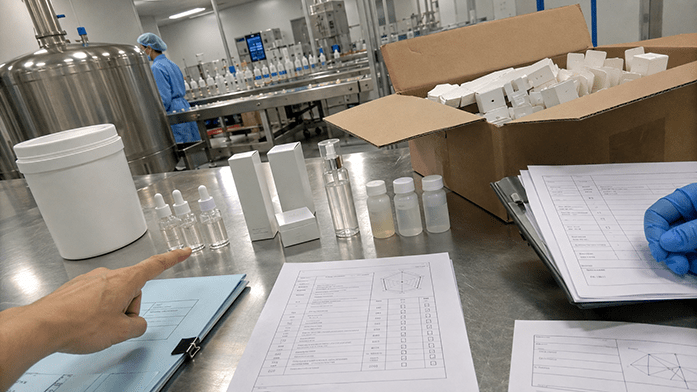
A skincare founder plans a launch around two promises found on a supplier's homepage: "no minimum order quantity" and "hyper-local, made near you." The pitch fits the 2026 mood — short supply lines, low risk, fast iteration. She orders a small first run, lists the product, and watches early sales arrive. Then the retailer auditing her channel asks for a Certificate of Analysis tied to a specific raw-material lot, proof of ISO 22716 GMP conditions, and a Responsible Person for the EU market. The local supplier cannot produce the batch record. The formula was, in fact, blended by a trading company reselling another factory's stock emulsion. The listing is pulled, and the cash that was meant to fund the next run is gone.
This is the pattern most often seen when a brand builds on "no minimum" and "hyper-local" as if they were product features rather than marketing language. From a compliance and regulatory standpoint, the 2026 supply chain shift is not moving from low MOQ to low MOQ that happens to be nearby. It is moving from chasing tiny order quantities toward securing audited, documented, regulation-ready manufacturing partners — wherever they sit. "Hyper-local" changes logistics. It does not change the compliance floor.
TL;DR: A "no-MOQ" offer does not remove the fixed costs of cosmetics production — packaging minimums, per-batch testing, setup loss, and audit-ready documentation. Those costs reappear as inflated unit prices or skipped quality steps. The 2026 shift toward hyper-local sourcing is better understood as a compliance-fragmentation challenge: each market (US MoCRA, EU 1223/2009, Australia's TGA boundary) keeps its own documentation trail, and proximity does not lower that burden. Custom formulation runs above 2,000 pieces are where quality systems and traceability become economically supportable.
The No-MOQ mirage — why zero threshold is the most expensive minimum
The appeal of "no minimum" is real: it lowers the cash needed to place a first order. The problem is structural. A finished cosmetic is a system of minimums — packaging components, raw materials, per-batch testing, and the filling run itself. The number on the homepage is only one of them, and rarely the binding one.
Key Takeaway: Minimum order quantities exist to cover fixed production costs — component supplier minimums, batch setup and filling loss, per-batch testing fees, and the documentation a regulated market requires. Drop the manufacturer's minimum and those costs do not vanish; they concentrate onto fewer units as a higher per-unit price, or they are hidden as steps quietly skipped.
Where the real minimums sit
Packaging components — bottles, jars, pumps, tubes — come from suppliers running their own lines, and those suppliers typically enforce minimums of several thousand pieces per component, higher still for custom tooling or decoration. A manufacturer accepting a tiny run is not ordering a few hundred custom bottles; the component supplier will not set up a line for that volume. The manufacturer is using generic stock, splitting a larger lot with other orders, or absorbing the component minimum and marking it up. None of these delivers custom-branded packaging at a low price.
Raw materials carry their own floor. Common carriers — glycerin, standard oils — are available in small quantities. The distinctive actives often are not. A specific peptide, a proprietary antioxidant, or a rare botanical extract may ship only in bulk drums from a specialty supplier. If your hero ingredient has a minimum, that minimum becomes your batch size.
Testing is the cost founders forget. Stability testing, microbiological testing, and preservative challenge testing are billed per batch, not per unit. The same fee applies whether the batch is small or large, so it weighs far more heavily on a small run. A supplier who skips testing to keep a small-batch price attractive is not doing you a favor — they are removing the very documentation a regulator or retailer will ask for.
When a low minimum is actually real
One scenario holds up: private label on a manufacturer's existing stock formula with stock packaging. Here the upstream minimums were already cleared months ago. Your job is to label a proven product. It is a legitimate route for testing a sales channel or validating demand before committing to a custom formula. The boundary is differentiation — the same stock base is available to other brands, so it cannot be the foundation of a defensible product.
Why the floor sits around 2,000 pieces
The relationship between run size and per-unit cost is not linear. The gap comes almost entirely from fixed costs that do not scale down.
| Run size | How fixed costs behave | What typically follows |
|---|---|---|
| A few hundred units | Setup, testing, packaging minimums concentrate on few units | Per-unit cost several times the baseline, or steps skipped |
| ~2,000 units | Fixed costs begin to amortize | Per-unit cost drops; documentation stays complete |
| ~5,000 units | Fixed costs spread wide | Per-unit cost approaches a sustainable floor |
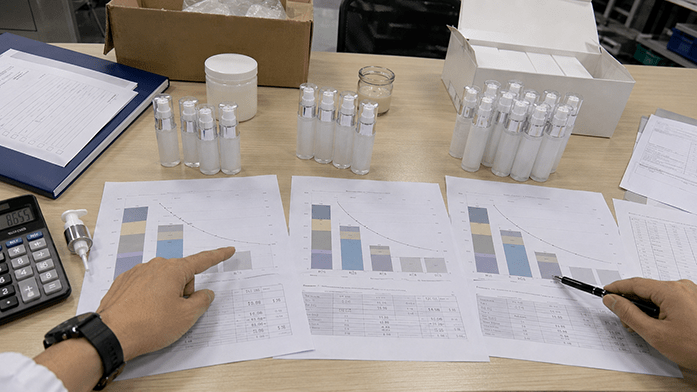
This is why custom formulation and custom packaging orders typically require more than 2,000 pieces. Those ranges are not a manufacturer being difficult; they are the volume at which the cost structure and the documentation burden both become supportable.
A recurring cash-flow failure pattern shows the trap in motion. A brand sells its first roughly 1,000 units at a per-unit cost set by a sub-500 run. Early traction looks like proof of concept. But the only cost structure that supports a retail price and marketing spend requires a multi-thousand-unit reorder — and the capital jump from the first run to that reorder exceeds what the early sales generated. The brand built its momentum on a false economy and stalls at exactly the moment it should scale.
Hyper-local sourcing is a compliance maze, not a volume shortcut
"Hyper-local" is often sold as the answer to high MOQs — make it nearby, make it small. From a regulatory auditor's view, proximity changes freight and lead time. It does not change the rule that each market demands its own evidence package.
Key Takeaway: A local manufacturer still operates under the same GMP baseline (ISO 22716) and still leaves the brand responsible for market-specific filings — a Responsible Person and CPNP notification in the EU, facility registration and product listing under US MoCRA, and a clear cosmetic-vs-therapeutic boundary under Australia's TGA. Hyper-local sourcing fragments compliance across jurisdictions; it never lowers it.
The documentation has to travel
In the EU, Regulation (EC) No 1223/2009 requires a Product Information File (PIF) and notification through the Cosmetic Products Notification Portal (CPNP), plus a designated Responsible Person. In the US, the Modernization of Cosmetics Regulation Act (MoCRA) added facility registration, product listing, safety substantiation, and adverse event recordkeeping as ongoing obligations. Australia's TGA enforces a hard line between cosmetics and therapeutic goods, and a product positioned near that boundary inherits the heavier regime. None of these obligations disappears because the factory is in your region.
A recurring failure pattern: a brand assumes a "local" supplier handles "local" compliance, only to discover the supplier has no Responsible Person arrangement, no CPNP notification, and no batch-level traceability. The product cannot be notified, defended in a retailer audit, or recalled cleanly. Hyper-local does not mean compliance-light.
Where local sourcing genuinely helps
The reversal cuts both ways. Regional manufacturing has real advantages a compliance auditor will defend: shorter lead times, easier in-person supplier audits, faster iterative pilot batches, and formulations tuned to a specific climate or regulatory sandbox. For a brand testing a market-specific formula, a nearby audited facility can be the most efficient path. The point is not that local is bad — it is that local is a logistics and auditability choice, never a substitute for the documentation a regulated market requires.
OEM vs ODM — and why the lower ODM figure sits below the economic floor
The manufacturing model you choose sets your compliance and cost structure before the first unit is made.
Key Takeaway: OEM means you own the formula and the manufacturer executes your specifications; ODM means the manufacturer provides a pre-developed formula you rebrand. The ODM "typical minimum" of 500–2,000 units is the supplier's public floor — and it still sits below the ~2,000-piece economic floor where quality systems and documentation become supportable. Even a "low-MOQ" ODM run carries the hidden-cost penalties described above.
| Factor | OEM (Original Equipment Manufacturer) | ODM (Original Design Manufacturer) |
|---|---|---|
| Formula IP | Owned by the brand | Owned by the manufacturer |
| Speed to market | Slower — requires R&D and stability validation | Faster — uses pre-existing, tested formulas |
| Customization | High — full control of ingredients and packaging | Low — limited to packaging, fragrance, color |
| Typical MOQ | 3,000–10,000+ units | 500–2,000 units (supplier's public floor; below the ~2,000-piece economic floor) |
| Best for | Brands building a defensible, unique product | Brands testing a category or needing speed — with the exclusivity trade-off understood |
A common trap seen in supplier audits: a brand treats an "ODM partner" as a manufacturer, only to find it is a trading company reselling another factory's formula. When the actual factory changes the formula, the brand's product is altered with no recourse and no change-control clause. Verify that any ODM partner owns and manufactures its formulas in-house under ISO 22716 GMP conditions — ask to see the line, not just a certificate on a website.
Two-stage development: a beauty lab for validation, a large-scale factory for compliance
The smartest founders do not pick lab or factory. They sequence them — and they treat the small run as validation, not a business foundation.
Key Takeaway: A beauty lab is for R&D and pilot validation batches; a GMP- and ISO 22716-certified large-scale factory is for compliant, cost-effective commercial production. Pilot batches prove a formula is stable and safe. They are not a substitute for the audited, documented commercial run that a retailer or regulator will expect.
Stage 1 — Innovation and validation (beauty lab)
Goal: develop and stabilize a unique formula. Partner: a contract lab with R&D chemists. Output: a lab-scale formula, pilot validation batches for user and stability testing, and a preliminary tech pack. Focus: efficacy, safety, stability.
Stage 2 — Scale-up and commercialization (large-scale factory)
Goal: produce the validated formula consistently at volume. Partner: a GMP- and ISO 22716-certified factory that has passed your audit. Output: commercial batches with full traceability and Certificates of Analysis (CoA). Focus: cost, consistency, compliance.
The handoff is the tech pack — a complete specification covering formula, procedure, and quality parameters. Stability testing during this stage should follow recognized guidance such as ISO/TR 18811:2018, with challenge testing aligned to ISO 11930 where preservative efficacy is claimed. A pilot batch that skips this validation is not a cheap launch; it is an unproven one.
The Quality Agreement — the compliance core competency
Healthcare private-label programs treat documentation and traceability as the business foundation, not a burden. Skincare is converging toward that discipline. The single most important document a brand signs with its manufacturer is the Quality Agreement, and a compliance auditor reads it before anything else.
Key Takeaway: A legally binding Quality Agreement must cover Change Control, Batch Records, Out-of-Specification (OOS) Protocol, and Auditing Rights. Without these four pillars, a brand cannot prove what was made, prove it was made to spec, respond to a failure, or verify the facility itself.
- Change Control — the manufacturer cannot alter any raw material, process, or specification without your written approval. A recurring failure pattern: a factory substitutes a cheaper grade of an ingredient to save cost; the batch fails stability and thousands of units are destroyed, with no contractual recourse because no change-control clause existed.
- Batch Records — detailed records of every production run, retained for a defined period and made available for your review. Healthcare private-label programs often cite a multi-year retention window; the principle transfers directly.
- OOS Protocol — a clear plan for what happens when a batch fails testing: who investigates, who pays for the destroyed lot, how the root cause is documented.
- Auditing Rights — your right to audit the facility yourself or through a third party on a regular basis. A certificate viewed on a website is not verification; scope and authenticity must be confirmed.
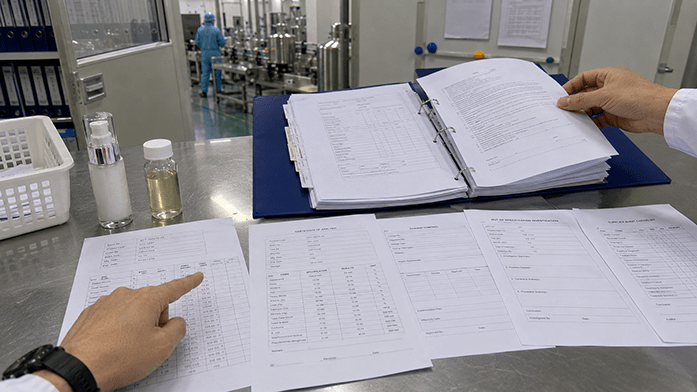
MoCRA's trajectory shows where this is heading. Facility registration, product listing, safety substantiation, and adverse event recordkeeping are now operational obligations in the US market — recurring costs, not one-time launch expenses. Brands that can present a CoA for every batch, demonstrate a validated process, and show an audited supplier operate on a different risk profile than those that cannot.
A 2026 compliance-readiness diagnostic for your supply chain
Before committing capital to a production run, a brand should be able to answer the questions below. They separate a supply chain built on a "no-minimum" promise from one built on audited, documented partnership.
Key Takeaway: Compliance-readiness in 2026 is measurable. If you cannot confirm GMP scope, a signed Quality Agreement with change control, batch-to-raw-lot traceability, per-batch CoA and stability data, mapped MoCRA/CPNP obligations, and retained auditing rights, your supply chain is not yet ready for a regulated launch — regardless of how low the minimum is.
| Question | Why it matters | Red flag |
|---|---|---|
| Does the manufacturer hold ISO 22716 GMP, and is the scope verified (not just a logo)? | GMP is the baseline quality system regulators expect | Certificate on a site with no scope confirmation |
| Is a Quality Agreement signed covering Change Control, Batch Records, OOS, Auditing Rights? | Defines who owns quality failures | "We'll handle quality, don't worry" |
| Can a finished unit be traced to its raw-material lots and test results? | Enables recall, audit defense, notification | No batch record system |
| Are CoA and stability data (per ISO/TR 18811:2018) delivered per batch? | Proof of safety and stability for the target market | Testing treated as an optional extra |
| Are MoCRA / CPNP / TGA obligations mapped to a responsible party? | Each market keeps its own filing trail | "Local supplier handles compliance" assumption |
| Are auditing rights retained and exercisable? | Verifies the facility beyond paper claims | Refusal or vagueness on audits |
A brand that answers yes across the board has a supply chain that can survive a retailer audit and a regulator's request. One that cannot is betting its launch on a promise.
The 2026 supply chain shift is real, but its direction is frequently misread. It is not a move from distant low-MOQ to nearby low-MOQ. It is a move from chasing minimums to securing audited, documented, regulation-ready partners — and recognizing that "hyper-local" changes logistics, not the compliance floor.
The brands that recover from the no-minimum failure pattern do not chase a lower number a second time. They sign a Quality Agreement with change control, validate the formula in a lab, and commit to a documented commercial run above 2,000 pieces with a partner they have actually audited. Local and small-batch sourcing keeps a legitimate role in that sequence — for pilot validation, market-specific formulation, and faster audit cycles. What it cannot do is replace the traceability and GMP evidence a regulated market requires. For a brand mapping a compliant launch, a readiness assessment before any deposit is the step that surfaces the questions a "no-minimum" pitch was built to hide.