The era of selling "air" to consumers is officially over. For decades, the beauty industry has equated luxury with weight and size—packaging a 50ml cream in a jar the size of a grapefruit. The European Union’s new Packaging and Packaging Waste Regulation (PPWR) is about to make that illegal.
Leading Paragraph: If you plan to sell in Europe, your current packaging might already be obsolete. The EU is cracking down on "over-packaging" to reduce waste, and ignorance of these new rules could lead to your products being banned from the shelves. (Max 30 words).
Snippet Paragraph: The EU PPWR packaging mandate is a regulation, not just a directive, meaning it applies directly to all member states. Its primary goal is to ensure all packaging is recyclable by 2030 and to strictly limit "void space[^1]" (empty space) inside boxes to a maximum of 40%. (Max 50 words).
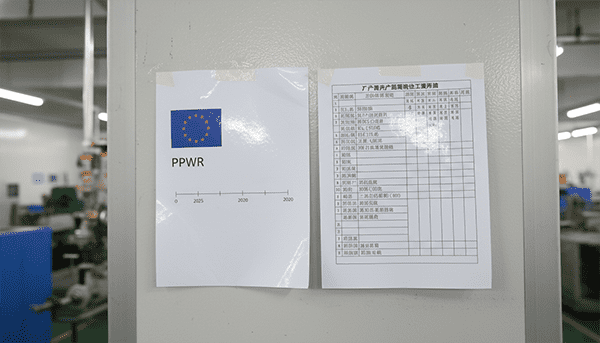
Transition Paragraph: This isn't just about being eco-friendly; it's about being market-legal. At Camellia Labs, we are already transitioning our clients to "future-proof" packaging. Let’s explore how you can redesign your product to survive the 40% rule and the shift to mono-materials.
Dealing with the 40% Void Space Limit: How to Redesign to Avoid Bans?
Leading Paragraph: The "Double-Wall" jar strategy—using thick plastic to make a product look bigger—is now a liability. Brands must now prove that their packaging volume is essential for product protection, not marketing deception. (Max 30 words).
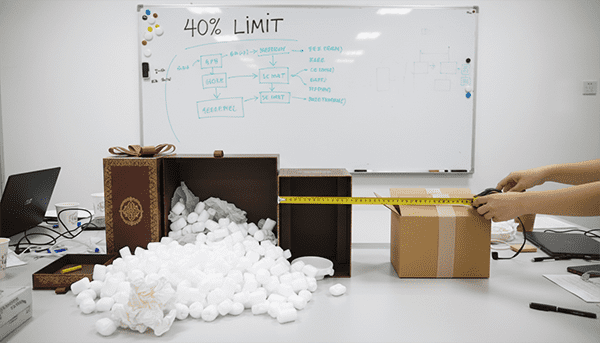
Snippet Paragraph: The PPWR explicitly states that the empty space ratio in grouped or transport packaging must not exceed 40%. To comply, you must eliminate unnecessary layers, false bottoms, and excessive headspace. Your box must fit the product, not the shelf presence. (Max 50 words).
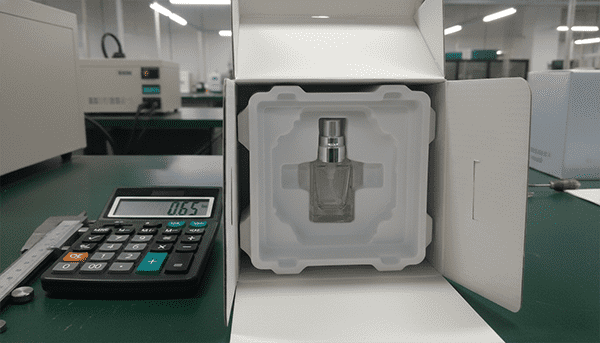
Dive Deeper: I have seen many US and Australian brands panic about this because their entire value proposition is based on "unboxing experiences" involving massive boxes and layers of foam.
Under the new Article 21 of the PPWR, you are legally required to minimize the weight and volume of packaging. This attacks the "Russian Doll" style of packaging common in luxury skincare.
The "Void Space" Calculation: The 40% limit applies to the space filled by paper cuttings, bubble wrap, or just air between the product and the outer box.
- The Risk: If customs officials or market surveillance authorities inspect your shipment and find a 15ml bottle inside a 10cm box, they can classify it as "misleading" and non-compliant.
- The Solution: You need "Right-Sizing[^2]." We are helping clients switch to:
- Molded Pulp Inserts[^3]: These fit the product snugly, eliminating air while being biodegradable.
- Flexible Pouches[^4]: These have near-zero void space[^1] compared to rigid bottles.
- SQTS (Square-to-Square) Design: Square bottles in square boxes eliminate the "dead corners" that round bottles create in square boxes.
Cost-Efficiency: While this forces a design change, it saves money. Shipping "air" is expensive. By reducing your packaging volume by 20-30% to meet PPWR, you also reduce your freight costs per unit significantly.
Why Must You Switch to Mono-Materials for Recyclability?
Leading Paragraph: "Recyclable" is no longer a marketing buzzword you can slap on a label; it is a technical requirement. If your pump, bottle, and cap are made of different plastics, they are likely headed for the incinerator. (Max 30 words).
Snippet Paragraph: To achieve recyclable cosmetic packaging[^5] status under PPWR, packaging must be designed for "high-quality recycling." The most effective strategy is using Mono-materials[^6]—where the entire package consists of a single polymer type that does not require disassembly by the consumer. (Max 50 words).
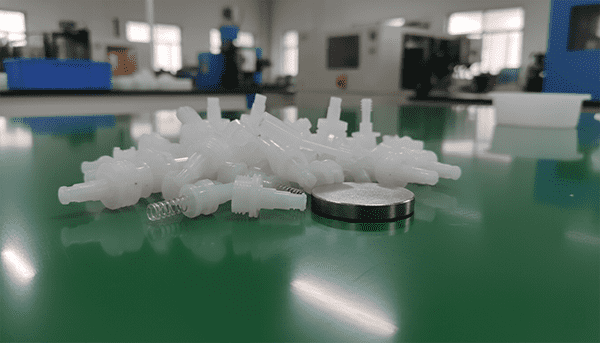
Dive Deeper: In the past, a standard lotion bottle might have a PET bottle, a PP cap, and a pump mechanism containing metal springs and a glass ball. Because these materials are fused or hard to separate, recycling facilities reject them.
The PPWR requires that packaging be recyclable "at scale" by 2030. This means you must design for the recycling streams that actually exist. At Camellia Labs, we recommend three specific Mono-material heroes:
The Top 3 Mono-Material Solutions
| Material | Application | Why It Complies with PPWR |
|---|---|---|
| All-PP[^7] (Polypropylene) | Jars, Airless Pumps, Caps | PP is robust and heat-resistant. We can now source "All-PP[^7]" airless pumps where even the spring is plastic, allowing the whole unit to be tossed in one bin. |
| All-PET[^8] (Polyethylene Terephthalate) | Toners, Serums, Cleansers | PET is the most recycled plastic globally (think water bottles). Using clear or light-blue PET (avoiding dark colors/Carbon Black) ensures high recyclability. |
| 100% Aluminum[^9] | Tubes, Bottles, Jars | Aluminum is infinitely recyclable without losing quality. It feels "luxury" (cold to the touch) and bypasses the plastic debate entirely. |
The "Metal Spring" Trap: Standard pumps contain metal springs. Under strict interpretation of mono-material recycling, these are contaminants. We strongly advise brands to switch to "Metal-Free" pumps (often made of PE or PP bellows) to ensure the package is 100% compatible with the plastic recycling stream.
Are Refillable Systems the Ultimate Loophole for Compliance?
Leading Paragraph: Single-use plastic is the primary target of EU regulators. Transitioning to a refill model not only signals environmental virtue but aligns perfectly with the PPWR's "Reuse" mandates. (Max 30 words).
Snippet Paragraph: The PPWR sets specific targets for "Reuse" in transport and grouping packaging. For consumer goods, a refillable system (where the consumer keeps the heavy outer shell and buys a light refill pod) drastically reduces plastic weight, helping you stay under the waste generation limits. (Max 50 words).
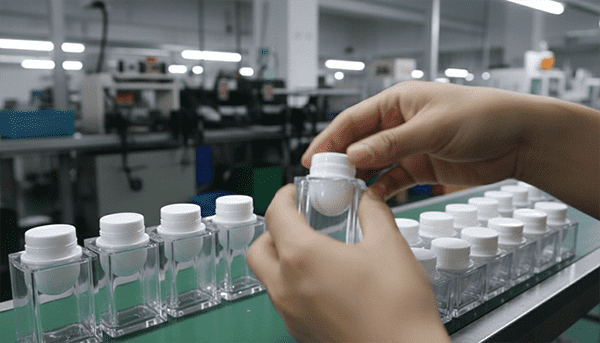
Dive Deeper: Refillable packaging used to be clunky and prone to leakage. Today, it is the pinnacle of "Smart Compliance."
How it Works for PPWR: The regulation penalizes the total weight of packaging waste generated.
- Scenario A (Traditional): Customer buys 5 jars a year. Total waste = 5 heavy acrylic jars + 5 boxes.
- Scenario B (Refill): Customer buys 1 heavy outer jar + 4 lightweight PP pods. Total waste is reduced by ~70%.
The Implementation Challenge: As a founder, you must realize that refills are a logistical challenge. You need two SKUs (the Starter Kit and the Refill).
- The "Click" Mechanism: The refill pod must lock securely but be easy to remove. We use bottom-push or twist-lock mechanisms at Camellia Labs to ensure a premium feel.
- Material Compatibility: The inner pod is usually PP (chemically resistant). The outer shell can be heavy glass or even wood, as it is not thrown away.
- Consumer Education[^10]: You must teach the customer how to refill. If it's too hard, they will just buy a new jar from a competitor.
Critical Insight: Refills are great for customer retention (subscription models). Once they have your "beautiful" outer shell, they are psychologically committed to buying your refills. It turns a compliance requirement into a loyalty engine.
Conclusion: The EU PPWR is daunting, but it is also an opportunity to trim the fat from your supply chain. By reducing void space[^1], switching to mono-materials like PP or Aluminum, and exploring refills, you aren't just following the law—you are building a leaner, more efficient brand. At Camellia Labs, we specialize in sourcing these "future-proof" packaging solutions so you can launch in Paris, Berlin, or Rome without fear of rejection.
[^1]: Learn about void space limits to ensure your packaging meets EU standards and avoids penalties. [^2]: Right-Sizing is essential for reducing waste and ensuring compliance with the EU PPWR. [^3]: Molded Pulp Inserts are eco-friendly solutions that minimize void space and enhance product protection. [^4]: Flexible Pouches reduce void space and are cost-effective, making them a smart choice for compliance. [^5]: Explore the requirements for recyclable packaging to enhance sustainability and meet EU compliance. [^6]: Discover how mono-materials can improve recyclability and compliance with EU packaging regulations. [^7]: All-PP solutions are robust and recyclable, making them ideal for sustainable packaging. [^8]: All-PET is widely recycled and ensures high-quality recycling, aligning with EU standards. [^9]: 100% Aluminum is infinitely recyclable and offers a premium feel, making it a sustainable choice. [^10]: Educating consumers on refillable systems is key to ensuring successful adoption and brand loyalty.