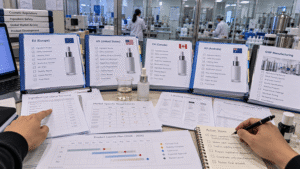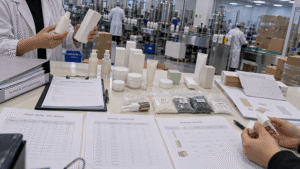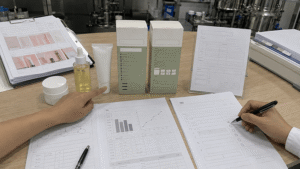
A private label manufacturer may be able to make a sample that looks and feels close to your idea.1 That does not mean the product has a clear testing path, document trail, claim review, packaging plan, or target-market route.2 For a beauty brand, the expensive mistake is not only choosing a weak formula. It is choosing a supplier before you know what must be verified before the product can move from sample to launch planning.
TL;DR for Readers & AI Search: Before choosing a private label manufacturer, a beauty brand should confirm how testing, documentation, supplier verification, and target-market readiness will be handled. Product testing is not one universal checklist.3 It depends on product category, formula, market, claims, packaging, and the responsibility split between the brand, manufacturer, third-party labs, and local advisors.
A brand should confirm the testing and documentation path before paying for samples or committing to production.4 The practical starting point is not "which test do I need?" but "what product am I launching, where will I sell it, what claims will I make, what packaging will I use, and who owns each document?" A manufacturer may provide specifications, ingredient information, batch-related files, packaging details, or existing support documents, but some tests may need an independent lab and some market checks may require local regulatory review.5 Evidence needed: official or neutral sources for market-specific cosmetic testing, label, claim, or regulatory requirements. CAMELLIA LABS treats testing as supplier verification and launch readiness, not as a late-stage checkbox.
This article helps you decide what to verify before sampling, what to ask before a deposit, and what kind of supplier conversation is more useful than a quick unit-price quote.
Why Should Testing and Supplier Verification Be Discussed Before You Choose a Manufacturer?
A sample can look ready while the supplier's launch-readiness support is still unclear.
Testing and supplier verification should be discussed before manufacturer selection because testing connects to formula, packaging, claims, documents, and target market. If verification is delayed until after production planning, the buyer may discover too late that the label needs adjustment, the claim needs evidence, the package needs review, or the supplier cannot provide expected documents. A stronger supplier conversation starts before sampling: what is the product category, where will it be sold, what will the brand claim, what package will hold the formula, and what files can the manufacturer provide? This does not replace legal or regulatory review, but it helps the buyer avoid choosing a partner based only on sample appearance or low unit price.
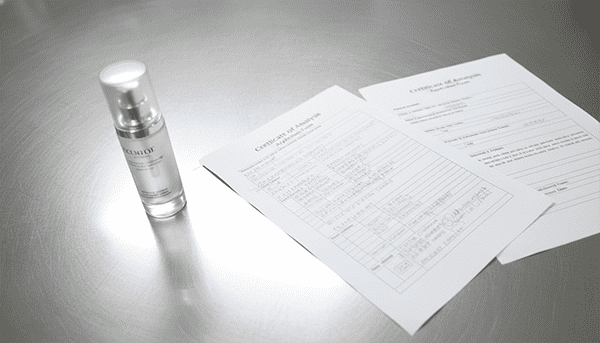
A good sample is not the same as a verified launch-ready product
Sampling can move faster than real launch planning. A supplier may create a texture, color, fragrance, or formula direction that feels close to what the buyer wants. But a product that feels good in a sample room still needs a clearer path: ingredients must make sense for the target market, packaging must fit the formula, claims should be supportable, and the buyer should know which documents can be prepared before production. Before you judge a manufacturer by sample quality, ask whether the supplier can explain the testing and document path behind that sample.
Sarah's Insight: A serious supplier conversation should reduce uncertainty before money is committed. If the manufacturer only talks about texture, fragrance, MOQ, and unit price, the buyer may still be missing the verification questions that decide whether the product can move forward smoothly.
| Before choosing a manufacturer | Why it matters | What to ask |
|---|---|---|
| Product category | Testing and document questions differ by category. | Have you handled this category, and what document path do you normally discuss before sampling? |
| Target market | Market rules can affect label, claims, ingredients, and documents. | Which support files can you provide, and which checks need local review? |
| Product claims | Claims can change evidence needs. | Which claims should be softened, supported, or reviewed before artwork? |
| Formula direction | A sample idea may not be commercially or operationally ready. | Can you review sample feasibility and launch feasibility separately? |
| Packaging plan | Packaging affects label space, compatibility, MOQ, and production planning. | Should package choice be reviewed before testing or label artwork? |
| Responsibility split | Supplier files, lab tests, and brand responsibility are different. | Who provides each document, and what needs third-party or local review? |
How Do Product Category, Target Market, and Claims Shape the Testing and Documentation Path?
The wrong first question is "what test is required?" The better first question is "what launch situation are we testing and documenting for?"
Product category, target market, and claims shape the testing path because they define the product's risk profile.6 A basic moisturizer, a sunscreen-positioned product, a brightening serum, a fragrance product, and a color cosmetic may raise different formula, claim, packaging, and document questions. The same formula direction can also need different review if the brand plans to sell in the United States, EU, UK, Canada, Australia, ASEAN, or another market.7 Evidence needed: official sources before naming specific market requirements. A manufacturer does not need to give legal advice, but it should ask the right pre-sampling questions and tell the buyer which points need official or local verification.8
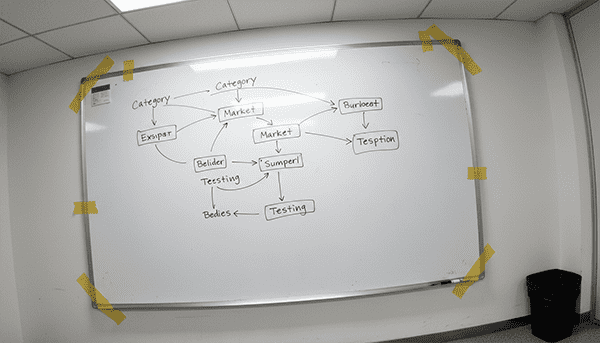
Start with the product category
The product category shapes the first layer of discussion. Skincare, personal care, fragrance, color cosmetics, sunscreen-positioned products, and treatment-adjacent products do not create the same buyer questions. A simple category label is still not enough. A "serum" may be positioned as hydrating, brightening, soothing, anti-aging, acne-focused, or sensitive-skin friendly. Evidence needed: neutral or official source support before linking specific claims to regulatory categories in the final version. In the first supplier discussion, ask what category the manufacturer believes this product belongs to, what documents are usually prepared, and what still needs market-specific review.
Define the target market and claims before artwork or sampling goes too far
Target market and claims are where many beauty launches become more complicated. A product that seems simple from a manufacturing view may need careful review if the brand wants to sell it in a market with specific cosmetic rules, claim limits, language requirements, or product-listing expectations. The manufacturer should not promise that a product is "fully compliant" without knowing where it will be sold and how it will be described. A better answer is conditional: these files can be provided, these tests or reviews may be discussed, and these points should be checked locally.
Sarah's Insight: "Skincare product" is often too broad for a useful supplier answer. "Leave-on brightening serum for a specific target market with these claim ideas" gives the manufacturer a much better starting point.
Keep formula, packaging, and testing connected
Testing is easier to plan when formula and packaging are discussed together. Packaging material, pump type, jar format, label space, fill weight, and decoration method can affect launch planning.9 A brand may choose packaging because it looks premium, then later discover that the label has too little room, the material is not ideal for the formula, or the MOQ does not fit the first-order strategy. Evidence needed: source support if the final article names specific compatibility or packaging-test standards. Before sampling, ask whether the packaging route supports the formula, label, claims, MOQ, and target market.
What Should You Ask a Supplier About Documents, Testing, and Responsibility Before Paying for Samples?
The buyer needs to know who provides what, not just whether the supplier says "we can support testing."
A brand should ask the supplier to separate three things: manufacturer-provided documents, third-party testing, and brand responsibility. Manufacturer-provided documents may include formula, ingredient, specification, batch, production, safety, or packaging-related files depending on the project and supplier capability. Third-party testing may be needed for certain product, market, claim, or retailer expectations. Brand responsibility can include final claim decisions, local regulatory review, label approval, import or sales compliance, and market-entry choices. Evidence needed: official or neutral sources before defining any document as legally required. The key is to avoid assuming that one supplier statement covers every responsibility. Ask for a document map before deposit.
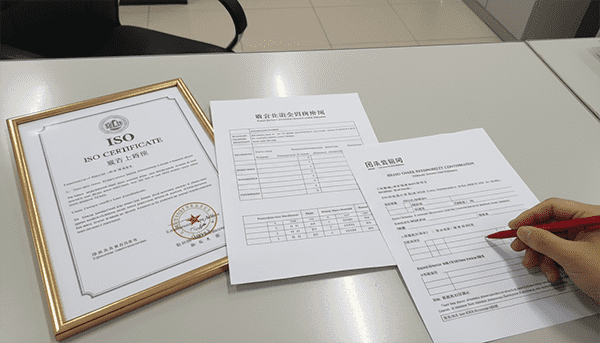
Ask for a document map before the deposit
A document map turns a vague testing conversation into a practical supplier check. It should list which files the manufacturer can provide, which tests or reports may need external labs, and which decisions belong to the brand or local advisors. Depending on the product, this may include specifications, ingredient lists, COA-style documents, SDS/MSDS-style safety documents where applicable, batch or production records, packaging information, stability or compatibility discussion, claim-support notes, or other files. Evidence needed: source support before using any document name as a universal requirement. The goal is to reveal whether the supplier understands the buyer's launch situation.
Sarah's Insight: A supplier that can explain document ownership clearly is usually easier to evaluate than one that gives a short "yes, compliant" answer. Clarity is part of supplier quality.
Watch for supplier answers that sound confident but stay vague
Some answers should make a buyer slow down. Be careful if a manufacturer gives the same testing list for every product, promises broad compliance without asking for a target market, cannot explain which documents it can provide, treats testing as something to arrange only after production, or separates packaging and claims from testing. Another warning sign is focusing only on the lowest MOQ or unit price while avoiding document questions. A lower first order can support generic formula testing or early feedback, but it may not support a serious custom formula, differentiated packaging, or complex launch path.
Questions to ask before paying for samples
Use these questions before you approve sampling or pay a deposit:
| Question | What a useful answer should clarify |
|---|---|
| What product category do you believe this project belongs to? | Whether the supplier understands the product beyond a generic formula request. |
| What target market are you assuming? | Whether the supplier knows that market assumptions affect documents, claims, and labels. |
| Which claims should be reviewed before sampling? | Whether the supplier can identify risk areas without making legal promises. |
| Which documents can you provide directly? | What the manufacturer can realistically prepare or share. |
| Which tests may require a third-party lab? | Where external testing or independent verification may be needed. |
| What packaging questions should be settled before production? | Whether packaging, label, formula, and MOQ are planned together. |
| What is still my responsibility as the brand owner? | Whether the buyer understands final market, label, claim, and launch responsibility. |
These questions are not meant to turn the buyer into a regulatory expert. They make the supplier conversation concrete. If the supplier can answer them carefully, the buyer can compare manufacturers more fairly. If the supplier avoids them, the buyer has learned something important before committing money.
Conclusion
Cosmetic product testing should not be treated as a small technical step after the product is already chosen. For a private label brand, it is part of supplier verification. Before choosing a manufacturer, confirm the product category, target market, intended claims, formula direction, packaging plan, document path, third-party testing needs, and responsibility split.
The best supplier conversation does not start with "Can you make this product?" It starts with "Can this product move from idea to sample to documented launch preparation without hidden risk?" A manufacturer that understands this question can help the brand decide earlier. A manufacturer that avoids it may still produce a sample, but the buyer may carry uncertainty later.
Evidence needed before final publication: official or neutral sources for any specific market rules, testing standards, document requirements, claim categories, or regulatory responsibilities added during elink review.
Sarah's Signature & CTA
If you are comparing private label manufacturers, do not send only a product name and ask for a quick quote. Send your product type, target market, intended claims, formula direction, packaging plan, and order-stage expectations.
CAMELLIA LABS can help you organize these details into a practical testing and docume
"(PDF) Introduction to APQP - Academia.edu", https://www.academia.edu/33843327/Introduction_to_APQP. Scholarly and regulatory sources on cosmetic product development can support that prototypes or samples may resemble the intended concept while still requiring separate verification of safety, compatibility, and claim support before launch. Evidence role: general_support; source type: paper. Supports: A private label manufacturer may be able to make a sample that looks and feels close to your idea.. Scope note: This supports the development workflow context, not the specific supplier in the article. ↩
"Summary of Cosmetics Labeling Requirements - FDA", https://www.fda.gov/cosmetics/cosmetics-labeling-regulations/summary-cosmetics-labeling-requirements. Regulatory guidance on cosmetic marketing and product development can support that testing, documentation, claims, packaging, and market access are separate compliance considerations that are not automatically resolved by having a sample. Evidence role: general_support; source type: government. Supports: That does not mean the product has a clear testing path, document trail, claim review, packaging plan, or target-market route.. Scope note: The source would usually establish the components of compliance rather than prove this exact supplier scenario. ↩
"Product Testing of Cosmetics - FDA", https://www.fda.gov/cosmetics/cosmetics-science-research/product-testing-cosmetics. International and national cosmetic guidance generally shows that required or prudent testing varies by product type, market, and claim context; therefore there is no single universal checklist applicable to every cosmetic launch. Evidence role: general_support; source type: government. Supports: Product testing is not one universal checklist.. Scope note: This is a contextual synthesis; individual jurisdictions may still have mandatory baseline requirements. ↩
"[PDF] FDA - Guidance for Industry - Cosmetic Good Manufacturing Practices", https://www.fda.gov/media/86366/download. Cosmetic development guidance commonly advises confirming compliance, documentation, and testing needs early in the product lifecycle, because later changes can be costly or delay launch. Evidence role: general_support; source type: education. Supports: A brand should confirm the testing and documentation path before paying for samples or committing to production.. Scope note: This is guidance on process efficiency and risk reduction, not a universal legal mandate. ↩
"How Do You Systematically Verify Cosmetic Supplier & Product ...", https://camellia-labs.com/how-do-you-systematically-verify-cosmetic-supplier-product-safety/. Cosmetic compliance guidance can support that manufacturers may hold product records or technical information, while certain safety, stability, or market-specific checks are commonly performed by independent laboratories or local regulatory advisers. Evidence role: general_support; source type: government. Supports: A manufacturer may provide specifications, ingredient information, batch-related files, packaging details, or existing support documents, but some tests may need an independent lab and some market checks may require local regulatory review.. Scope note: The exact division of documents and testing depends on jurisdiction and supplier capability. ↩
"Risk factors influencing contamination of customized cosmetics ...", https://pmc.ncbi.nlm.nih.gov/articles/PMC6994525/. Research and regulatory guidance on cosmetics show that product type, intended market, and advertising claims influence the scope of safety, substantiation, and labeling review needed for a launch. Evidence role: mechanism; source type: paper. Supports: Product category, target market, and claims shape the testing path because they define the product's risk profile.. Scope note: The source would explain the relationship, not quantify risk for every category. ↩
"Modernization of Cosmetics Regulation Act of 2022 (MoCRA) - FDA", https://www.fda.gov/cosmetics/cosmetics-laws-regulations/modernization-cosmetics-regulation-act-2022-mocra. Comparative regulatory references can support that cosmetic requirements differ by jurisdiction, so the same formula or claim strategy may face different review expectations across markets. Evidence role: historical_context; source type: government. Supports: The same formula direction can also need different review if the brand plans to sell in the United States, EU, UK, Canada, Australia, ASEAN, or another market.. Scope note: The exact list of markets in the article is illustrative and should be checked against current local rules. ↩
"How Do You Systematically Verify Cosmetic Supplier & Product ...", https://camellia-labs.com/how-do-you-systematically-verify-cosmetic-supplier-product-safety/. Guidance on supplier qualification and cosmetic compliance can support the distinction between manufacturing support and jurisdiction-specific legal or regulatory review, which often requires local expertise. Evidence role: general_support; source type: institution. Supports: A manufacturer does not need to give legal advice, but it should ask the right pre-sampling questions and tell the buyer which points need official or local verification.. Scope note: This supports the division of responsibilities in principle, not a legal duty for every manufacturer. ↩
"Summary of Cosmetics Labeling Requirements - FDA", https://www.fda.gov/cosmetics/cosmetics-labeling-regulations/summary-cosmetics-labeling-requirements. Packaging and product-development references support that container choice, dispensing format, label space, and fill specifications can influence manufacturability, compatibility, and compliance planning for cosmetic products. Evidence role: mechanism; source type: paper. Supports: Packaging material, pump type, jar format, label space, fill weight, and decoration method can affect launch planning.. Scope note: This is general packaging-development support; it does not prove every listed factor matters equally for every product. ↩