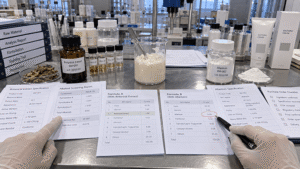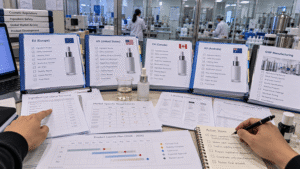

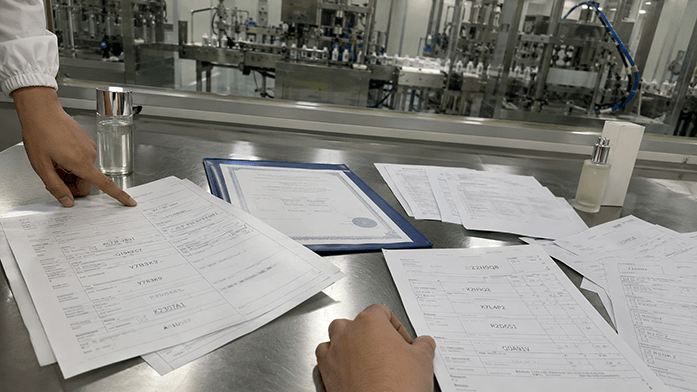
A brand founder comparing two quotes rarely sees the difference that matters most to a compliance officer. One quote comes from a GMP-certified plant. The other comes from a trading company that resells the same production. The per-unit number on the second quote may look easier to swallow — but the liability chain, the certificate path, and the batch record behind it are not the same product.
TL;DR: Sourcing private label cosmetics factory-direct keeps the regulatory Responsible Person, the manufacturer certificate, and the batch record on one verifiable chain. Buying through an intermediary often severs that chain, pushing compliance liability back onto the brand while hiding the actual plant. The trade-off is real: direct sourcing demands higher minimums and closer documentation work, which is the price of traceability.
This article looks at the direct-vs-middleman decision from the angle most buying guides skip — where compliance responsibility and product traceability actually sit. We are not comparing sticker prices. We are mapping who can prove what, to which regulator, when a shipment or a safety question lands.
Who Carries the Compliance Liability When You Source Through a Middleman?
Under the U.S. MoCRA framework, defined parties carry defined duties: facility registration, product listing, safety substantiation, and adverse event recordkeeping. The Responsible Person — a U.S. agent the brand must name — is the point of contact FDA expects to answer. When a trading company sits between your brand and the plant, that chain can fracture in ways a unit-price spreadsheet never shows.
Key Takeaway: If the entity you contract is not the entity that manufactured the goods, you must confirm the factory's facility registration, the Product Information File, and the safety substantiation sit under a Responsible Person you control. A reseller's letter is not a substitute for the plant's own records.
We see this gap most clearly in certificates. A middleman will present a "GMP certificate" that names the manufacturer — not the company you signed with. Under ISO 22716:2007 alignment, the certificate describes a specific site's practices; it does not extend to a reseller's warehouse or rework bench. The brand still owns the adverse event recordkeeping and the safety substantiation, but now it must retrieve those files through a third party that may never have received them from the plant.
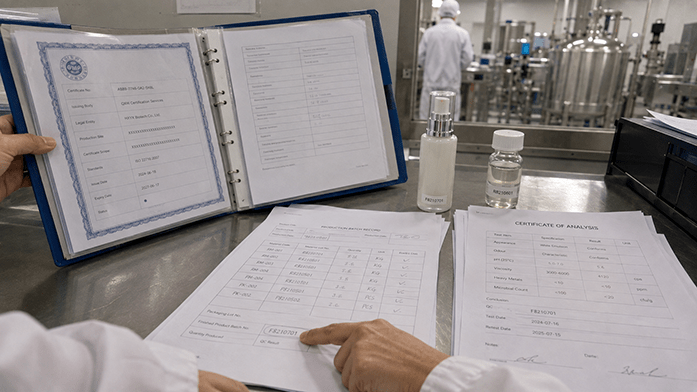
The compliance blind spots follow a predictable pattern. The table below maps each symptom to its root cause and the fix that keeps the chain intact.
| Symptom | Root cause | Fix |
|---|---|---|
| INCI list on the box disagrees with the commercial invoice | Middleman re-keyed the formula without factory sign-off | Use the plant's own INCI list and batch record as the single source of truth |
| GMP or ISO certificate names an entity other than your contract party | Reseller showed a manufacturer's certificate as its own | Match the certificate's legal entity to the contract and the FDA facility registration |
| No safety substantiation retrievable at recall time | Intermediary never received the dossier from the plant | Hold the Product Information File and safety substantiation under the brand's Responsible Person |
When a middleman is the legitimate choice
This is not an argument to never use an intermediary. For market-validation test batches, a distributor consolidating components from several plants into one purchase order, or a brand entering a market it does not yet staff locally, a reseller can be the rational structure. The boundary is clear: an intermediary works for distribution and small test runs; it becomes a liability when you need the Responsible Person chain and batch-level traceability for a regulated launch. We tell brands to use the middleman for access, not for the compliance backbone.
Why a 500-Unit Order Cannot Reach Factory Pricing — The Fixed-Cost Floor
A 500-piece minimum looks like a door into wholesale. It is usually the opposite: a reseller slicing someone else's batch. The reason genuine factory pricing only appears at higher volumes is structural, not negotiable.
Key Takeaway: GMP line cleaning, inter-batch sanitation, changeover waste, and compliance testing are fixed costs that must spread across volume. Below category minimums the per-unit cost rises sharply because the same overhead lands on far fewer units. We run custom formulation orders at category thresholds, not at a 500-piece "wholesale" rate.
A GMP-compliant line requires cleaning and sanitation validation between product runs. Color cosmetics add shade-changeovers and component setups that consume material and time. Changing a preservative system or base resets stability and compatibility testing. None of these scale down with order size. The same cleaning and testing overhead spread across a few hundred units instead of several thousand makes the per-unit cost climb — which is exactly why a 500-piece run cannot match a compliant full run on price.
Category minimums we apply, drawn from how the production line actually amortizes that fixed cost:
- Personal care: typically 2,000–6,000 pieces per SKU
- Color cosmetics: typically 6,000–12,000 pieces per SKU
The floor for a custom formulation order sits above 2,000 pieces. We cover the mechanics of why zero-threshold offers cost more in the hidden cost of zero-MOQ and why no-MOQ offers mislead buyers who read them as factory pricing.
The limitation cuts both ways. Direct sourcing ties up more working capital and more launch planning than a reseller slice. A brand must justify the volume with a real product roadmap. That is the honest cost of traceability — and it is why low-minimum language should be read as a resale pitch, not a manufacturing rate.
Documentation That Stops Customs Holds — and Where the Intermediary Link Breaks
Customs holds on cosmetics most often trace to document mismatches, and the mismatch usually originates at the reseller layer rather than the plant. FDA's cosmetics import guidance places entry compliance on the importer, and FDA's cosmetics importer obligations page clarifies what that importer must answer for. The plant's job is to produce consistent records; the importer's job is to make those records match at the border.
Key Takeaway: Align the INCI list, the HS code, the commercial invoice, and the SDS at the factory source. The intermediary hand-off is where they diverge — a single transcribed ingredient can break the match between box and paperwork.
We see the failure pattern repeat: a middleman copies the formula into the invoice, one ingredient drops in transcription, and the box label no longer matches the documents. Customs flags the discrepancy; the shipment sits in a port accruing fees. FDA's GMP inspection checklist and the FDA GMP guidance document describe the manufacturing discipline that keeps those records consistent at the source. The factory-direct link keeps one entity owning the INCI list, the SDS, and the invoice — which is the mechanism, not a price promise.
| Document | Why it matters | Common middleman failure |
|---|---|---|
| Commercial Invoice with HS code (e.g., 3304.99) | Drives duty and admissibility | Wrong or generic HS code across SKUs |
| Packing List | Carton-level inspection | Quantities differ from the invoice |
| Bill of Lading | Title to the goods | Shipper named as reseller, not the plant |
| Certificate of Origin | Duty treatment | Country of manufacture obscured |
| SDS / MSDS | Safe transport of chemicals | Copied from a different formula |
| ISF 10+2 filing | Mandatory for U.S. ocean freight | Filed late or by an unknown party |
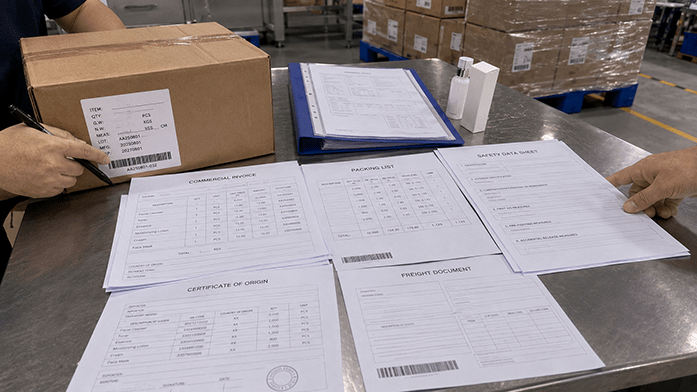
If your team is weighing a factory-direct private label run against an intermediary offer, the deciding factor is rarely the unit price. It is whether one entity owns the Responsible Person chain, the batch record, and the entry documents. We can walk through your product category, target market, and documentation readiness in a sourcing-compliance assessment before you commit a deposit — and our guide to start a private label line covers the launch sequence those documents support. You can also verify GMP, ISO, and FDA certificates with the plant before signing.