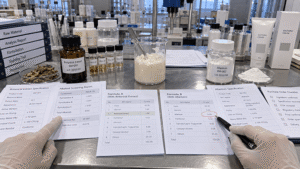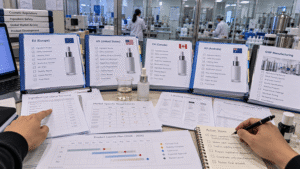

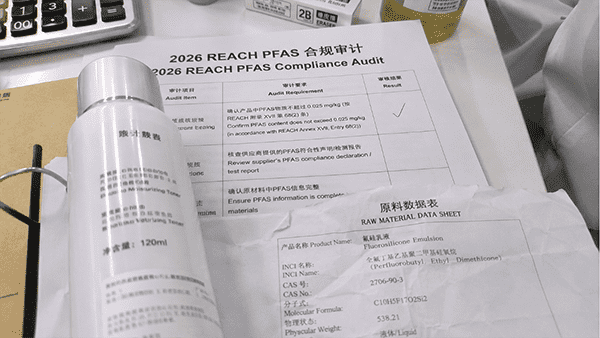
The 2026 PFAS deadline feels far away, but your best-selling products could become illegal to sell1. Vague supplier promises leave your brand exposed to massive risk.
The 2026 REACH deadline for PFAS isn't a future compliance issue; it's an immediate business decision. To protect your brand, you must verify your entire supply chain for hidden PFAS now by demanding raw material safety data sheets and third-party testing from your manufacturer.
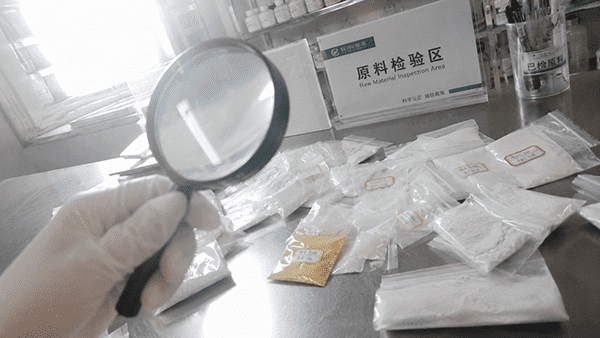
As a manufacturing partner, I talk to brand founders every day. The conversation about the upcoming PFAS ban has shifted. It is no longer about if you need to comply, but how you will navigate the transition without disrupting your business. Many founders are realizing their current suppliers can't give them the clear answers they need. The problem is not just about the final formula on a label; it's a complex supply chain challenge that starts with the raw ingredients. We need to break down the real business risks you face today.
Why is a 'PFAS-Free' Promise from Your Supplier Not Enough?
You asked your supplier if they are PFAS-free, and they said yes. But this verbal promise, without documentation, leaves your business completely vulnerable when regulators start checking.
A simple 'yes' is meaningless in the world of compliance. True verification means you must demand and review specific documents, like the raw material Safety Data Sheet (SDS) for every single ingredient2. This is the only way to prove a claim and protect your brand.
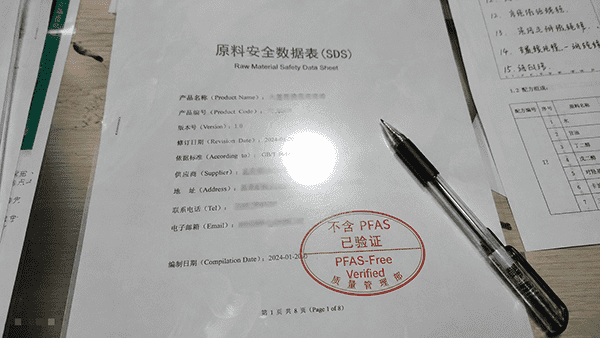
From a manufacturing standpoint, the biggest risk we see is what I call the "simple answer trap." A brand founder asks, "Are your formulas PFAS-free?" and is satisfied with a simple "yes." This is a critical mistake. The real danger isn't in the intentional use of restricted PFAS; it's in the accidental contamination from the raw material supply chain3. Your manufacturer's supplier might use a processing aid or a coating on a pigment that contains a restricted substance, and without proper documentation, neither you nor your manufacturer would know until it’s too late.
The Supply Chain Blind Spot
A cosmetic formula can have dozens of ingredients. The risk lies in each one. A film-former that gives your foundation its long-wear properties or a special coating on a pigment4 for a unique texture could be the source of non-compliance. Your best-selling product could be made obsolete because of one single, unvetted ingredient.
What to Demand from Your Manufacturer
You must shift your thinking from asking for promises to demanding proof. A trustworthy manufacturing partner should be able to provide this documentation without hesitation.
| Vague Supplier Promise | Verifiable Compliance Proof |
|---|---|
| "Our formulas are PFAS-free." | Raw Material Safety Data Sheets (SDS) for all ingredients. |
| "We are fully compliant." | Third-party lab test reports for specific PFAS compounds.5 |
| "We work with trusted vendors." | Full traceability documentation for key raw materials. |
When we onboard a new client, this documentation process is non-negotiable. It's the only way to build a resilient supply chain and ensure the final product is compliant not just today, but through 2026 and beyond.
Should You Reformulate Your Hero Product or Launch Something New?
Your best-seller might contain potential PFAS. Now you face a difficult choice: start a costly, slow reformulation with no guarantees, or abandon a product your customers love.
The right path depends on your business stage and scale. Established, scaling brands may need to invest in a custom reformulation. For emerging brands, launching new, pre-vetted compliant stock formulas is a much faster and less risky way to navigate the transition.
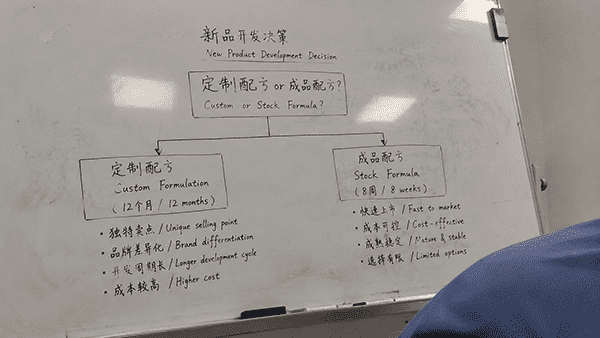
This is one of the most frequent strategic questions I discuss with founders. The answer isn't the same for everyone. It comes down to your budget, timeline, and risk tolerance. From our perspective as a manufacturer with both custom and private label capabilities, we see two distinct paths forward.
The Custom Reformulation Path
This path is for our scaling brand partners, typically those ordering 12,000 units or more. They have a "hero" product with a dedicated customer base and significant market share. The goal here is to protect that asset. Reformulating a complex product to match the exact texture, performance, and stability while removing any non-compliant ingredients is a major R&D project. It takes 6-12 months6 and a significant financial investment. The process involves auditing every raw material, testing dozens of new ingredient combinations, and running full stability and compatibility tests. It’s a necessary investment for a brand built on a specific product, but it is not a quick or easy fix.
The Fast-Track Private Label Path
This path is for the agile, emerging founder who needs to get to market quickly and manage cash flow. They can't afford to tie up $50,0007 and wait a year for a custom reformulation. The smarter move is to de-risk the transition entirely. By choosing a pre-tested, high-performance stock formula from our library, they can launch a fully compliant, market-ready product in just 4-8 weeks8. This allows them to test the market, build revenue, and avoid the R&D black hole. For these partners, with MOQs between 1,000 and 3,000 units, speed and compliance assurance are the top priorities.
Are You Prepared for the 2025 Manufacturing Capacity Crunch?
You think you have time until the 2026 deadline. The problem is, thousands of other brands are thinking the same thing. What happens when everyone rushes to reformulate at once?
A massive manufacturing bottleneck is coming in 2025.9 Brands that delay action will face soaring costs, extreme lead times, and rushed, poor-quality work. Securing your spot with a compliant, capable manufacturing partner now is the best move you can make.
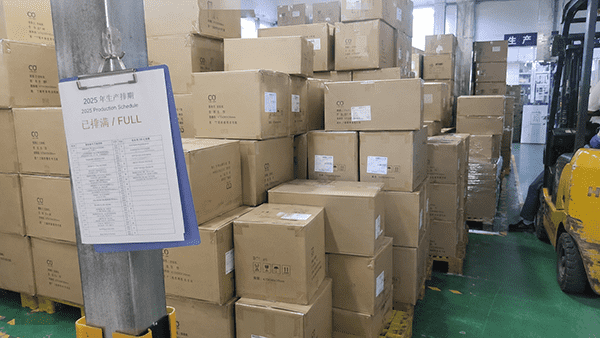
I am having conversations about 2025 production schedules right now. The most proactive brand founders understand that the 2026 deadline will create a crisis long before the actual date arrives. The supply of high-quality, GMP-certified manufacturing capacity is finite.10 The demand for it is about to explode.
The Economics of a Bottleneck
It's simple supply and demand. In 2025, factories that can prove a fully vetted, PFAS-compliant supply chain will be in high demand. Factories that cannot will be irrelevant. As unprepared brands scramble to find a new partner and reformulate, the compliant factories will be overwhelmed. This will lead to inflated prices for R&D services, longer wait times for production slots, and rushed work from overwhelmed labs11. Brands who wait will be at the back of a very long and expensive line. They risk missing an entire season of sales or launching a poorly reformulated product that damages their brand reputation.
Securing Your Spot in the Queue
The time to vet and secure your manufacturing partner is not in late 2025; it is now. You should be asking potential partners about their PFAS compliance strategy today. Ask them to show you their documentation process. Ask about their R&D capacity for reformulations and their lead times for new projects. At CAMELLIA LABS, we are already allocating R&D resources and production slots for 2025 to our existing partners who are planning ahead. Locking in your partner now is not just about compliance; it's a crucial business decision to secure your future production and protect your brand from the coming storm.
Conclusion
The 2026 PFAS ban is not a distant deadline. It's a strategic choice you must make today about your products, your supply chain, and your partners to ensure your survival.
"EU REACH - International Trade Administration", https://www.trade.gov/eu-reach. Explains the enforcement mechanisms of the EU's REACH regulation, which specifies that once a substance restriction enters into force, 'placing on the market' of products containing the substance above a certain limit is prohibited, with penalties enforced by individual member states. Evidence role: historical_context; source type: government. Supports: The legal mechanism by which products become illegal to sell under REACH if they contain a restricted substance after a deadline.. ↩
"[PDF] Hazard Communication Standard: Safety Data Sheets - OSHA", https://www.osha.gov/Publications/OSHA3514.html. Provides guidance from regulatory bodies like ECHA or OSHA on the requirements for Safety Data Sheets, explaining that while hazardous ingredients above certain concentrations must be listed, trace contaminants, impurities, or non-hazardous substances may not always be disclosed. Evidence role: mechanism; source type: government. Supports: The legal requirements for what must be disclosed on a Safety Data Sheet (SDS) under regulations like REACH or OSHA's Hazard Communication Standard.. Scope note: The source clarifies the utility of an SDS while also highlighting its limitations, supporting the article's broader point that additional verification may be needed. ↩
"Per and Polyfluoroalkyl Substances (PFAS) in Cosmetics - FDA", https://www.fda.gov/cosmetics/cosmetic-ingredients/and-polyfluoroalkyl-substances-pfas-cosmetics. A peer-reviewed study analyzing the presence of PFAS in cosmetics, which often finds evidence of these substances as unlisted contaminants or impurities originating from raw materials or manufacturing processes. Evidence role: case_reference; source type: paper. Supports: That PFAS can be present in consumer products, including cosmetics, as unintended contaminants from manufacturing processes, packaging, or raw material impurities.. ↩
"Per and Polyfluoroalkyl Substances (PFAS) in Cosmetics - FDA", https://www.fda.gov/cosmetics/cosmetic-ingredients/and-polyfluoroalkyl-substances-pfas-cosmetics. Research from scientific or environmental organizations often identifies specific classes of cosmetic ingredients, such as certain polymers used as film-formers, emulsifiers, and surface treatments for pigments, as common sources of intentionally added or contaminating PFAS. Evidence role: general_support; source type: research. Supports: The types of cosmetic ingredients and product categories (like long-wear foundation or waterproof mascara) that are most frequently found to contain PFAS.. ↩
"Per and Polyfluoroalkyl Substances (PFAS) in Cosmetics - FDA", https://www.fda.gov/cosmetics/cosmetic-ingredients/and-polyfluoroalkyl-substances-pfas-cosmetics. Guidance from standards organizations or regulatory bodies often emphasizes that while documentation like an SDS is a starting point, analytical testing by an accredited third-party laboratory is the most definitive method for confirming the absence or presence of restricted substances like PFAS. Evidence role: general_support; source type: institution. Supports: The role of analytical testing in verifying compliance with chemical restrictions in consumer products.. ↩
"MoCRA Timeline - Personal Care Products Council", https://www.personalcarecouncil.org/public-policy/modernization-of-cosmetics-regulation-act-mocra/mocra-timeline/. Industry reports and cosmetic science literature describe the multi-stage process of reformulation, including raw material sourcing, benchtop formulation, stability testing, and safety assessments, which typically spans several months to over a year. Evidence role: statistic; source type: other. Supports: The typical development and testing timeline for reformulating a cosmetic product.. Scope note: Timelines can vary significantly based on product complexity, ingredient availability, and the extent of required stability and compatibility testing. ↩
"[PDF] Cost of Reformulating Foods and Cosmetics - Regulations.gov", https://downloads.regulations.gov/FDA-2004-N-0258-0006/attachment_75.pdf. Analysis from cosmetic industry consultants or trade publications often estimates the cost of a full custom reformulation project—including R&D labor, raw material samples, stability testing, and regulatory compliance—to be in the tens of thousands of dollars. Evidence role: statistic; source type: other. Supports: The range of costs associated with custom cosmetic formulation and R&D projects.. Scope note: The actual cost can vary widely depending on the contract manufacturer, product complexity, and extent of testing required. ↩
"Operation Stork Speed", https://www.fda.gov/food/infant-formula-homepage/operation-stork-speed. Industry guides on private label manufacturing explain that by using pre-formulated and pre-tested bases, brands can significantly shorten the product development cycle, with timelines from order to delivery often measured in weeks rather than the months required for custom formulation. Evidence role: general_support; source type: other. Supports: The typical timeline for launching a product using a private label or stock formula approach.. ↩
"Statement By Alexandra Kowcz, Chief Scientist, Personal Care ...", https://www.personalcarecouncil.org/newsroom/statement-by-alexandra-kowcz-chief-scientist-personal-care-products-council-on-pfas-in-cosmetics-and-personal-care-products/. Reports from industry analysts and trade publications have projected that widespread regulatory changes, such as the proposed PFAS ban, will likely lead to a bottleneck as numerous brands simultaneously seek R&D and manufacturing services to update their product lines ahead of the deadline. Evidence role: expert_consensus; source type: other. Supports: That upcoming broad-scope regulations are expected to cause a surge in demand for reformulation services and compliant manufacturing capacity.. Scope note: This is a forecast based on current trends and may be subject to change based on market responses and the final form of the regulation. ↩
"ISO 22716:2007(en), Cosmetics — Good Manufacturing Practices ...", https://www.iso.org/obp/ui/en/#!iso:std:36437:en. Market research reports on the cosmetic contract manufacturing industry provide data on the number of facilities and overall market capacity, illustrating the finite nature of high-quality, certified production resources available to brands. Evidence role: statistic; source type: research. Supports: The approximate number or market size of GMP-certified (or equivalent, like ISO 22716) cosmetic contract manufacturers.. Scope note: Exact, up-to-date numbers can be difficult to obtain, but market reports can provide reliable estimates and growth trends for the sector. ↩
"Measurement and Effects of Supply Chain Bottlenecks Using ...", https://www.federalreserve.gov/econres/notes/feds-notes/measurement-and-effects-of-supply-chain-bottlenecks-using-natural-language-processing-20230206.html. Describes the economic principle of a demand-pull shock, where a sudden increase in demand for a fixed supply of goods or services leads to price inflation, longer queues, and potential decreases in service quality as providers become overwhelmed. Evidence role: mechanism; source type: education. Supports: The basic economic principles of supply and demand, which dictate that a surge in demand for a finite service will lead to increased prices and wait times.. Scope note: This provides a general economic model rather than specific evidence from the cosmetics industry, but it explains the mechanism behind the article's prediction. ↩