

The deposit is the last gate of trust — and the moment of greatest exposure. Up to that point, everything is reversible: a bad sample, a slow reply, a vague certificate. Once the wire clears, the leverage shifts to the factory. Many buyers treat a GMP certificate as the finish line. It is the starting line of the real check.
TL;DR: Verifying a cosmetic supplier before deposit means checking four layers — documents, samples, factory, and traceability — then running a five-step pre-payment gate. Most deposit losses trace to one cause: reading a certificate as proof of production reality. A red-flag shortlist and deposit-term negotiation separate safe partners from traps.
This guide lays out a practical, buyer-side sequence you can run before any money moves. It assumes you already shortlisted suppliers and want a systematic supplier verification process rather than a gut call. Each section ends with the specific signal that should stop you.
Four Gates Before the Wire: Documents, Samples, Factory, Traceability
A certificate proves one narrow thing: on a specific audit date, an assessor found a quality system compliant with a standard. It does not prove the certificate belongs to the site filling your product, nor that the system holds on the day your batch runs. The four gates below close the gap between paper and plant.
| Dimension | What to request | Green light | Red flag |
|---|---|---|---|
| Documents | ISO 22716 / GMP certificate naming the exact manufacturing entity and site; a batch-specific COA; business license | Certificate issued to the entity and address that will make your product; COA tied to your sample batch | Certificate for a different legal entity or address; no batch-specific COA; vague document requests |
| Samples | Pre-production sample with a version ID; stability and packaging-compatibility test records | Sample matches the brief, stays stable across conditions, and is version-locked | Unstable sample; no version control; no compatibility data on file |
| Factory | Live video or on-site audit; a sanitized Batch Production Record; a written QC plan | Transparent about the facility; can show a BPR and explain QC steps | Refuses any tour; cannot show production or QC documentation |
| Traceability | Batch-coding logic; a walkthrough of a mock recall | Can trace a finished unit back to its raw-material lots | No clear batch-coding or recall procedure |
A GMP certificate is a useful filter, not a verdict. To see what GMP and ISO 22716 certificates prove — and where they stop — hold the document against the full package: the COA, the Batch Production Record, and the traceability walkthrough. A supplier that produces these quickly is usually running the system, not performing for the audit.
The practical rule: verify the certificate against the production site, not the sales deck, and require batch-level evidence rather than generic assurances.
The Five-Step Pre-Deposit Verification Sequence
When the Document Check Alone Is Proportionate
Not every order needs the full five-step run. A repeat order of a same-site batch that has already cleared the four gates, produced as a standard production-scale run of an established formula with conventional packaging, is a different risk profile from a first-time engagement. If a distributor-recognized third-party audit from a recent cycle sits on file, and the certificate names the same legal entity and address as the plant that will fill the product, the document-and-sample check can stand on its own. The sample still has to match and stay stable; the certificate still has to name the right site. That is the floor, not a shortcut.
The boundary is sharp. The moment a custom formula enters the scope, or the market-registration file depends on the certificate-holder entity, or formula ownership is still unsettled, or the deposit would put material cash-flow exposure on your books, you return to the full sequence. A standard production-scale run of an established formula does not by itself open the exemption — what opens it is a documented prior pass, a certificate entity matching the plant, and an audit already trusted by your distribution channel. Read those three conditions against your order and you can decide, without a consultant, whether two gates are enough for this one.
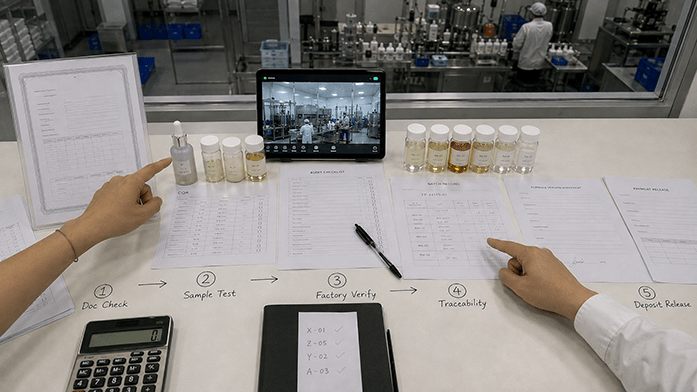
Run the steps in order. Each one is a point where you can still walk away without losing money. Skipping step three or step five is where most deposits go wrong.
[Key Takeaway: Do not release the deposit until step five is signed — certificate match, sample stability, factory audit, and a traceability walkthrough all cleared first.]
Step 1 — Match the certificate to the site. Confirm the ISO 22716 / GMP certificate names the exact manufacturing entity and site address that will produce your product. Verify the issuing body through an accreditation directory such as ANAB's list of accredited certification bodies. A certificate issued to a headquarters legal entity, while production happens elsewhere, fails this step.
Step 2 — Demand a batch-specific COA and test the sample. Request a Certificate of Analysis for the exact sample batch you approved, covering pH, viscosity, microbial purity, and appearance. Then commission or run stability and packaging-compatibility checks. A sample that separates, discolors, or leaks in its target bottle is a no-go regardless of how the deck looked.
Step 3 — Audit the factory, live. A real-time video walkthrough of the filling line, raw-material storage, and QC lab beats ten marketing photos. For EU-bound supply, cross-check substance compliance through ECHA's REACH-IT portal during this step. For US-bound product, confirm the facility's MoCRA registration and product listing are in place before you fund production.
Step 4 — Run a mock recall. Ask the supplier to trace one finished unit back to its raw-material lot numbers. This exposes whether batch coding and record-keeping are real or aspirational. If the explanation stalls at "we have a system," that is your answer.
Step 5 — Lock the version and ownership in writing. A signed agreement should fix the formula version, the approved sample as the reference standard, and state who owns the final formula. No signature, no deposit.
Two Deposits That Disappeared: What Went Wrong
These are composite patterns drawn from anonymized buyer reports on industry forums — not accounts of any single company. The mechanics, however, repeat often enough to memorize.
Two failure patterns account for most lost deposits: a certificate that does not match the plant, and a "manufacturer" that is really a sourcing agent.
A new skincare brand shortlisted a supplier whose deck showed an ISO 22716 certificate. The brand paid a deposit in the 40% range. During pre-shipment documentation, the buyer's regulatory agent noticed the certificate was issued to the supplier's trading-company headquarters, while filling happened at a separate toll plant with no GMP certificate of its own. Without a certificate matching the actual site, the brand could not complete market registration. Re-sourcing mid-launch cost a full selling season, and the deposit was not recovered.
A different founder ran a clean sampling phase — several revision rounds, stable emulsions, prompt replies. He signed and paid. The first production batch slipped by more than a month. When he pushed for a factory visit, the supplier admitted it was a sourcing agent, not a manufacturer, and had subcontracted to a plant it could not name until pressed. The formula was bottled by a facility with different preservative practices, prompting a preservation-efficacy concern that required a full retest.
Both failures shared one trait: the deposit moved before step three and step five of the sequence above. The certificate and the sample looked fine. The plant and the contract did not.
Holding the Wire: Negotiating Deposit Terms
A deposit is not a fee; it is leverage sized to the work. The percentage you accept should reflect how much of the risk sits on your side of the table.
In practice, treat 30–50% as a negotiable range rather than a fixed ask — and treat "full payment, no audit, no COA" as a walk-away signal, not a term.
Deposit ratios between 30% and 50% are commonly reported by brand owners, though the right number depends on tooling, batch size, and who holds the formula. Per industry feedback, several elements are usually negotiable:
- Staged release. Tie the deposit to contract signing, release a milestone payment on sample sign-off, and hold 20–30% until first-article inspection and QC pass.
- Retained final payment. Keep a portion until you have the batch-specific COA and a clean filling record in hand.
What is not negotiable: if a supplier refuses a factory audit or cannot produce a batch-specific COA, paying in full upfront is itself a red flag. Walk away.
Watch the hidden line items. Mold and tooling fees commonly run from $500 to $5,000, and third-party testing from $200 to $2,000 per product, per industry feedback. These should appear as itemized lines before the deposit, not as surprises after. For custom formulations, batch setup and quality-release economics typically only make sense above 2,000 units per run — size the deposit against a realistic batch, not a token amount, or you carry the setup cost alone if the supplier exits.
The Red-Flag Shortlist: Five Signals to Walk Away
Some signals are loud enough to end the conversation before sampling begins.
A quote well below comparable suppliers — roughly 30% or more under market, per industry feedback — deserves a documented scope and cost breakdown before you proceed; paired with any other signal here, it is reason to walk away.
| Red flag | What you see | What it usually means |
|---|---|---|
| Price far below market | Quote 30%+ under comparable suppliers, per industry feedback | Corners cut on raw materials, testing, or compliance — or the scope was misunderstood and fees will follow |
| Refuses video audit | "Visit later," or only marketing photos | No control over the actual plant, or conditions worth hiding |
| Blurry certificate scan | Low-resolution file, no issuer, no site address | The certificate cannot be verified to your production site |
| Avoids capacity numbers | "We can do any volume," with no monthly output | No real production planning or capacity evidence |
| Avoids formula ownership | Vague on who owns the final formula | Risk of losing control of your core asset |
When several appear together, the decision is easy. The harder case is a single red flag buried in an otherwise smooth process — which is why the five-step sequence exists: it forces the uncomfortable questions before the wire clears.
If you are structuring a custom OEM or ODM project, the client-solutions page outlines how a verification-first engagement works from shortlist to first batch. And for choosing a partner on more than price, the 7 due-diligence dimensions for OEM selection broaden this checklist into a full selection framework.
Verification is cheaper than a lost deposit and a lost season. Run the gates, sign step five, and let the terms carry the risk you should not. If your shortlist is set and you want a second set of eyes before the wire, request a pre-deposit supplier assessment.
References / Sources
- ISO 22716 (GMP standard) — https://www.iso.org/standard/36437.html
- ANAB Accreditation Directory (verify certification bodies) — https://anab.ansi.org/resource/product-certification-bodies-accreditation-directory/
- FDA — MoCRA Cosmetic Facility Registration & Product Listing (deadline guidance) — https://www.fda.gov/cosmetics/cosmetics-news-events/deadline-registration-and-listing-cosmetic-product-facilities-and-products-what-does-deadline-mean
- EU REACH-IT (ECHA) — https://reach-it.echa.europa.eu/