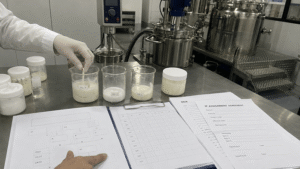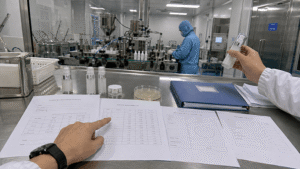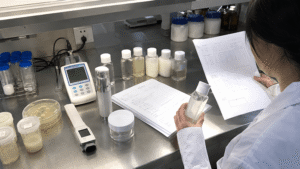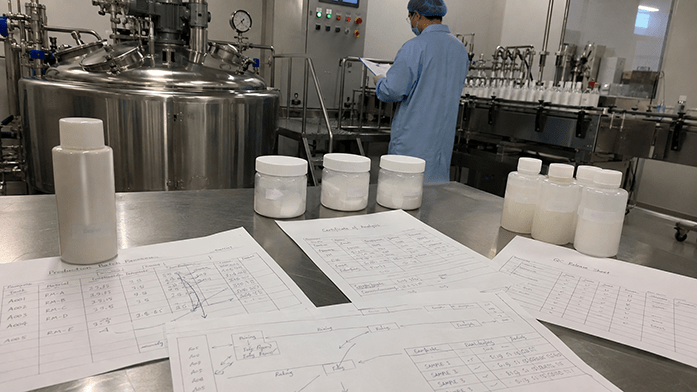
Most brand owners can confirm their supplier prints a batch number on the shipping carton. Ask them to follow that batch backward — through filling, through compounding, all the way to the raw material lot that went into it — and the answers get vague fast. A batch code on a label is the last step in traceability, not the first one. The question behind this article is the one buyers bring to us after a problem has already surfaced: my supplier said they could trace batches, so why can't they find the root cause?
TL;DR: Real batch traceability means a finished-goods batch number can be linked, through dated production records, to specific raw material lots, equipment logs, and QC release data — and regulators in the US (MoCRA) and EU (Regulation (EC) No 1223/2009) increasingly expect that link to exist. This article explains what to verify before you trust a supplier's "yes, we can trace."
The gap between "we have batch codes" and "we can find the root cause" is where private label projects get exposed. What follows is what traceability should look like, what the law ties to it, and the questions that separate a real system from a sticker.
What "batch traceability" actually means — and where it breaks
A batch, in cosmetics manufacturing, is a defined quantity of finished product made under uniform conditions from a specific set of inputs. Traceability is the ability to follow that batch in both directions: forward, to which warehouse or customer received it, and backward, to which raw material lots, compounding records, and QC results produced it. Both directions matter. A recall uses the forward link. A root-cause investigation uses the backward link.
Key Takeaway: A supplier has traceability when, given a finished-goods batch number, they can produce — within hours, not weeks — the raw material lot numbers, the compounding and filling records, the in-process and release QC data, and the distribution list for that batch. If they can only show you the batch number printed on the carton, they have labeling, not traceability.
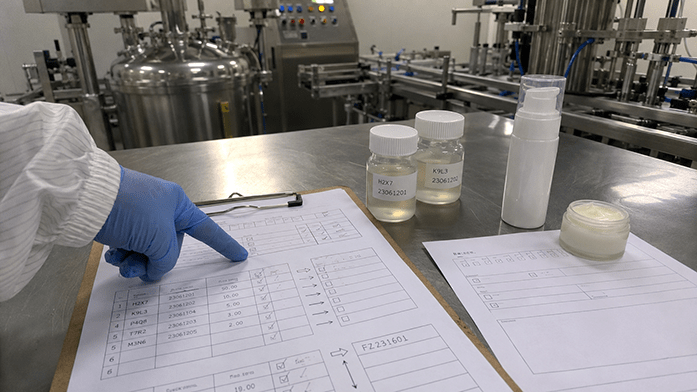
The chain has four links. Raw material receipt assigns a lot number to each incoming ingredient, tied to the supplier's Certificate of Analysis (CoA) and the factory's incoming inspection result. Compounding records then list which raw material lots went into a given production batch. Filling and packaging records connect the compounded bulk to the finished units and the batch code on the label. QC release ties microbiological, physicochemical, and fill-weight results to that batch before it ships. Distribution records finally connect the released batch to the customer or destination. Break any link, and the chain stops.
Where it breaks most often is the first link — the one most buyers never ask about. We see suppliers that keep tidy batch codes on finished goods but cannot tie a finished batch back to the specific glycerin or emulsifier lot that went into it, because incoming materials were logged by delivery date rather than by lot. We see paper records that exist but cannot be searched, so a cross-batch question — "which other batches used the same raw material lot?" — takes days instead of minutes. And we see co-mingling, where two raw material lots are drawn down into one batch without recording the split. Defensible in practice, fatal in an investigation.
One honest caveat. For early validation or pilot batches that ship to a single brand warehouse rather than to retail, the forward distribution link is less critical — the brand controls where every unit went. The backward link, to raw materials and QC, still matters, because a safety or stability problem in a pilot batch can affect the formula going into production. Lighter traceability is rational for some stages. Absent traceability is not.
What regulators tie to traceability (MoCRA and EU 1223/2009)
Traceability is not only a quality preference. Both the US and EU frameworks connect it to obligations that activate exactly when something goes wrong — adverse events, recalls, authority inspections.
Key Takeaway: Under MoCRA, serious adverse event reporting requires the responsible person to identify the product and, where available, the batch — which means the manufacturer's records must be able to supply that batch's production history on demand. Under EU Regulation (EC) No 1223/2009, batch identification is a labeling requirement, and the Product Information File (PIF) together with CPNP notification creates a documentation chain the responsible person must maintain and make available to authorities.
In the US, the Modernization of Cosmetics Regulation Act (MoCRA) introduced facility registration, product listing, safety substantiation, and adverse event recordkeeping for cosmetic products. The adverse event mechanism is where traceability bites. When a serious adverse event is reported, the responsible person must submit a report to FDA, and the product and batch identification in that report is only as good as the records behind it. If the manufacturer cannot tell you which raw material lots and QC results belong to that batch, the brand cannot investigate the cause, cannot scope a recall precisely, and cannot answer follow-up questions from FDA with confidence. MoCRA also requires records to be retained and made available to FDA upon request — records that, to be useful, must be organized so a specific batch can be pulled without a search.
In the EU, Regulation (EC) No 1223/2009 takes a different route to the same destination. The regulation requires cosmetic products to carry batch identification on the label, so that any unit on a shelf can be tied to a batch. The Product Information File (PIF) — which includes the Cosmetic Product Safety Report — must be kept for years after the last product is placed on the market, and the Cosmetic Products Notification Portal (CPNP) records the product's placement in the EU market. When a product is found not to comply or to be unsafe, the responsible person must notify the competent authority and ensure corrective action — which again depends on knowing which batches are affected and where they went.
Underlying both is ISO 22716, the cosmetic GMP standard, which treats traceability as a documented system requirement rather than an optional add-on. Factories certified to ISO 22716 are expected to identify and record batches through every stage of production and to retain those records in a retrievable form. A supplier that holds an ISO 22716 certificate should, in principle, have the documentation discipline traceability demands. Whether they actually do is what the next section tests.
Five questions that test whether traceability is real
The fastest way to audit a supplier's traceability is not to ask "do you have traceability?" — every supplier says yes. Ask operational questions that a supplier without a real system cannot bluff. We use variations of these in supplier evaluation, and the quality of the answer tells you more than any certificate scan.
Key Takeaway: These five questions probe the four links in the traceability chain — raw material, production, QC, and distribution. A supplier with a real system answers with a specific record type and a realistic retrieval timeframe. One without deflects to generalities or says "we can check and get back to you."
-
"Show me the production record for one of your recent batches — can you point to the raw material lots that went into it?" This tests the backward link directly. A real system lets someone pull the batch record and read off the lot numbers. A supplier that needs to "look into it" likely logs materials by delivery, not by lot.
-
"If a customer reported a defect in a batch today, how long before you could list every other batch that shared the same raw material lot?" This tests cross-batch search — the capability that turns a single complaint into a scoped recall instead of a panic. Minutes to hours signals a real system. Days means someone is rifling through paper.
-
"Where is the CoA for an incoming ingredient stored, and how is it linked to the batch that used it?" This tests incoming-material evidence. The CoA should be retrievable by lot and cross-referenced on the batch record. If the CoA exists but is not linked to the batch, the chain is broken at the source.
-
"Can you produce the in-process and release QC results for a specific batch on request?" This tests the QC link. Release testing — microbial, physicochemical, fill weight — should be tied to the batch number and available without a hunt.
-
"If I had to recall a batch from three distributors, could you give me the shipping records showing which distributor received which batch?" This tests the forward link. Distribution records should connect batch numbers to destinations. Without them, a recall is guesswork.
A note on what a good answer sounds like. The supplier names a record type, a location (an electronic system or a bound log), and a realistic retrieval time. The supplier that answers "of course, we have full traceability" without naming a record or a system is handing you the sticker, not the chain.
When the chain has to hold
Batch traceability is one of the areas where a factory's documentation discipline shows up most clearly — and where the gaps cost the brand, not the factory, when a recall or an authority inquiry lands. MoCRA adverse event reporting and the EU PIF obligations both assume the records exist and are retrievable. If they do not, the brand is the party exposed.
At CAMELLIA LABS, we build batch records that link every finished-goods lot to its raw material lots, compounding log, and release QC data, under GMP and ISO 22716. That discipline is what makes an adverse event reportable and a recall scoppable rather than open-ended. If you are evaluating suppliers for a private label or custom project and want to pressure-test traceability before you commit, request a traceability readiness review — share your product category, target market, and the batch records you would expect a manufacturer to produce on demand, and we will walk through what a compliant batch trail should look like for your specific launch.