A brand founder has a product concept — a positioning, an ingredient story, a target market — but no formula. They need a factory that can take that concept, develop a bespoke formulation, and manufacture it at scale. The search starts with "cosmetic manufacturer" on Google, and within an hour they're drowning in suppliers who all claim R&D capability, GMP certification, and competitive MOQs. Most of those suppliers are private label fillers, not co-manufacturers. The distinction isn't semantic. It determines who owns the formula, how much development work you're paying for, what IP protections you need, and whether your product survives the jump from lab bench to production line.
A reliable co-manufacturer is a factory with dedicated R&D bench strength, pilot-to-scale equipment continuity, and enforceable IP assignment clauses — not merely a GMP-certified supplier willing to fill your jars.
What follows breaks down what co-manufacturing actually means, how to evaluate a factory's development and production capability for custom formulation work, and why the process and cost structure look different from standard private label sourcing.
Private Label, Co-Manufacturing, and Full Custom — Where the Lines Fall
Most buyers use "OEM," "ODM," and "private label" interchangeably. The confusion is understandable — factories themselves deploy these terms loosely in marketing materials. But when you're sourcing a custom formulation, the distinction determines your cost structure, timeline, and IP exposure.
Three models, defined by who owns the formula:
Private label (factory-owned formula): The factory has an existing, already-stability-tested formula. You select it, add your branding, and the factory manufactures it. No R&D involvement. Lower MOQ because development cost has already been amortized across existing production. Fastest of the three paths to market.
Co-manufacturing (factory develops formula to brand's brief): You bring the concept — target market, ingredient preferences, performance claims, packaging direction. The factory's R&D team develops a bespoke formula and manufactures it. Formula IP is typically factory-owned or shared, depending on contract terms. This is the model most brands actually mean when they say "custom formulation."
Full custom (brand-owned IP formula): You own the complete formula, developed internally or by an independent formulator. The factory manufactures it under license, with no R&D input. Maximum IP control, but you bear all formulation risk and regulatory responsibility.
Key Takeaway: Co-manufacturing sits between private label and full custom — the brand owns the concept, the factory's R&D team develops the formula, and the factory manufactures it. If a stock formula already meets your differentiation needs, co-manufacturing adds development cost and timeline risk without proportional benefit.
When co-manufacturing isn't the right call: if a factory's existing formula meets your performance, ingredient, and positioning requirements, commissioning a custom formulation is unnecessary. Stock formulas have already passed stability testing and are in active production — shorter lead times, lower MOQ, no R&D fees. A brand testing market fit with a limited budget should consider private label first. Move to co-manufacturing once product-market fit is validated and differentiation requires a formula you can't find off the shelf.
The failure pattern is predictable when brands skip this judgment: a brand commissions a custom formulation when a stock formula would have served → pays for weeks of R&D and multiple stability cycles → discovers the market wants a different texture or format → reformulates from scratch at double the cost and a delayed launch. The question isn't whether co-manufacturing is superior — it's whether your current stage actually requires it.
Five Dimensions for Evaluating a Co-Manufacturer
Generic supplier selection checklists focus on GMP certificates, production capacity, and unit price. Those matter — broader manufacturer due diligence guides cover GMP verification, production capability, and quality control systems in depth. Co-manufacturing demands a different lens because you're buying R&D capability, not just filling capacity. Here are five dimensions specific to co-manufacturing evaluation.
1. R&D bench depth — not just "has a lab"
Ask how many formulators are on staff, what product categories they specialize in (emulsion systems, anhydrous formulas, color cosmetics, and surfactant-based products require different expertise), and whether they can share anonymized development records from past projects. A factory with one formulator juggling every client project is a bottleneck — your development timeline depends on their availability. Engagement with professional bodies like IFSCC (International Federation of Societies of Cosmetic Chemists) or PCPC (Personal Care Products Council) signals active technical involvement, not just a certificate on the wall.
2. Certification scope matching your target markets
ISO 22716 is the cosmetic GMP baseline — it confirms manufacturing quality systems but says nothing about market-specific regulatory compliance. Selling in the United States? MoCRA (Modernization of Cosmetics Regulation Act) requires facility registration and product listing. EU markets require Regulation (EC) No 1223/2009 compliance, including CPNP (Cosmetic Products Notification Portal) notification, a Product Information File (PIF), and a Cosmetic Product Safety Report (CPSR). Verify that the factory's certifications and regulatory experience cover your actual target markets, not just a generic GMP certificate that addresses production hygiene.
3. Pilot-to-scale equipment continuity
This is the dimension most buyers never think to ask about. A formula developed on a 5-liter benchtop homogenizer may behave differently when scaled to a 500-liter production homogenizer. Shear rates differ. Heat transfer dynamics change. Mixing times shift. If pilot and production equipment are different models from different manufacturers, the formula may need reformulation during scale-up — costing you another stability testing cycle. Ask whether the factory has pilot-scale equipment that bridges lab and production, and whether the same equipment family is used at both scales.
4. Structured communication during development
Custom formulation is iterative. You'll go through multiple sample rounds, each with feedback and adjustment. Ask how many revision rounds are included in the development fee, how long each iteration typically takes, and whether you'll communicate directly with the formulator or through a sales intermediary. Factories that route all technical communication through sales staff add translation lag and introduce misunderstandings about formulation specifics.
5. Contractual IP protection
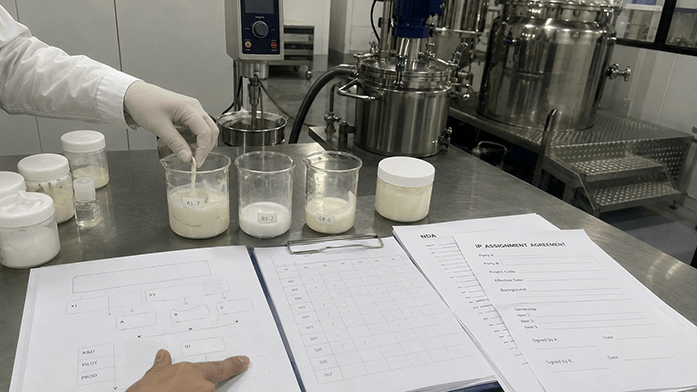
Custom formulations involve your brand's positioning, ingredient strategy, and possibly proprietary active combinations. Before sharing your brief, ensure a Non-Disclosure Agreement (NDA) is signed. The NDA is table stakes. The real protection is an IP assignment clause specifying who owns the final formula. Without it, the factory can legally reformulate variants of your formula for other clients. WIPO (World Intellectual Property Organization) publishes guidance on IP protection frameworks for manufacturing partnerships that can inform your contract structure.
Key Takeaway: Evaluate co-manufacturers on five dimensions that generic checklists miss — R&D bench depth, target-market certification scope, pilot-to-scale equipment continuity, structured development communication, and contractual IP assignment. The most expensive failures in co-manufacturing come from capability gaps, not price.
The failure pattern: a brand picks a factory with a polished showroom but no dedicated R&D bench → accepts a sample that looks and feels excellent → the pilot batch passes → at production scale the emulsion breaks because the production homogenizer has different shear geometry → the brand pays for reformulation and a second stability cycle, losing months. Each dimension above prevents one link in that chain.
The diagnostic table below maps common co-manufacturing failure symptoms to their root causes and fixes:
| Symptom | Root Cause | Fix |
|---|---|---|
| Sample looks perfect, pilot batch separates | Formula developed on lab equipment with different shear profile than pilot homogenizer | Request pilot batch using equipment from the same family as production scale before approving formula |
| Pilot passes, formula fails at full production run | Scale-up changed mixing time, temperature, or cooling rate without re-validation | Insist on a production-scale trial batch and re-run stability testing per ISO/TR 18811:2018 protocols |
| Stability test passes, product separates on shelf after months | Preservative system incompatible with active ingredients or packaging material | Run packaging compatibility testing during the stability phase, not after production |
| R&D timeline doubles original estimate | Single formulator handling multiple client projects simultaneously | Ask about formulator-to-project ratio before signing; build timeline contingency into the contract |
| Formula works but can't be registered in target market | R&D used ingredients restricted in the brand's destination market | Provide target-market restricted-substance lists to R&D before formulation begins |
| Brand discovers competitor using near-identical formula | No IP assignment or exclusivity clause; factory reuses the formula | Negotiate exclusivity or IP assignment before development begins; document in the NDA |
The Custom Formulation Process and Why >2000pcs MOQ Is the Floor
Understanding the collaboration sequence helps you judge whether a co-manufacturer's timeline and MOQ are reasonable or inflated. The process has six stages, and each adds cost that explains why custom formulation work doesn't scale down to small batches.
Stage 1 — Brief. The brand provides product concept, target market, ingredient preferences, performance claims, packaging concept, and regulatory requirements. Specificity here determines how many revision cycles follow. A vague brief ("make a good vitamin C serum") generates more iterations than a precise one ("15% L-ascorbic acid, pH 3.5, ferulic acid plus vitamin E, airless pump, EU and US markets").
Stage 2 — R&D feasibility. The factory's formulators evaluate whether the concept is technically achievable, whether ingredients are available and compliant in target markets, and whether the formulation approach is sound. This stage often surfaces constraints the brand didn't anticipate — a hero ingredient may require patent licensing, or a preservative may be restricted under EU Regulation (EC) No 1223/2009 or listed on Health Canada's Cosmetic Ingredient Hotlist.
Stage 3 — Pilot batch. A small-batch prototype is developed for evaluation. Texture, scent, appearance, and performance are assessed against the brief. Multiple iterations are normal — three to five rounds is common for complex formulations.
Stage 4 — Stability testing. The finalized pilot formula undergoes stability testing — typically involving sustained elevated-temperature storage, freeze-thaw cycling, and centrifugation, aligned with ISO/TR 18811:2018 protocols. This stage also includes compatibility testing with the final packaging material. Depending on product type and target shelf life, stability testing takes weeks to months. Compressing this stage risks shelf-life failures after launch.
Stage 5 — Scale-up. The formula transitions from pilot equipment to production-scale equipment. Equipment continuity (dimension 3 above) determines whether the formula transfers cleanly or needs adjustment. A production-scale trial batch confirms the formula behaves as expected at full volume.
Stage 6 — Production. Full-scale manufacturing under ISO 22716 GMP conditions, with batch records, in-process quality checks, and final release testing. In China, NMPA's Cosmetics Good Manufacturing Practice (GMP) Regulations govern production quality management, and facilities following these standards typically maintain documented batch traceability from raw material intake to finished goods release.
Key Takeaway: The co-manufacturing process spans six stages — brief, feasibility, pilot, stability, scale-up, production — and each adds fixed cost that doesn't scale with order volume. Custom formulation orders require >2000pcs MOQ because R&D labor, stability testing fees, and batch setup costs are per-project, not per-unit.
Why >2000pcs is the floor for custom formulation:
Development cost is largely fixed. Formulator time across multiple iterations, stability testing fees (charged per batch, not per unit), cleanroom and line setup costs, and raw material minimums from specialty suppliers all remain constant regardless of order size. At low volumes, per-unit development overhead makes the order economically unworkable for both sides.
For personal care products, custom formulation orders typically start above 2,000pcs. Color cosmetics typically carry higher MOQs — often 6,000 to 12,000pcs — because pigment dispersion and filling precision require longer line setup and larger batch economics. Premium or specialized packaging can push requirements above 12,000pcs due to component supplier minimums.
If you're deciding whether your product concept is ready for co-manufacturing — or whether a stock formula would better serve your current stage — a project readiness assessment can map your brief, target-market compliance requirements, and volume expectations. The right conversation happens before the development fee.