Cleanroom Standards in Cosmetic Manufacturing — What Buyers Should Verify
A supplier tells you their plant runs a "Class 100,000 cleanroom." Another says "ISO 8." A third hands you a photo of a sealed door with a blue light overhead. None of those answers means the same thing, and none tells you whether your specific product is safe to fill there. For a brand owner planning a launch, the cleanroom grade is not a certificate to file away — it is a variable that shapes microbial risk, documentation burden, and recall exposure before the first unit ships.
TL;DR An ISO 14644 class certifies one thing: airborne particle concentration at the time of classification. It does not by itself prove microbial control, GMP compliance, or that the room is used for your product's filling step. Match the class to your product's contamination risk, then verify the claim with the certificate, monitoring logs, and a line walk — not a photo.
Most buyers ask the right opening question — "do you have a cleanroom, and what class?" — but stop at the answer. This article decodes what the class label does and does not prove, shows how grade should track your product type, and gives you five on-site checks you can run in about twenty minutes before you sign.
What an ISO 14644 class actually proves for a cosmetic plant
The term gets used as a shorthand for "clean enough," but the standard is narrower than that. ISO 14644-1:2015 classifies a room by the maximum concentration of airborne particles of a given size, measured under defined test conditions. Cosmetic filling and mixing areas most often sit at ISO Class 7 or Class 8; aseptic or sterile-adjacent operations would need ISO Class 5. Each step down the class scale tightens the permitted particle concentration by roughly a factor of ten at a given particle size — so a Class 8 room caps 0.5 µm particles at [Evidence needed: ISO 14644-1:2015 Class 8 maximum permitted concentration at ≥0.5 µm, verify exact value against standard table], and Class 7 is ten times tighter still.
[Key Takeaway: An ISO class is a particle-count rating of the air at classification time. It is not a microbial rating, not a GMP certification, and not proof the room is used for your product's critical step.]
A classification certificate answers one question: how many particles were in the air when the accredited lab ran the test. It does not answer these:
- Microbial load. ISO 14644 measures particles, not bacteria or fungi. A room can pass particle classification and still have poor microbial control. Microbial monitoring follows a separate program — settle plates, contact plates, active air sampling — that the certificate will not show.
- Ongoing performance. A one-time classification is a snapshot. Continuous or periodic particle monitoring under ISO 14644-2 is what keeps the room in class during production. Ask whether monitoring is live or annual.
- Quality system. ISO 14644 covers the room. Cosmetic GMP under ISO 22716 governs personnel, documentation, traceability, and complaint handling. A clean room inside a weak quality system is still a weak supplier.
- Zone usage. A supplier may hold a Class 7 certificate for a small aseptic booth while your cream is filled in an unclassified open area. The certificate covers the booth, not your line.
Here is the regulatory nuance most buyers miss: ISO 22716 requires appropriate environmental control for cosmetic manufacture, but it does not mandate a specific ISO 14644 class. There is no single "cosmetic cleanroom class" written into the regulation. The correct grade is risk-based — tied to your formula, your preservative system, and your target market — not to a number printed on a wall.
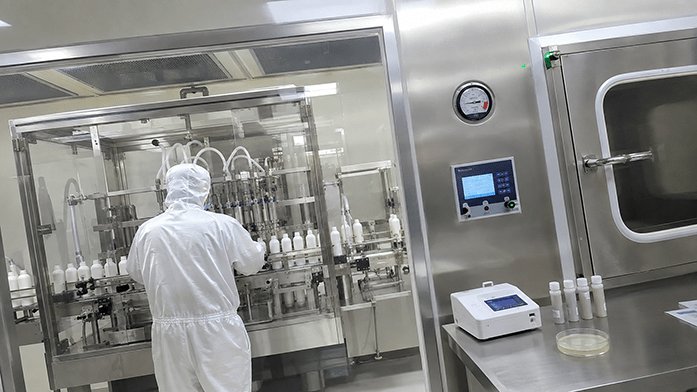
How cleanroom grade maps to product type and contamination risk
Treating every formula the same wastes budget or invites risk. A high-water-content, low-preservative leave-on serum and a viscous rinse-off shampoo face different microbial threats, so they deserve different environmental control. The grade should follow the product, not the supplier's default setup.
[Key Takeaway: Match the cleanroom grade to your product's water activity, preservative strength, and contact area — not to the supplier's default class. Over-specifying wastes money; under-specifying raises microbial and recall risk.]
The table below is a decision aid, not a regulation. It maps common cosmetic categories to a sensible grade and the risk each one carries. Exact thresholds and local requirements vary, so verify against your formula and market.
| Product type | Sensible grade range | Primary contamination risk | What to verify |
|---|---|---|---|
| Rinse-off (shampoo, body wash, bar) | Controlled, often ISO 8 or non-classified GMP area | Low; brief skin contact, robust preservation | GMP discipline and water quality, not the room class |
| Leave-on cream / lotion (standard preservation) | ISO 8 filling | Moderate; water-rich, longer skin contact | Filling-zone class, preservative challenge test evidence |
| Low-/no-preservative, high-water serum | ISO 7 filling | High; weak microbial defense | Tighter class, microbial monitoring logs, aseptic technique |
| Eye-area, compromised-skin, or sterile-adjacent | ISO 5 aseptic where claims require it | Highest; sensitive route of exposure | Full aseptic program, not just a classified room |
| Anhydrous / oil-based | ISO 8 or controlled | Low microbial, high foreign-matter | Foreign-particle and metal control, not just air particles |
The reverse case matters too. A robust rinse-off formula with a strong preservative system does not need an ISO 5 suite, and pushing for one adds cost and lead time without lowering real risk. We see brands over-specify because they equate a smaller class number with safety — when the actual lever is preservative system, water activity, and filling hygiene. Specify to the risk, not to the fear.
Five on-site signals to verify a supplier's cleanroom claim
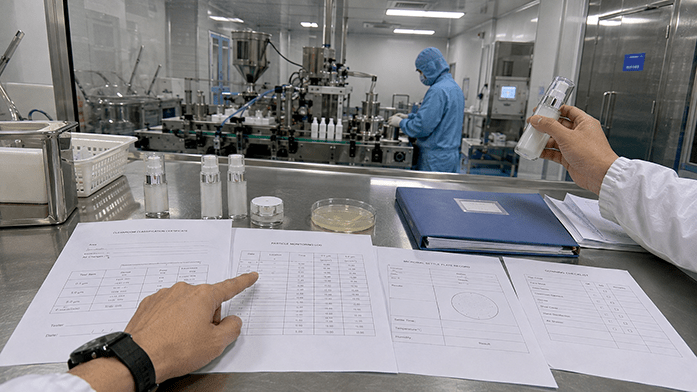
Certificates are cheap to show. Operations are harder to fake. We have watched buyers accept a laminated ISO page and skip the fifteen-minute line walk that would have exposed the gap. Use these five checks on your next factory visit, or ask your agent to run them and send the findings.
[Key Takeaway: Verify with documents and observation together — the certificate, the monitoring logs, the zone layout, the pressure and gowning discipline, and the microbial program. One missing is a question; all five absent is a red flag.]
-
Ask to see the ISO 14644-1 classification certificate, with the issue date and the accredited lab named. Watch whether it covers the room where your product is actually filled, or a demonstration booth. A certificate dated more than [Evidence needed: typical re-test interval for ISO 14644 classification, per ISO 14644-2] ago tells you little about today's air.
-
Watch whether particle monitoring is continuous or one-time. A classified room monitored only at certification can drift out of class between tests. Ask for recent monitoring logs and the frequency [Evidence needed: typical particle monitoring frequency for cosmetic cleanrooms — verify against ISO 14644-2 and site SOP].
-
Ask which process steps happen inside the classified zone. Filling only, or mixing and filling both? The riskiest step — getting the product into the container — should be the one inside the room. A supplier who fills in open air and classifies only the storage corridor is not giving you what the label implies.
-
Walk the line and watch pressure and gowning discipline. Cleanrooms hold positive pressure against adjacent areas — typically [Evidence needed: typical pressure differential in Pa, e.g. 10–15 Pa, between cleanroom and less-clean adjacent space] — so dirty air cannot push in. Watch the airlock, the gowning sequence, and whether operators move from dirty to clean zones without changing. Discipline shows faster on a walk than on a certificate.
-
Verify the microbial program separately. ISO 14644 says nothing about microbes. Ask for the microbial monitoring method — settle plates, contact plates, active air sampling — and how often [Evidence needed: typical microbial monitoring frequency for cosmetic cleanroom filling]. A supplier who cannot describe their microbial control has a particle number but not a contamination strategy.
A cleanroom is a tool, not a guarantee. The class tells you the air was clean on test day; the documents and the walk tell you whether it stays clean while your product is made.
When you are scoping a private label or custom line, the cleanroom question should come early — not as a checkbox, but as part of a facility readiness review tied to your product type, preservative system, and target market. If you want a second opinion on whether a supplier's grade claim fits your formula's risk profile, request a facility readiness assessment and share your product category and intended markets. The right grade is the one your contamination risk actually requires.