Is Your Manufacturer Ready for Canada's SOR/2024-63 Regulations?
Canada's new SOR/2024-63 cosmetic rules are here. A simple "yes" from your supplier isn't enough, leaving your brand exposed to huge risks like recalls and fines1.
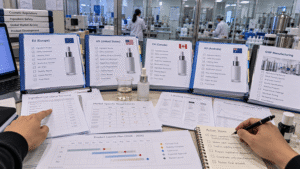
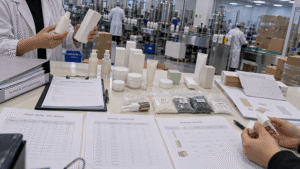
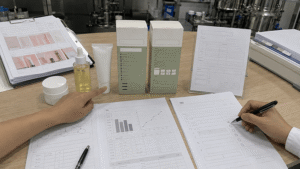
To ensure compliance with Canada's SOR/2024-63, you must verify your manufacturer's entire system. This includes how they vet raw materials, control their manufacturing process to prevent contamination, and manage batch traceability and record-keeping for regulatory audits. It's a process, not just a document.
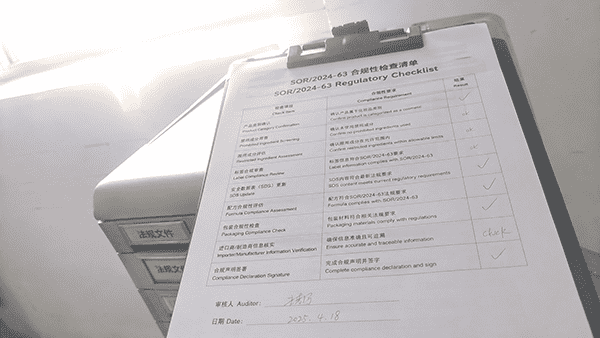
I talk to brand owners every day about entering new markets. Recently, the conversation always turns to Canada. The new SOR/2024-63 regulations are causing a lot of uncertainty. Brands are worried, and rightfully so. They ask me for a simple checklist, but the truth is a bit more complex. A checklist is a good start, but it doesn't protect your brand from the real dangers of non-compliance: seized shipments2, mandatory recalls, and a damaged reputation. The key isn't just asking if your partner is compliant, but how they prove it. Let's break down what that really means for your business.
Is Your Supplier's 'Compliant Ingredient' List a Trap?
You've checked that every ingredient in your formula is allowed in Canada. But during production, new, restricted substances can form3, making your final product illegal and unsafe.
Yes, a formula with compliant raw materials can become non-compliant during manufacturing. Some ingredients, known as formaldehyde-releasers, can create restricted substances under certain conditions. You must vet your manufacturer’s process control, not just their initial ingredient list, to avoid this trap.
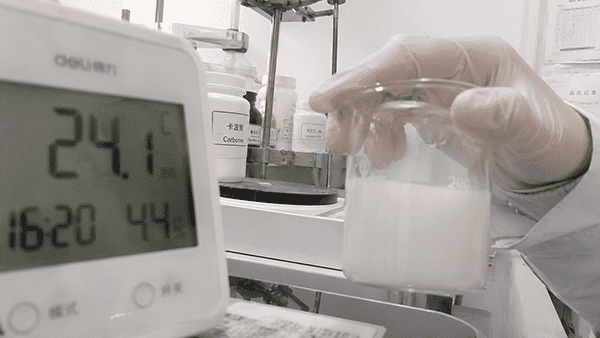
When we get inquiries from brands targeting the Canadian market, this is a common point of confusion. A brand owner will send us a formula and say, "All these ingredients are on Canada's approved list." That's a great first step, but it's not the end of the story. The SOR/2024-63 regulation applies to the finished cosmetic product you sell, not the raw ingredients that go into it.4
The Raw Material vs. Finished Good Problem
Some ingredients, while perfectly safe on their own, can react with other ingredients or change during the manufacturing process. Heat, pressure, or storage time can create byproducts. A common example is ingredients known as "formaldehyde-releasers."5 These are preservatives that slowly release tiny, safe amounts of formaldehyde to keep the product free of bacteria. But if the manufacturing process isn't controlled properly, they could potentially release more than the allowed limit6, making your product non-compliant.
How to Vet Your Manufacturer's Process
Instead of asking "Are your ingredients compliant?", you need to ask better questions. Here’s how we guide our partners to think about it:
| Vetting Question | What It Reveals About Your Partner |
|---|---|
| What are your testing protocols for byproducts? | Shows if they actively monitor for restricted substances. |
| How do you control temperature and mixing? | Proves they understand and manage chemical reactions. |
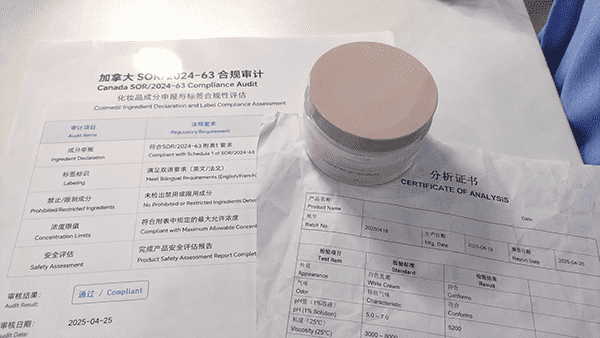
| Can you provide a Certificate of Analysis (CoA)7? | Confirms the final product was tested and meets specs. |
This shifts the focus from a simple ingredient list to the reality of production. A reliable partner welcomes these questions because they already have these systems in place.
Are You Asking Your Manufacturer the Right Questions About Compliance?
You ask your manufacturer, "Are you SOR/2024-63 compliant?" They say yes. But this simple answer offers no proof and leaves you completely exposed to regulatory action.
Stop asking yes-or-no questions. Instead, ask for evidence of their compliance system. Ask "How do you verify raw material suppliers?" or "What are your testing protocols?" This forces them to demonstrate their process, giving you real assurance and protecting your brand.
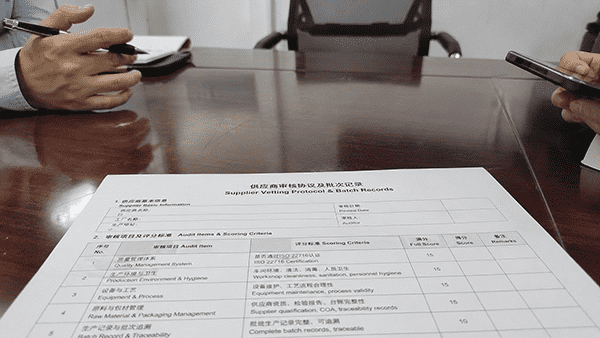
A huge part of my job is helping brands de-risk their supply chain. When it comes to regulations like SOR/2024-63, the biggest risk is taking a supplier's "yes" at face value. Compliance is a system, not a promise. A simple claim doesn't hold up during a regulatory audit, but documented proof does.
Moving Beyond "Yes/No" Answers
The goal is to shift from a checklist mindset to an investigative one. Your questions should force a manufacturer to explain their process. A good partner will have no problem sharing this; a weak one will hesitate or give vague answers. This is the single most effective test you can run.
Key Areas to Probe
Your vetting process should cover the entire production lifecycle. We built our "Free Formula Compliance Check" around this principle, looking at the entire system, not just a list of ingredients. Here are the questions you should be asking any potential partner:
| Vetting Area | Critical Question to Ask | Why It Matters for SOR/2024-63 |
|---|---|---|
| Raw Materials | "How do you qualify and audit your raw material suppliers?" | Ensures banned substances aren't entering your supply chain. |
| Production Control | "Show me your batch records. How do you ensure traceability?" | Proves they can track every ingredient from source to final product. |
| Final Testing | "What are your release testing protocols for finished goods?" | Confirms the final product meets all regulatory limits. |
These questions turn a vague promise of compliance into a concrete, verifiable process.
Does Your Compliance Plan Cover Labeling and Record-Keeping?
You focused so much on getting the formula right for Canada. But incorrect labeling or missing paperwork can get your shipment stopped at the border, costing you everything.
SOR/2024-63 is about more than just what’s inside the bottle. It includes strict rules for labeling, like listing all ingredients8, and requires you to maintain compliance records for inspection9. A good manufacturing partner manages this for you, protecting you from post-market risks.
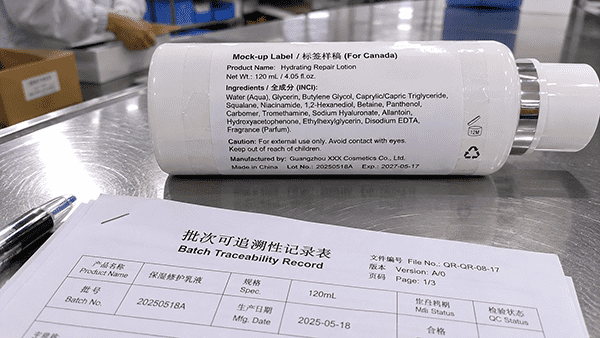
Many brands we speak with are laser-focused on the prohibited substances list in SOR/2024-63. That's important, but it's only one piece of the puzzle. The Canadian authorities care just as much about what's on the outside of the bottle and what's in your filing cabinet.
"On-Bottle" and "In-Office" Compliance
Think of compliance in two parts. First is "on-bottle" compliance, which is your product label. The regulations require a complete list of ingredients (often called an INCI list) so consumers know exactly what they are using. Simple mistakes here can lead to a product being pulled from shelves. Second is "in-office" compliance. This refers to the records you must keep. Canadian regulators can request to see your product safety reports, batch records, and compliance documentation at any time10.
Your Manufacturer's Role as a Safety Net
This is where a true partner stands out. They don't just make your product; they help protect your brand long after it ships. They should provide you with all the necessary documentation for your records and ensure every label they produce is 100% compliant.
| Compliance Area | Manufacturer's Responsibility | Brand's Risk if Ignored |
|---|---|---|
| Labeling | Provide accurate, compliant INCI lists for all labels. | Product recalls, fines for mislabeling. |
| Record-Keeping | Maintain and provide batch records & Certificates of Analysis. | Inability to respond to regulatory audits, forced market withdrawal. |
| Traceability | Ensure every ingredient and batch can be traced. | Ineffective recalls, huge liability in case of a safety issue. |
Your manufacturer should be your first line of defense, proactively managing these details so you can focus on growing your brand.
Conclusion
Canada's SOR/2024-63 isn't a barrier. It's a guide to choosing a better manufacturing partner who values process, transparency, and long-term safety for your brand's success.
"Food and Drugs Act - Wikipedia", https://en.wikipedia.org/wiki/Food_and_Drugs_Act. Health Canada's compliance and enforcement framework for health products, under the authority of the Food and Drugs Act, includes a range of actions such as issuing public advisories, overseeing voluntary recalls, and taking measures to stop the sale of non-compliant products. Evidence role: general_support; source type: government. Supports: The source should describe the compliance and enforcement actions Health Canada can take regarding non-compliant cosmetics, including the authority to order recalls and issue penalties.. Scope note: The source may describe a range of enforcement options without specifying exact fine amounts for every type of infraction. ↩
"Importing, exporting or transhipping consumer products and cosmetics", https://www.canada.ca/en/health-canada/services/consumer-product-safety/legislation-guidelines/guidelines-policies/importing-exporting-commercial/document.html. The Canada Border Services Agency (CBSA) works with Health Canada to enforce regulations on imported goods, and has the authority to recommend the refusal of entry for cosmetic products that are suspected of being non-compliant with the Food and Drugs Act and its associated regulations. Evidence role: general_support; source type: government. Supports: The source should confirm that the Canada Border Services Agency (CBSA), in partnership with Health Canada, has the authority to detain, refuse entry, or seize shipments of imported goods that do not meet Canadian regulatory requirements.. ↩
"Determination of nine prohibited N-nitrosamines in cosmetic ... - PMC", https://pmc.ncbi.nlm.nih.gov/articles/PMC9850448/. Scientific research on cosmetic formulation and stability demonstrates that interactions between raw materials or exposure to process conditions like heat can lead to the formation of unintended byproducts, such as nitrosamines, which may be restricted for safety reasons. Evidence role: mechanism; source type: paper. Supports: The source should explain that chemical reactions between ingredients, or degradation of ingredients due to factors like heat or light during manufacturing and storage, can lead to the formation of unintended substances (impurities or byproducts).. ↩
"Potassium Hydroxide as a Cost-Effective Catalyst for Broad-Scope ...", https://pmc.ncbi.nlm.nih.gov/articles/PMC12455661/. Canada's Food and Drugs Act defines a 'cosmetic' as any substance intended for use on the human body for cleansing, improving, or altering the complexion, skin, hair or teeth. Regulations, therefore, apply to the finished good as sold, not solely its constituent raw materials. Evidence role: definition; source type: government. Supports: The source should clarify that Canadian cosmetic regulations, including amendments like SOR/2024-63, apply to the final product being sold to consumers.. ↩
"Formaldehyde may be found in cosmetic products even when ... - PMC", https://pmc.ncbi.nlm.nih.gov/articles/PMC5152996/. Scientific literature and regulatory assessments describe formaldehyde-releasing preservatives as a class of antimicrobial ingredients used in cosmetics that decompose over time to release small amounts of formaldehyde, thereby protecting the product from contamination. Evidence role: definition; source type: paper. Supports: The source should define formaldehyde-releasers as preservatives used in cosmetics that work by slowly releasing small amounts of formaldehyde to prevent microbial growth.. ↩
"National Emission Standards for Hazardous Air Pollutants for ... - EPA", https://www.epa.gov/stationary-engines/national-emission-standards-hazardous-air-pollutants-reciprocating-internal-0. Health Canada's Cosmetic Ingredient Hotlist specifies the conditions of use and maximum permitted concentrations for certain substances, including formaldehyde, in finished cosmetic products. Evidence role: statistic; source type: government. Supports: The source should identify the maximum allowable concentration of formaldehyde in finished cosmetic products as specified by Health Canada's Cosmetic Ingredient Hotlist.. Scope note: The exact limit may be conditional based on the product type (e.g., oral vs. topical) and whether other formaldehyde-releasers are present. ↩
"Certificate of analysis - Wikipedia", https://en.wikipedia.org/wiki/Certificate_of_analysis. In manufacturing industries, including cosmetics and pharmaceuticals, a Certificate of Analysis (CoA) is a document that attests to the results of quality control testing on a specific batch of a product, confirming that it meets its required specifications before release. Evidence role: definition; source type: education. Supports: The source should define a Certificate of Analysis (CoA) as a formal document issued by a quality control department that confirms a product batch meets its predetermined product specifications and quality standards.. ↩
"Industry Guide for the labelling of cosmetics - Canada.ca", https://www.canada.ca/en/health-canada/services/consumer-product-safety/reports-publications/industry-professionals/labelling-cosmetics.html. Under Canada's Cosmetic Regulations, labels for most cosmetic products are required to include a list of all ingredients, using the International Nomenclature of Cosmetic Ingredients (INCI) naming convention, in descending order of predominance. Evidence role: definition; source type: government. Supports: The source should detail the mandatory labeling requirements for cosmetics sold in Canada, including the requirement to list all ingredients using the International Nomenclature of Cosmetic Ingredients (INCI) system.. ↩
"Food and Drugs Act - Wikipedia", https://en.wikipedia.org/wiki/Food_and_Drugs_Act. While the Cosmetic Regulations do not explicitly mandate a specific format for record-keeping, they do require that evidence of a product's safety be available to the Minister of Health upon request, effectively obligating manufacturers and importers to maintain such records. Evidence role: general_support; source type: government. Supports: The source should confirm that under Canadian law, manufacturers and importers must be able to provide evidence of a cosmetic's safety to Health Canada upon request, which necessitates maintaining appropriate records.. ↩
"Title 21 – Food and Drugs - OLRC Home", https://uscode.house.gov/view.xhtml?path=/prelim@title21&edition=prelim. Section 23 of Canada's Food and Drugs Act grants inspectors broad powers, including the authority to enter any place where a regulated activity is conducted and to examine, copy, or take extracts from any books, records, or other documents relevant to compliance. Evidence role: historical_context; source type: government. Supports: The source should cite the section of Canada's Food and Drugs Act that grants inspectors the authority to enter any place they believe a regulated activity is conducted and examine records or documents.. ↩