A founder building a skincare brand searches for a manufacturer and lands on an attractive phrase: low minimum order quantity. The math feels reassuring — test the market with a few hundred units, prove the concept, then scale. So they send a brief for a custom serum in a distinctive bottle with a hero peptide. The reply changes everything. The bottle supplier won't run custom tooling for a few hundred pieces. The peptide ships only in bulk drums. The per-unit price at their target volume comes back several times higher than the "from" figure they had budgeted.
Nothing in that reply was a lie about the filling line. It was the trap the low minimum had been hiding: a finished cosmetic product is a system of minimums, and the one printed on the website was never the one that mattered.
TL;DR: An ultra-low MOQ rarely survives contact with a custom product. Packaging components, raw materials, and per-batch testing each carry their own minimum, and the highest one — not the filling line — sets your real order size. When a manufacturer advertises a low minimum, the upstream costs don't disappear; they reappear as tooling minimums, bulk ingredient drums, and inflated per-unit prices.
This article walks through where the real minimums live, why a 2,000-plus-piece run exists for a structural reason, and how to evaluate a manufacturer beyond whatever number sits on their homepage.
A product is a system of minimums — the advertised number is only one of them
The founder's mistake is not choosing a small batch. It is treating the filling-line minimum as the product's minimum. A filling line can often accommodate a modest run. The suppliers feeding that line cannot — and this is the framing we correct constantly in sourcing conversations.
Key Takeaway: A finished cosmetic item is a system of at least four minimums — packaging components, raw materials, batch testing, and the filling/assembly run itself. Your true minimum is the highest of these, not the lowest.
Where the higher minimums actually sit
Packaging is the most common wall. Bottles, tubes, jars, and pumps come from component suppliers running their own lines, and those suppliers typically enforce minimums of several thousand pieces per component — higher still when the order involves custom tooling, a custom color, or decoration such as screen printing. A manufacturer accepting a small run is not ordering a few hundred custom bottles; the component supplier will not set up a line for that volume.
Raw materials are the second constraint. Common ingredients — glycerin, standard carrier oils — are available in small quantities. The ingredients that make a product distinctive often are not. A specific peptide, a proprietary antioxidant blend, or a rare botanical extract may be produced in bulk by a specialty chemical supplier who sells only in full drums. If your hero ingredient carries a minimum, that minimum becomes your formula's batch size.
Testing is the third cost, and the one founders forget. Stability testing, microbiological testing, and preservative challenge testing are billed per batch, not per unit. The same fee applies whether the batch is small or large, which means it weighs far more heavily on a small run.
Each of these is a separate floor. The filling line's willingness to run 200 or 500 units is real but irrelevant when the bottle requires a several-thousand-piece tooling run or the peptide ships only in bulk drums.
When a low minimum is actually real
There is one scenario where a low minimum holds up: private label on a manufacturer's existing stock formula with stock packaging.
Here the manufacturer has already absorbed the high upstream minimums. They bought the packaging in bulk, they hold stability-tested stock formulas, and their suppliers' floors were cleared months ago. Your job is to put a label on a proven product. It is a legitimate strategy — fast, low capital risk, useful for testing a sales channel or validating demand before committing to a custom formula.
The boundary is differentiation. The same stock formula and stock bottle are available to other brands from the same manufacturer. If your product is defined by a custom formula, a custom component, or a distinctive ingredient, the stock-model economics do not apply — and the advertised low minimum was never meant for your project.
The four fixed costs that don't disappear — and why 2,000+ pieces is the economic floor
Minimums exist to cover structural costs. When a manufacturer drops the minimum, those costs do not evaporate. They get concentrated onto your smaller number of units, or they get hidden as steps quietly skipped.
Key Takeaway: Packaging supplier minimums, batch setup and filling loss, per-batch testing fees, and production scheduling are fixed costs. At low volume they inflate per-unit price; at 2,000-plus units they amortize to a level that supports quality and documentation.
Packaging supplier minimums
Component suppliers set their own floors, as above. When a manufacturer accepts a small order anyway, they are doing one of three things: using generic stock, splitting a larger lot with other orders — meaning shared, delayed, or substituted packaging — or absorbing the component minimum and passing it to you as a steep markup. None of these delivers custom-branded packaging at a low price.
Batch setup and filling loss
Every run carries fixed setup: cleanroom preparation, equipment calibration, formula batching, line setup, and post-run cleaning. Filling lines also lose product during startup — purging air, reaching consistent fill weights, flushing between formulations. That startup loss can be a meaningful fraction of a small batch and becomes negligible at scale. If setup costs are fixed, a small run spreads them across far fewer units, and per-unit setup cost climbs before filling loss is even counted.
Per-batch testing fees
Stability, microbiological, and preservative challenge testing are charged per batch. A small batch and a large batch may carry similar testing fees. At low volume, testing becomes a significant slice of per-unit cost; at higher volume, the same fee spreads across many more units. A supplier who skips testing to keep the small-batch price attractive is not doing you a favor — they are removing the documentation that proves the product is safe, stable, and notifiable in your target market.
That documentation is not optional in regulated markets. For EU-bound products, Regulation (EC) No 1223/2009 requires a Product Information File (PIF) and notification through the Cosmetic Products Notification Portal (CPNP). US MoCRA requires facility registration, product listing, and safety substantiation. Every one of those filings rests on the very test results a low-price small batch is tempted to skip.
Production scheduling
Factories schedule in blocks, and larger orders get priority slotting. Small, low-margin orders may be fitted around larger runs — longer lead times, less predictable delivery, lower priority when something goes wrong. A manufacturer eager to accept tiny orders may also have idle capacity, which can signal inconsistent demand or financial pressure.
Why the floor sits around 2,000 pieces
The relationship between run size and per-unit cost is not linear. The gap comes almost entirely from fixed costs that don't scale down.
| Run size | How fixed costs behave | What typically follows |
|---|---|---|
| A few hundred units | Setup, testing, and packaging minimums concentrate on few units | Per-unit cost several times the baseline, or steps skipped |
| ~2,000 units | Fixed costs begin to amortize | Per-unit cost drops; documentation stays complete |
| ~5,000 units | Fixed costs spread wide | Per-unit cost approaches a sustainable floor |
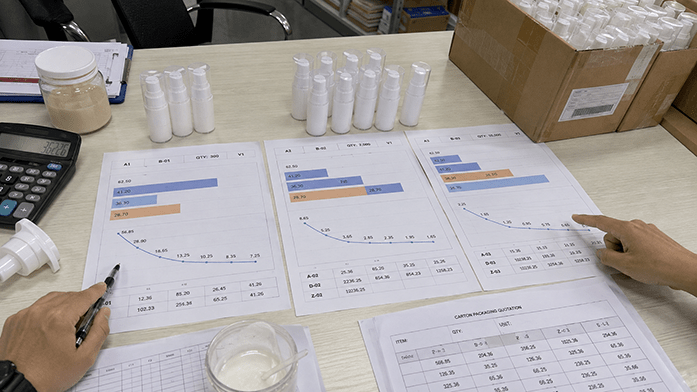
This is why custom formulation and custom packaging orders typically require more than 2,000 pieces — and why color cosmetics often require 6,000–12,000 pieces, personal care 2,000–6,000, and premium or complex packaging 12,000 or more. These ranges are not a manufacturer being difficult. They are the volume at which the cost structure works for both sides.
What to ask before you trust a low minimum — screening the manufacturer, not just the number
A clear, category-appropriate minimum is a signal that a manufacturer understands their own cost structure and runs a real operation. A low minimum is not automatically fraud — but it should trigger questions, not relief.
Key Takeaway: Treat the MOQ as a screening signal. Use the table below to test whether a low minimum is masking compromises, then confirm packaging source, testing scope, and batch traceability before you commit.
| Signal | What it may indicate | Question to ask |
|---|---|---|
| "Low minimum, any quantity" | Generic stock packaging, or costs hidden in the unit price | "Where does my packaging come from, and what is the decoration minimum?" |
| Unusually low price at low volume | Testing or documentation being skipped | "What testing is included, and can I see a sample batch record?" |
| Vague answers on lead time | Your order slotted around larger runs or outsourced | "What production slot does my order get, and how is it scheduled?" |
| No batch traceability | Factory lacks GMP-level documentation | "Can you trace a finished unit back to its raw material lots?" |
| MOQ far below category norms | May be a trading company reselling, not manufacturing | "Do you manufacture in-house, and can I see the line?" |
When we screen a manufacturer for a custom project, three questions matter more than the number itself. Ask where the packaging comes from and what the decoration minimum is — if the manufacturer cannot answer, they are almost certainly using generic stock, and your "custom" product will look like everyone else's. Ask what testing is in the quote and whether a sample batch record is available; stability, microbiological, and preservative challenge testing should be part of the package, not extras. Ask whether the manufacturer can trace a finished unit to its raw material lots, production date, and test results — this is baseline ISO 22716 documentation, and without it a recall or retailer audit becomes difficult to defend.
Manufacturers who state clear minimums and can explain the reasoning are giving you information you can build a brand on. A supplier who promises a small run of a custom product at a low price is losing money on your order, marking up the unit price dramatically, or cutting something you have not been told about yet.
If you are weighing manufacturers for a custom launch, the highest-value step is a readiness check before any deposit. Map the packaging route, the formula requirements, and your target market's compliance obligations, then ask the supplier to walk you through each upstream minimum in writing. A low minimum that survives that exercise is real. One that dissolves under the first question was never a starting point — it was the trap.