
You want to launch a hit tinted serum, but your samples are failing. This guide shows you the hidden formulation traps and how to avoid costly mistakes before production.
Creating a custom tinted serum is complex because it involves balancing unstable ingredients. Water-based skincare actives and oil-coated pigments naturally separate.1 Success requires advanced stabilizers, a robust preservative system, and testing the formula with its final packaging from the very beginning to ensure stability and performance.
A great tinted serum looks effortless on a store shelf, but getting it there is a different story. Many brands I work with underestimate the technical challenges involved. They think it's a simple mix of two existing products. This assumption often leads to months of delays and wasted development costs. Let's break down the common traps I see every day, so you can plan your project with more realistic expectations and make better decisions from the start.
Are Skincare Actives and Cosmetic Pigments a Bad Mix?
You have a best-selling serum and want to add pigment for light coverage. But when the lab samples arrive, they are gritty, separated, or the color looks wrong.
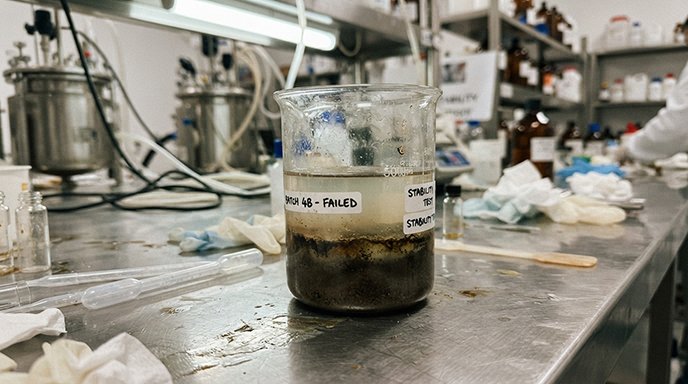
Yes, they often make a bad mix without expert formulation. Water-soluble actives like Hyaluronic Acid and oil-coated pigments like Iron Oxides naturally repel each other. This causes instability, leading to separation, a gritty texture, or color shifts unless specialized emulsifiers and stabilizers are used.
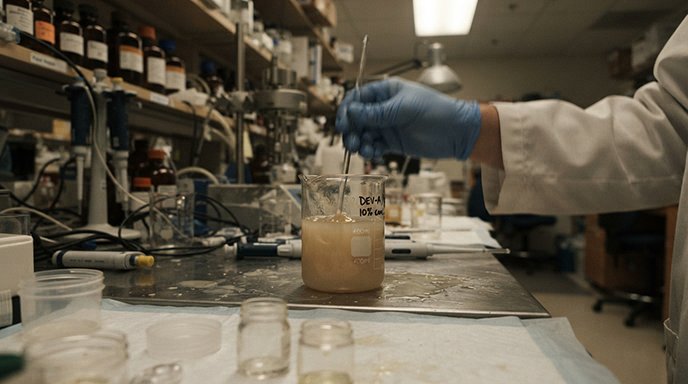
This is the most common pitfall I see. A brand founder will come to us with a product brief and say, "Let's take our popular hydrating serum and just add 10% pigment." On paper, it sounds simple. In the lab, it's a recipe for failure. The core issue is a chemical clash between the two main components. Most powerful skincare actives are water-soluble (hydrophilic)2, while the cosmetic pigments used for color are almost always coated to be oil-soluble (hydrophobic)3. When you try to force them together without the right technology, they fight each other. The formula's emulsion breaks, causing the water and oil phases to separate. This isn't just a cosmetic problem; it can also affect the pH of the formula, which might deactivate the skincare actives4 you wanted in the first place.
The Formulation Conflict
| Component | Solubility | Common Goal | The Problem |
|---|---|---|---|
| Skincare Actives | Water-Soluble (Hydrophilic) | Hydration, brightening, anti-acne | Repels oil-coated pigments |
| Cosmetic Pigments | Oil-Soluble (Hydrophobic) | Even skin tone, coverage | Repels water-based serum |
Solving this requires more than just a standard emulsifier. It demands a deep understanding of interfacial chemistry to select stabilizers that can effectively bridge the gap between water and oil phases in a very thin, fluid system.
How Do You Keep Pigments from Sinking in a Runny Serum?
You want your product to feel like a weightless, watery serum. But after a few weeks, all the heavy pigments have settled into a sludge at the bottom of the bottle.
To prevent pigments from sinking in a thin formula, you must use advanced rheology modifiers. These ingredients build an invisible structural network to suspend the pigments. The key is finding a modifier that provides stability without making the serum feel sticky, heavy, or slimy on the skin.
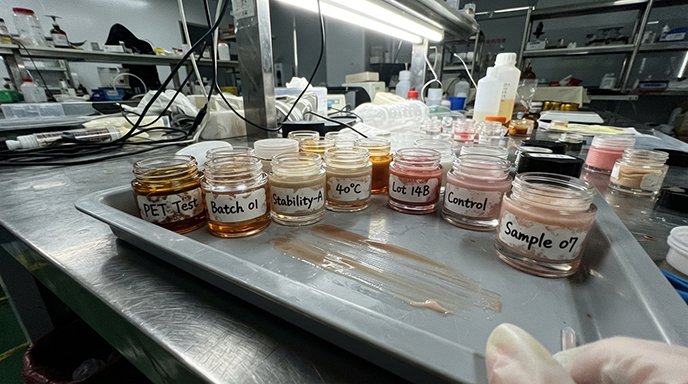
This is a physics problem. Mineral pigments like titanium dioxide and iron oxides are dense particles. In a low-viscosity liquid like a serum, gravity will always pull them down.5 To defy gravity, formulators use rheology modifiers to build a 'scaffold' within the formula.6 This internal structure holds the pigments in place when the product is sitting still in the bottle. A common mistake is using a simple thickener at a high concentration to solve this. While it might stop the pigments from settling, it often ruins the sensory experience, resulting in a product that feels tacky or stringy. The goal is to create what’s known as a "shear-thinning" system.7 This means the product is almost gel-like in the bottle but instantly thins out and becomes fluid when you shake it or spread it on your skin. Achieving this perfect balance is a signature of a well-formulated tinted serum.
The Suspension Trade-Off
| Rheology Modifier | Suspension Power | Sensory Feel | Common Issue |
|---|---|---|---|
| Simple Gums | Medium | Can be tacky/slimy | Ruins "weightless" feel |
| Natural Clays | High | Smooth but can feel "dry" | Needs careful processing |
| Polymeric Thickeners | High | Excellent, light feel | Can be costly, synthetic |
Finding the right system requires extensive testing to balance long-term stability with the desired lightweight, serum-like application.
Can Pigments Make Your Skincare Actives and Preservatives Useless?
Your formula includes great skincare actives and passes initial safety checks. But months later, it fails microbial testing, and you find the active ingredients are no longer effective.
Yes, pigments can deactivate other ingredients. Their large surface area can attract and bind to skincare actives and preservatives, a process called adsorption.8 This makes the actives ineffective and weakens the preservative system, leaving the product vulnerable to contamination and failing required safety tests.
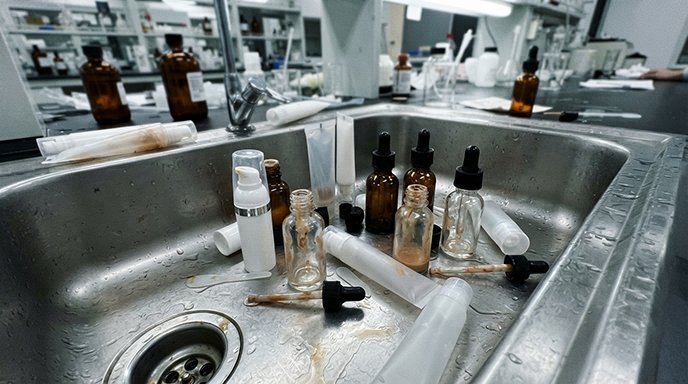
This is an invisible risk that can ruin a product launch. Think of pigment particles as tiny magnets. Their surfaces have an electrical charge that can attract and hold onto other molecules in the formula. When this happens to a skincare active, like Vitamin C or Salicylic Acid, the active becomes "stuck" to the pigment and is no longer free to work on the skin. The more dangerous issue is when this happens to preservatives. If the preservative molecules are bound to the pigments, they cannot move freely through the formula to kill bacteria, yeast, and mold.9 Your product might look, feel, and smell perfect, but it could be microbiologically unsafe. This is why Preservative Efficacy Testing (PET), also known as a challenge test, is absolutely essential for hybrid formulas.10 The formulator must anticipate this risk and may need to use a specialized preservative system or adjust concentrations to ensure the product remains safe and effective throughout its shelf life.
Why Must Packaging and Formulation Be Developed Together?
You finally perfected your tinted serum formula after months of lab work. You pour it into a standard dropper bottle, only to find that it clogs, leaks, and leaves a messy ring.
Packaging and formulation must be tested together because tinted serums are notoriously difficult to dispense. The wrong packaging can cause clogging, leaking, or even break the formula's emulsion. Choosing and compatibility-testing the right component, like an airless pump, early on prevents costly reformulations.

I call this the "last-mile" failure. A perfect formula is useless if the customer can't get it out of the bottle correctly. Tinted serums are a nightmare for many standard packaging options. Dropper bottles are a popular choice for serums, but with a tinted formula, the pigments can settle in the glass pipette or clog the narrow opening.11 The suction can also separate the formula's delicate emulsion over time. Standard lotion pumps often "spit" a product with this unique viscosity and can dry out, leaving a crusty clump of pigment at the nozzle. This is why you cannot treat packaging as an afterthought. It must be part of the R&D process from the beginning. We run compatibility tests where we fill the final packaging options with the formula and put them through cycles of heating, freezing, and vibration to simulate shipping and daily use.12 This ensures the packaging doesn't leak, clog, or cause the formula to break before you commit to producing thousands of units.
Common Packaging Risks for Tinted Serums
| Packaging Type | Potential Risk | Why It Happens |
|---|---|---|
| Glass Dropper | Clogging, messy neck, separation | Pigment settles in bulb and pipette |
| Standard Pump | Spitting, clogging, inconsistent dose | Viscosity is too thin for the mechanism |
| Airless Pump | Generally good, but needs testing | Must match the pump engine to formula viscosity |
| Squeeze Tube | Separation, messy cap | Water phase can separate and leak out first |
Conclusion
Creating a successful tinted serum is a technical challenge. It demands careful planning, rigorous stability testing, and integrating formulation with packaging decisions from the very beginning of your project.
"Advances in emulsion stability: A review on mechanisms, role of ...", https://pmc.ncbi.nlm.nih.gov/articles/PMC12311586/. Provides a foundational overview of emulsion instability and phase separation in cosmetic chemistry. Evidence role: mechanism; source type: paper. Supports: Explains the thermodynamic instability of water-in-oil and oil-in-water emulsions.. Scope note: Focuses on general emulsions rather than specific tinted serum formulations. ↩
"The Roles of Vitamin C in Skin Health - PMC", https://pmc.ncbi.nlm.nih.gov/articles/PMC5579659/. Details the chemical properties and water solubility of prevalent skincare actives such as ascorbic acid and hyaluronic acid. Evidence role: general_support; source type: encyclopedia. Supports: Supports the classification of common skincare actives as hydrophilic.. ↩
"Titanium dioxide in our everyday life; is it safe? - PMC", https://pmc.ncbi.nlm.nih.gov/articles/PMC3423755/. Examines the use of silanes and silicones in coating mineral pigments to enhance their dispersion in the oil phase of cosmetic emulsions. Evidence role: mechanism; source type: paper. Supports: Describes the surface treatment of cosmetic pigments to increase hydrophobicity.. ↩
"Chemical Stability of Ascorbic Acid Integrated into Commercial ...", https://pmc.ncbi.nlm.nih.gov/articles/PMC8773188/. Highlights how fluctuations in formulation pH can accelerate the degradation of sensitive hydrophilic actives like L-ascorbic acid. Evidence role: mechanism; source type: paper. Supports: Demonstrates the pH-dependent stability of skincare actives.. Scope note: Specific to ascorbic acid rather than all skincare actives. ↩
"Designing Titanium Dioxide Aqueous Dispersion with High Solid ...", https://pmc.ncbi.nlm.nih.gov/articles/PMC12019455/. Outlines the physical principles of sedimentation, confirming that high-density particles like titanium dioxide will rapidly settle in low-viscosity media. Evidence role: mechanism; source type: encyclopedia. Supports: Explains Stokes' Law and particle sedimentation.. ↩
"a hidden potential of the alginates as thickeners and gelling agents", https://pubmed.ncbi.nlm.nih.gov/34403151/. Discusses how polymeric and clay-based rheology modifiers establish a micro-structural network to prevent the sedimentation of insoluble particles. Evidence role: mechanism; source type: paper. Supports: Details the mechanism of rheology modifiers in creating yield stress.. ↩
"Rheological and Viscoelastic Analysis of Hybrid Formulations ...", https://pmc.ncbi.nlm.nih.gov/articles/PMC10610526/. Explains the rheological profile of shear-thinning fluids, which maintain high viscosity at rest for stability but exhibit reduced viscosity under application shear. Evidence role: definition; source type: paper. Supports: Defines shear-thinning (pseudoplastic) behavior in cosmetics.. ↩
"Cosmetics Preservation: A Review on Present Strategies - PMC", https://pmc.ncbi.nlm.nih.gov/articles/PMC6099538/. Investigates the physical adsorption of antimicrobial agents onto the high-surface-area particles of titanium dioxide and iron oxides in cosmetic suspensions. Evidence role: mechanism; source type: paper. Supports: Provides evidence of preservative adsorption onto mineral pigments.. ↩
"Cosmetics Preservation: A Review on Present Strategies - PMC", https://pmc.ncbi.nlm.nih.gov/articles/PMC6099538/. Demonstrates that the antimicrobial efficacy of a preservative system is dependent on its unbound concentration in the continuous aqueous phase. Evidence role: mechanism; source type: paper. Supports: Explains that only the free fraction of preservatives in the aqueous phase is microbiologically active.. ↩
"Comparison of Compendial Antimicrobial Effectiveness Tests - PMC", https://pmc.ncbi.nlm.nih.gov/articles/PMC3066379/. References ISO 11930 guidelines, which mandate the evaluation of the antimicrobial protection of a cosmetic product through challenge testing. Evidence role: expert_consensus; source type: institution. Supports: Cites the international standard for preservative efficacy testing.. ↩
"The effect of particle shape on discharge and clogging - PMC - NIH", https://pmc.ncbi.nlm.nih.gov/articles/PMC7870973/. Analyzes the flow dynamics of dense suspensions, noting that particle aggregation can lead to bridging and subsequent clogging in narrow dispensing tubes. Evidence role: mechanism; source type: paper. Supports: Describes the mechanics of particle bridging and clogging in narrow orifices.. Scope note: Focuses on general fluid dynamics rather than specific cosmetic dropper designs. ↩
"[PDF] Guidance for Industry Q1A(R2) Stability Testing of New Drug ... - FDA", https://www.fda.gov/media/71707/download. Details industry-standard stability testing procedures, including freeze-thaw cycling and mechanical vibration, to predict the long-term physical integrity of cosmetic formulations. Evidence role: expert_consensus; source type: institution. Supports: Outlines standard accelerated stability testing protocols for cosmetics.. ↩