Are you struggling to translate your brilliant beauty product concept into a stable, effective, and market-ready formula? Many brand founders are frustrated when their lab samples separate, change color, or fail to deliver on their promises. Understanding the science behind cosmetic formulation is the critical first step to bridging the gap between a creative vision and a commercially viable product.
The science behind cosmetic formulation is a strategic business process focused on risk management. It involves balancing the marketing appeal of active ingredients with the complex realities of formula stability, ingredient compatibility, user safety, regulatory compliance, and the physical constraints of large-scale manufacturing. It is a discipline of synergy and precision, not simply mixing high concentrations of trendy ingredients.
This balance is far more delicate than most people realize. A formula that looks perfect on paper can easily fail in the lab, and a sample that's stable in a beaker can break during mass production. Let's explore the critical scientific challenges you must navigate to turn your idea into a successful product.
What's Wrong with the 'Hero Ingredient' Approach to Cosmetic Formulation?
Does your product development brief start and end with a high percentage of a single, trending "hero ingredient"? While this is great for marketing, it often creates a cascade of chemical and commercial problems.
The allure is understandable: build a story around 15% Vitamin C or 10% Niacinamide. The problem is that cosmetic chemistry is a game of synergy, not brute force. Simply cramming in a high concentration of one active can completely destabilize the entire system.
Dive Deeper: The Law of Diminishing Returns
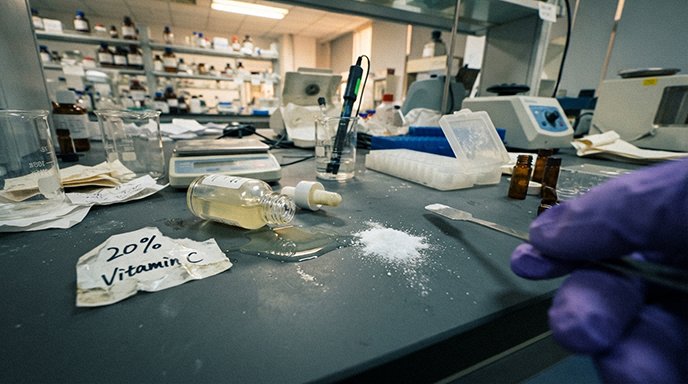
In our consulting sessions with beauty brands, we often see formulation sheets that prioritize marketing claims over chemical stability. A founder might demand a 20% concentration of an active because a competitor claims 15%. However, this approach ignores several fundamental principles of cosmetic science.
- Solubility and Saturation: Every ingredient has a solubility limit in a given base1 (like water or oil). Exceeding this limit doesn't make the product more potent; it just causes the active ingredient to "crash out" of the solution, forming crystals or sediment. The product becomes gritty, aesthetically unpleasing, and less effective, as the active is no longer bioavailable to the skin.
- Optimal pH and Irritation: Many active ingredients are only effective and stable within a very narrow pH range. For example, L-Ascorbic Acid (a form of Vitamin C) requires a very low pH (below 3.5) to be effective2. While great for the ingredient, a pH that low can be highly irritating to the skin for many users. A skilled formulator must buffer the system to find a balance between the active's stability and the final product's safety and feel.
- Formula Integrity: High concentrations of certain actives can disrupt the emulsifiers, thickeners, and stabilizers that create your product's texture. We’ve seen beautiful, silky cream concepts turn into a separated mess of water and oil simply because the percentage of an acid or botanical extract was too high for the emulsification system to handle.
A better approach is to define the desired effect first. Do you want brightening, hydration, or barrier repair? A good formulator can then achieve that goal by combining multiple synergistic ingredients at lower, more stable, and safer concentrations. For example, a 1% Bakuchiol and 2% Niacinamide formula might outperform a harsh 1% Retinol formula for certain skin types, with far fewer stability and irritation risks.
How Does Ingredient Incompatibility Challenge the Science Behind Cosmetic Formulation?
Are you asking your lab to combine multiple popular actives into one "do-it-all" serum? This can be a minefield of conflicting chemistry, where ingredients work against each other, leading to inactivation, instability, or even skin damage.
Managing ingredient conflict is at the core of the science behind cosmetic formulation. A formulator's job is not just to add ingredients, but to ensure they can coexist peacefully and effectively within the same bottle, from the production line all the way to the customer's shelf.
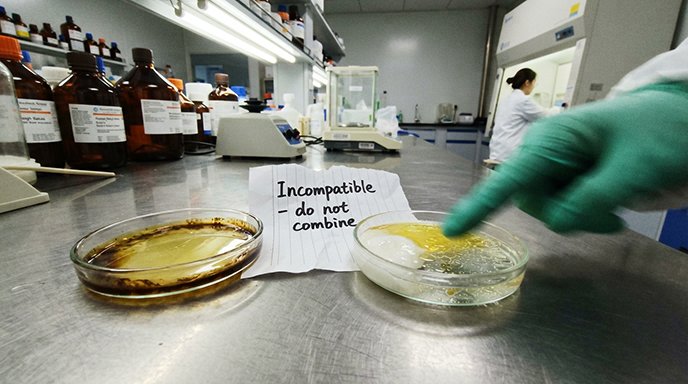
Dive Deeper: The Incompatibility Matrix
When evaluating a third-party formula, our first question is always about potential ingredient conflicts. Brand founders are often surprised to learn that some of their favorite actives are mortal enemies in a formulation context. While a dermatologist might recommend using these ingredients at different times of the day, mixing them in one product is a different story.
Here are some common conflicts we see:
| Ingredient Combination | The Potential Problem | The Formulation Solution |
|---|---|---|
| Vitamin C (L-Ascorbic Acid) + Niacinamide | At low pH, these can form nicotinic acid, causing redness and flushing3. They work best at different pH levels, making one or both less effective in a single formula. | Formulate separately, or use advanced encapsulation technologies or derivative forms of Vitamin C that are stable at a higher pH (e.g., Sodium Ascorbyl Phosphate). |
| AHAs/BHAs (e.g., Glycolic Acid) + Retinol | Both can be irritating on their own. Combining them in a high-strength formula can over-exfoliate the skin, leading to a compromised skin barrier4, redness, and peeling. | This is more of a usage conflict than a chemical one, but formulators must be cautious. A responsible formula might use a very low concentration of one, or use gentler alternatives. |
| Copper Peptides + Vitamin C (L-AA) | The acidic environment required by L-Ascorbic Acid can break down the copper peptides, rendering them useless. The copper ions can also accelerate the oxidation of the Vitamin C5. | Formulate with Vitamin C derivatives that work at a neutral pH, or keep them in separate products. |
| Oil-Based Actives + Water-Based Formulas | This is a classic challenge. Without a proper emulsification system, oils like CBD or certain oil-soluble vitamins will separate from a water-based gel or serum. | Requires a robust and stable emulsifier, and the homogenization process during scale-up must be precise to create and maintain tiny, evenly-dispersed oil droplets. |
Understanding this "incompatibility matrix" is crucial for managing your expectations and product development timeline. It's not about saying "no" to your ideas; it's about finding scientifically sound ways to achieve them, whether through different active forms, advanced delivery systems, or a multi-product regimen.
Why is Stability a Non-Negotiable Part of the Science Behind Cosmetic Formulation?
Have you been tempted by the "preservative-free" marketing trend? While it sounds appealing, launching an improperly preserved water-based product is one of the biggest safety and financial risks a brand can take.
A core pillar of the science behind cosmetic formulation is ensuring the product remains safe and stable for its entire lifecycle. Without a robust preservation system, your beautiful, natural formula can quickly become a breeding ground for bacteria, yeast, and mold.
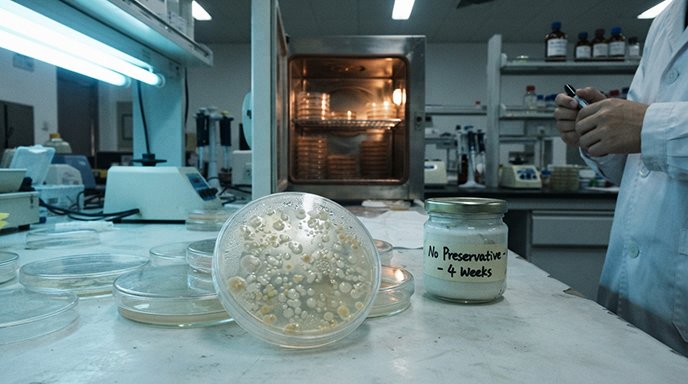
Dive Deeper: Preservation is a Safety Imperative
The demand for "clean" and "natural" beauty has put immense pressure on formulators to remove traditional, time-tested preservatives like parabens and phenoxyethanol. However, this demand is often not accompanied by an understanding of the consequences. Every cosmetic product containing water (which includes most creams, lotions, serums, and toners) is a potential microbial habitat6.
Here's what happens without effective preservation:
- Microbial Contamination: Bacteria, mold, and yeast can be introduced during manufacturing or, more commonly, by the consumer dipping their fingers into a jar. This contamination can lead to nasty skin infections, eye infections, and other health issues.
- Product Spoilage: The formula can separate, change color, develop a bad odor, or shift in pH. This not only ruins the customer experience but also degrades the active ingredients, making the product useless.
To prevent this, every new formulation must undergo Preservative Efficacy Testing (PET)7, also known as a "challenge test." In this test, the lab deliberately introduces high concentrations of various microbes into the product and measures how effectively the preservation system kills them off over 28 days.
Many brands ask for "natural" preservatives. While options like caprylyl glycol, certain essential oils, or radish root ferment filtrate8 exist, they come with trade-offs:
- They are often "broad-spectrum-ish," not truly broad-spectrum, meaning they may be effective against some bacteria but weak against mold or yeast. This often requires combining multiple natural preservatives, increasing cost and the potential for skin sensitization.
- They can be highly pH-dependent and may destabilize the formula's texture or color.
- They can be much more expensive than traditional, highly effective preservatives used at very low concentrations (e.g., <1%).
Your choice of packaging is also part of the preservation strategy. An open-mouthed jar is the highest-risk format, while an airless pump dispenser9 is the best, as it minimizes the product's exposure to both air and fingers. Effective formulation science is not about being "preservative-free," but about being responsibly and effectively preserved.
How Does Manufacturing Scale-Up Impact Cosmetic Formulation Science?
Did your final production batch look, feel, or smell different from the perfect lab sample you approved? This is a common and costly problem caused by ignoring the "scale-up chasm."
A formula that is perfectly stable in a 100ml glass beaker can fail catastrophically when you try to produce it in a 1,000kg stainless steel tank. The science behind cosmetic formulation must therefore account for the physics and mechanics of factory production from day one.
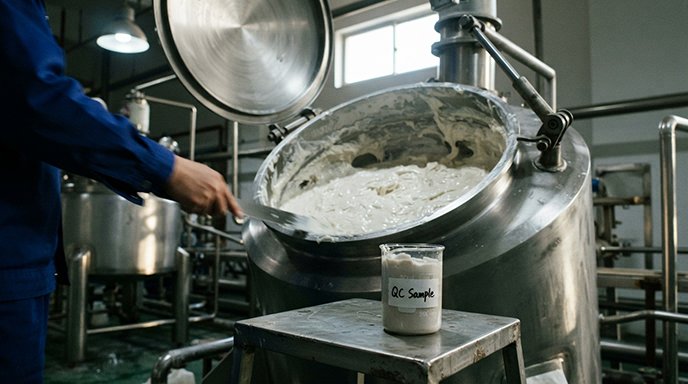
Dive Deeper: From Beaker to Batch
When we develop a formula, we are always thinking about the scale-up process. The transition from a lab bench to a production floor introduces dramatic changes in physical forces, thermal dynamics, and environmental exposure.
Here’s why a lab sample isn't a guarantee of production success:
- Shear Forces10: In the lab, a chemist might gently mix an emulsion with a small propeller. In the factory, a massive blade or high-shear homogenizer whips the batch with incredible force. This energy can "break" a fragile emulsion, destroying the product's texture. The formula must be robust enough to withstand this.
- Heating and Cooling: Cooling a 100ml beaker from 80°C takes minutes. Cooling a one-ton batch can take hours11. During this extended cooling period, certain ingredients might crystallize, the viscosity can change unexpectedly, or the emulsion might separate. The formula's cooling curve must be predictable and manageable at scale.
- Ingredient Addition Order: In the lab, a chemist adds ingredients precisely and slowly. On the factory floor, bags of powder and drums of liquid are added. The order of operations and the rate of addition are critical. Adding an ingredient at the wrong time or temperature can ruin the entire batch.
- Transfer and Filling: The finished product must be pumped through hoses and into a filling machine. This journey can introduce more shear stress. A thick cream might be perfect in the tank but too viscous to be filled into tubes without creating air pockets or breaking the emulsion.
A good manufacturing partner will perform pilot batches12 (e.g., 25-50kg) to test the formula under production-like conditions before committing to a full-scale run. This step is essential for identifying and solving scale-up issues early. When you're assessing a manufacturer, always ask about their scale-up and pilot batch process. It's a key indicator of their technical expertise and commitment to your product's quality.
Frequently Asked Questions
How long does cosmetic formulation take?
The timeline varies significantly. A simple modification to a pre-existing base (private label) might take 2-4 weeks for sampling. A fully custom formula developed from scratch can take anywhere from 3 to 12 months or more, depending on the complexity of actives, stability testing requirements, and regulatory hurdles.
Can I bring my own formula to a manufacturer?
Yes, this is known as Toll Manufacturing. However, the manufacturer's technical team will need to thoroughly review your formula sheet for feasibility, stability, safety, and scalability. Be prepared for them to recommend adjustments to ensure it can be produced safely and consistently in their facility.
What's the difference between a private label and a custom formula?
A private label (or white label) formula is a pre-existing, lab-tested base owned by the manufacturer. You can customize it with different fragrances, colors, or by adding certain pre-approved active ingredients. A custom formula is developed exclusively for your brand from the ground up, giving you unique intellectual property but requiring a much larger investment in time and R&D.
Why did my lab sample look different from the final production batch?
This is almost always a scale-up issue. The differences in heating/cooling rates, mixing energy (shear), and ingredient dispersion between a small lab beaker and a large production tank can cause slight to significant variations in viscosity, color, or emulsion stability. This is why pilot batches are a critical risk-reduction step.
Conclusion
Ultimately, the science behind cosmetic formulation is not an abstract academic exercise; it is the practical and essential discipline of managing risk in your beauty business. It requires a delicate balance between a compelling marketing story and the unyielding laws of chemistry, physics, and biology. From managing the "hero ingredient" fallacy and navigating ingredient incompatibilities to ensuring robust preservation and planning for the scale-up chasm, every decision impacts your final product's safety, efficacy, and commercial success. Viewing your formulator or manufacturing partner as a strategic consultant in this process is the key to launching a product that is not only beautiful in concept but also stable, compliant, and beloved by your customers.
If you are a brand founder ready to move from a product idea to a commercially sound formulation, we can help. Camellia Labs works with international brands to navigate these complexities and make realistic decisions for developing products that are ready for your target market. Contact us to discuss your project and build a formula that works, from the beaker to the bottle.
"Safety Assessment of Inorganic Hydroxides as Used in ...", https://www.accessdata.fda.gov/drugsatfda_docs/omuf/order/supportDoc/OTC000039/3.3_Literature_References/rev_cir-2015-sodium-hydroxide_090026f88e12645d.pdf. This is governed by fundamental physical chemistry principles where exceeding the saturation solubility of an active in a specific vehicle leads to crystallization. Evidence role: mechanism; source type: paper. Supports: the physical chemistry principle that active ingredients have specific solubility limits in cosmetic bases. ↩
"Evaluation and Definition of Potentially Hazardous Foods", https://www.fda.gov/files/food/published/Evaluation-and-Definition-of-Potentially-Hazardous-Foods.pdf. Research indicates that topical L-ascorbic acid must be formulated at a pH below 3.5 to ensure adequate stability and skin penetration. Evidence role: expert_consensus; source type: paper. Supports: the requirement of a pH below 3.5 for optimal L-ascorbic acid stability and skin absorption. ↩
"Mixing Medications and Dietary Supplements Can ...", https://www.fda.gov/consumers/consumer-updates/mixing-medications-and-dietary-supplements-can-endanger-your-health. While niacinamide can hydrolyze into nicotinic acid under highly acidic conditions over time, this reaction typically requires extreme heat or prolonged exposure to very low pH. Evidence role: mechanism; source type: paper. Supports: the chemical interaction between niacinamide and ascorbic acid at low pH levels. Scope note: The rate of this conversion in standard commercial cosmetic shelf-lives remains a subject of ongoing formulation debate. ↩
"Report on the Use of PFAS in Cosmetic Products and ...", https://www.fda.gov/media/190319/download?attachment. Dermatological studies show that simultaneous application of strong acids and retinoids can significantly increase transepidermal water loss (TEWL) and induce barrier irritation. Evidence role: mechanism; source type: paper. Supports: the potential for skin barrier disruption when combining retinoids with acidic exfoliants. ↩
"ORA Lab Manual Vol. IV Section 11 - Nutrient Analysis ( ...", https://www.fda.gov/media/73589/download. Transition metal ions, particularly copper and iron, are well-documented catalysts that accelerate the aerobic oxidation of L-ascorbic acid in aqueous solutions. Evidence role: mechanism; source type: paper. Supports: the catalytic role of copper ions in accelerating the degradation of ascorbic acid. ↩
"ISO 29621:2017(en), Cosmetics — Microbiology", https://www.iso.org/obp/ui/es/#!iso:std:68310:en. According to cosmetic microbiology standards, water-containing formulations provide the high water activity necessary for the proliferation of bacteria, yeasts, and molds. Evidence role: definition; source type: institution. Supports: the high susceptibility of water-based cosmetic formulations to microbial growth. ↩
"Is a Stock Formula Really the Fastest Way to Launch Your ...", https://camellia-labs.com/is-a-stock-formula-really-the-fastest-way-to-launch-your-beauty-product/. Standardized protocols such as USP <51> or ISO 11930 define the specific microbial strains and log-reduction criteria required to pass preservative efficacy testing. Evidence role: expert_consensus; source type: government. Supports: the standardized methodology and necessity of preservative challenge testing in cosmetics. ↩
"January 14, 2021 Trophikos, LLC Paul E. Dryden President ...", https://www.accessdata.fda.gov/cdrh_docs/pdf20/K201922.pdf. While Leuconostoc/radish root ferment filtrate offers mild antimicrobial properties, studies suggest it often requires combination with other boosters to achieve broad-spectrum efficacy. Evidence role: general_support; source type: paper. Supports: the antimicrobial properties and formulation limitations of radish root ferment filtrate. Scope note: Efficacy can vary significantly depending on the overall formulation matrix and pH. ↩
"Why Can't I Put My High-Active Serum in Cheap Stock Packaging?", https://camellia-labs.com/high-active-serum-packaging-compatibility/. Research demonstrates that airless packaging systems significantly reduce consumer-introduced microbial contamination and protect oxygen-sensitive ingredients compared to open jars. Evidence role: general_support; source type: paper. Supports: the role of airless packaging in reducing microbial contamination and oxidation risks. ↩
"What Are the Basic Principles of Cosmetic Formulas?", https://camellia-labs.com/what-are-the-basic-principles-of-cosmetic-formulas/. In industrial processing, excessive or poorly controlled shear energy can alter droplet size distribution, potentially leading to coalescence and emulsion separation. Evidence role: mechanism; source type: paper. Supports: how high-shear forces during industrial scale-up can destabilize cosmetic emulsions. ↩
"Lyophilization of Parenteral (7/93)", https://www.fda.gov/inspections-compliance-enforcement-and-criminal-investigations/inspection-guides/lyophilization-parenteral-793. The slower cooling rates inherent to large industrial vessels can profoundly affect the crystallization kinetics of lipids and the final viscosity of cosmetic creams. Evidence role: mechanism; source type: paper. Supports: the impact of slower cooling rates in large-scale manufacturing on product rheology and crystallization. ↩
"Questions and Answers on Current Good Manufacturing ...", https://www.fda.gov/drugs/guidances-drugs/questions-and-answers-current-good-manufacturing-practice-regulations-production-and-process. Standard cosmetic manufacturing guidelines recommend pilot-scale batches (typically 10% of commercial scale) to validate process parameters before full-scale production. Evidence role: case_reference; source type: other. Supports: the role of pilot batches in bridging the gap between laboratory development and commercial production. ↩