
Cosmetic formulation development services can look simple when a brand only sees the finished serum, cream, lipstick, or body wash. The problem is that many formulas fail outside the lab. That failure becomes expensive when packaging, ingredient MOQs, testing, and target-market rules are checked too late. I prefer to solve those constraints before sampling begins.
Cosmetic formulation development services help beauty brands turn a product concept into a factory-ready formula by aligning performance goals, benchmark references, ingredient feasibility, packaging compatibility, production constraints, testing needs, and target-market compliance checks. The best service is not just “making a formula.” It is guiding commercial decisions before scale-up creates avoidable risk.
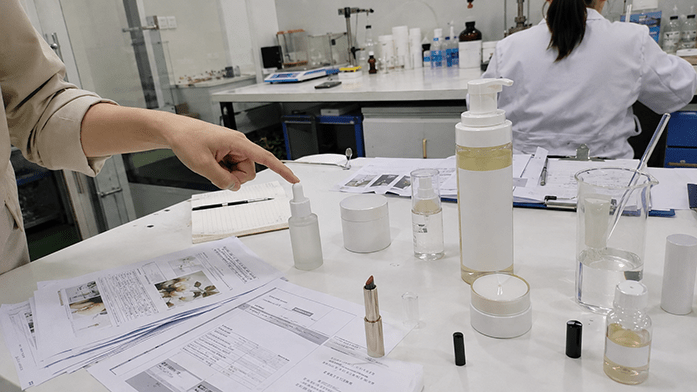
When reviewing client briefs, I often see the same pattern. The marketing idea is strong, but the formula path is not yet manufacturable. The real value comes from connecting R&D, packaging, sourcing, compliance preparation, and production logic early enough to prevent rework.
Why should cosmetic formulation development services start with the commercial brief?
A weak brief creates weak samples. A founder may ask for a “clean, luxury, brightening serum,” but that phrase does not tell a lab enough. The risk is simple. The team may create something beautiful that cannot be packed, claimed, tested, sourced, or produced at the intended volume.
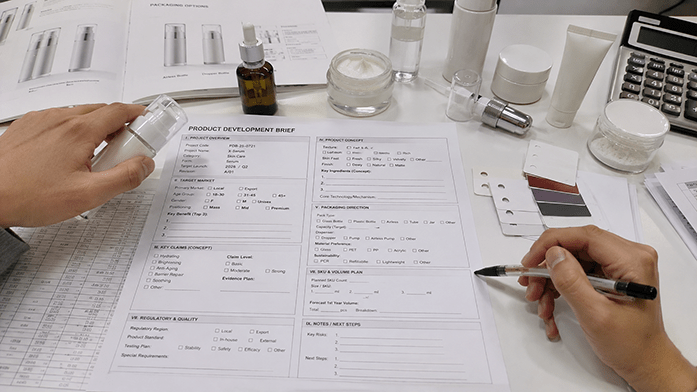
Cosmetic formulation development services should start with a commercial brief because the formula must support a real launch plan. The brief should define the target market, claims direction, texture, benchmark products, packaging route, ingredient restrictions, price position, SKU count, and production expectations before lab work begins.
What I ask before a lab touches the formula
When reviewing client briefs, we often ask practical questions before discussing emulsifiers, preservatives, or active systems. These questions may feel less exciting than ingredient trends, but they protect the project.
I usually want to know:
-
Which market will receive the product first?
A formula intended for the EU, UK, US, GCC, ASEAN, or Australia may need different documentation and ingredient checks1. -
What is the product benchmark?
A benchmark gives the lab a texture, absorption, payoff, fragrance intensity, or sensorial target. -
What claims are planned?
“Hydrating” and “anti-acne” may trigger very different review paths depending on the market. -
What packaging is preferred?
A pump bottle, airless jar, tube, glass dropper, stick, compact, or mascara component changes the formula constraints. -
What volume range is commercially realistic?
A custom formula with niche actives may not fit a very small initial run because raw material suppliers may impose minimum purchase quantities. -
How many SKUs or shades are involved?
One face cream is different from a 12-shade concealer range or a fragrance collection.
The most common bottleneck we resolve in early consultations is not “how to make a formula.” It is how to stop the wrong formula from being developed.
Why the brief changes the formulation route
A formula is not only a technical file. It is a commercial decision. A brand may want a natural extract, a special active, a patented delivery system, or a premium fragrance. Each choice can affect:
| Decision Area | Why It Matters |
|---|---|
| Ingredient sourcing | Specialty ingredients may have supplier MOQs, lead times, grade variations, or documentation limits2. |
| Packaging compatibility | Oils, solvents, acids, pigments, and fragrances may interact with pumps, plastics, liners, or coatings3. |
| Stability testing | Texture, color, odor, viscosity, separation, and microbial risk must be evaluated under relevant conditions4. |
| Claims support | Marketing wording may require evidence, careful phrasing, or market-specific review. |
| Production scale-up | A lab sample may not behave the same in larger mixing equipment. |
| Labeling preparation | INCI names, allergens, warnings, directions, and market language may need early planning. |
I have seen brands spend too much time debating a hero ingredient before checking whether that ingredient is compatible with their target market and budget. That sequence creates frustration. A better sequence is simple:
- Define the market and claim direction.
- Select the benchmark and sensory target.
- Screen ingredients and restrictions.
- Check packaging route.
- Discuss realistic production assumptions.
- Then begin formulation sampling.
This approach does not make the creative process less exciting. It makes it more useful. A strong brief allows cosmetic formulation development services to produce samples that are closer to launch reality, not just attractive lab prototypes.
Are cosmetic formulation development services better when you customize a benchmark formula?
Many founders want a 100% custom formula because they believe uniqueness must start from zero. The problem is that “from scratch” can create more unknowns than value. It may increase testing risk, sourcing complexity, stability concerns, and revision cycles before the brand has confirmed market demand.
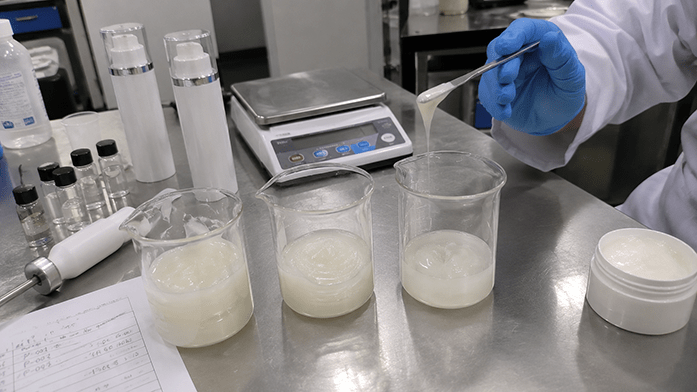
Cosmetic formulation development services are often more efficient when they optimize a proven benchmark or library base formula. This route can preserve brand differentiation through texture, active positioning, fragrance, claims direction, packaging, and storytelling while reducing avoidable formulation risk compared with building every system from the ground up.
The custom vs. benchmark trap
The “custom vs. benchmark” debate is one of the first conversations I have with international founders. Many clients come to us with the sentence: “We need something completely unique.” I understand the instinct. Beauty is competitive. No one wants to launch a product that feels generic.
However, a formula can be differentiated in several ways:
- Texture and skin feel
- Active ingredient combination
- Fragrance or no-fragrance strategy
- Finish, payoff, or absorption speed
- Packaging experience
- Claim architecture
- Target consumer positioning
- Hero ingredient story
- Product system within a routine
A formula does not always need to start from a blank page to feel proprietary to the consumer.
Why a benchmark base can reduce risk
A benchmark or library formula is not the same as a finished private label product. It can be a tested starting point that the R&D and manufacturing team already understands. From there, the brand can request controlled modifications.
Common adjustments include:
-
Changing the sensory profile
For example, a cream can move from rich and cushiony to lighter and fast-absorbing. -
Adjusting the active system
The team can add, remove, or rebalance ingredients after checking stability and compliance considerations. -
Changing fragrance direction
A product may become fragrance-free, allergen-managed, botanical, clean-smelling, or more premium. -
Reworking color or finish
This matters for color cosmetics, tinted skincare, body glow products, and hybrid makeup. -
Aligning with packaging
The viscosity can be adjusted for pumps, tubes, jars, sticks, droppers, or airless systems.
When fully custom development makes sense
A fully custom route can be appropriate when the product has a technical reason to exist. For example, a brand may need:
- A specific delivery format
- A special texture not found in current references
- A new active system
- A fragrance or sensorial signature
- A performance goal that cannot be met through existing bases
- A strict ingredient philosophy that excludes common formulation tools
But the brand should enter that route with realistic expectations. Fully custom formulation can require more rounds of screening, reformulation, compatibility checks, and supplier coordination. It also may expose the brand to hidden MOQ pressure from specialized ingredients.
I usually tell founders this: “Custom is not automatically better. Controlled customization is often smarter.”
The strongest approach is often a hybrid. Start with a proven technical structure, then customize the parts that matter to the consumer and the brand strategy. That is where cosmetic formulation development services become commercially useful. They help the brand avoid paying for complexity that does not improve launch quality.
Why must cosmetic formulation development services include packaging compatibility?
A formula developed without packaging is only half a product. The problem appears later when the serum oxidizes in clear glass, the lotion clogs the pump, the fragrance softens a plastic component, or pigments stain the applicator. At that stage, every revision becomes slower and more expensive.
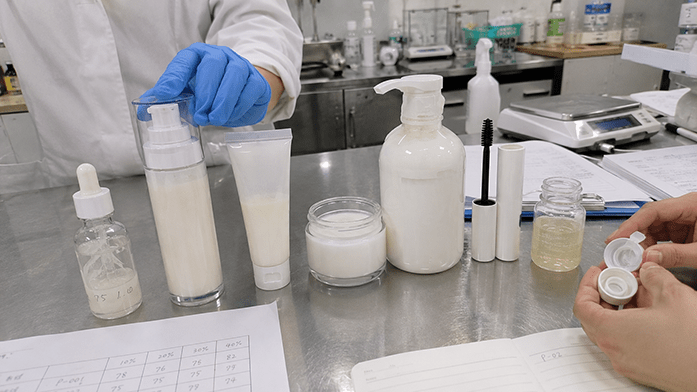
Cosmetic formulation development services must include packaging compatibility because formula and packaging are codependent. Ingredients can react with plastics, coatings, pumps, wipers, caps, liners, adhesives, or glass exposure. Packaging can also affect dispensing, oxidation, microbial risk, stability, user experience, labeling space, and shipping performance.
Formula and packaging are one system
I often see brands choose packaging from a catalog first because it looks premium. That is understandable. Packaging sells the product before the first application. But in product development, packaging is not only visual. It is functional.
A formula can behave differently depending on:
- Air exposure
- Light exposure
- Pump spring and gasket materials
- Tube barrier properties
- Dropper bulb compatibility
- Jar opening size
- Wiper tightness for mascara or lip products
- PCR plastic composition
- Inner coating quality
- Hot-fill or cold-fill requirements
- Shipping temperature swings
For example, a botanical oil blend may look beautiful in clear glass, but light exposure can accelerate oxidation if the formula is sensitive5. A formula with certain solvents or fragrance components may not suit some plastic parts. A high-viscosity lotion may need a pump with stronger dispensing force6. A mineral SPF or pigment-rich product may require special attention to sedimentation, shaking behavior, or nozzle performance7.
Why packaging decisions should start early
Packaging compatibility should not be treated as a final check after the “real formula” is finished. It should influence formulation development from the beginning.
Here is a practical comparison:
| Development Sequence | Common Result |
|---|---|
| Formula first, packaging later | Higher risk of incompatibility, dispensing failure, oxidation, leakage, or reformulation. |
| Packaging first, formula later | Higher risk that visual packaging limits formula performance or ingredient choices. |
| Formula and packaging developed together | Better alignment between texture, stability, filling, dispensing, claims, and consumer use. |
A good project process usually includes:
-
Packaging intention review
The team checks whether the packaging concept fits the formula type. -
Material and component screening
The team reviews plastics, glass, pumps, caps, liners, coatings, and applicators where relevant. -
Formula viscosity and flow checks
The product must dispense consistently under expected use conditions. -
Compatibility observation
The team monitors color, odor, separation, swelling, leakage, staining, corrosion, and closure performance. -
Label and regulatory space check
Packaging must hold required information for the target market.
Why PCR and premium packaging require caution
More brands now request PCR plastics, refillable systems, metalized finishes, and premium custom components. These choices can be excellent for brand positioning, but they can add technical constraints.
For example:
- PCR plastics may vary more than virgin plastics depending on source and grade.
- Refillable systems may need careful closure and hygiene thinking.
- Metalized parts may raise compatibility questions with acidic or solvent-rich formulas.
- Decorated components may face rubbing, leakage, or migration concerns.
- Luxury pumps may require volume planning and supplier coordination.
This is why I avoid treating packaging as a purchasing task only. Packaging is part of formulation strategy. Strong cosmetic formulation development services should help the brand connect the packaging route with the formula route before orders are placed.
Can cosmetic formulation development services solve raw material MOQ bottlenecks?
A factory may accept a production discussion, but the raw materials can still block the project. The founder may choose a rare active, biotech ingredient, natural extract, pigment, or fragrance that sounds perfect on the product page. Then the supplier MOQ changes the entire production plan.
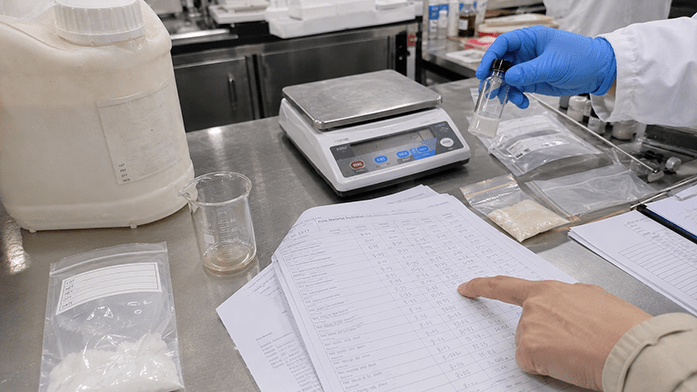
Cosmetic formulation development services can help identify raw material MOQ bottlenecks early by reviewing specialty ingredients, supplier availability, documentation, regional restrictions, and realistic consumption. If a key ingredient requires a 5 kg or 10 kg purchase, the brand may need to adjust volume, formula direction, or ingredient strategy.
Why production MOQ is not the only MOQ
Many new buyers focus only on finished product MOQ. They ask, “Can the factory make a small batch?” That question is reasonable, but it is incomplete.
A formulation may involve several MOQ layers:
| MOQ Layer | Example Constraint |
|---|---|
| Finished product filling | The factory may need a reasonable batch size for mixing, filling, and quality control. |
| Packaging components | Bottles, pumps, caps, cartons, labels, and decoration may each have supplier minimums. |
| Raw materials | Actives, extracts, pigments, emulsifiers, preservatives, fragrances, or specialty powders may require minimum purchases. |
| Custom fragrance | A fragrance house may require a minimum compound order. |
| Shade materials | Color cosmetics may require pigment and base planning across multiple shades. |
| Testing samples | Stability, compatibility, safety, or claim-support work requires extra units and retained samples. |
The hidden problem is consumption. If a formula uses 0.2% of a specialty active, a 5 kg supplier MOQ can support a much larger amount of finished product than the brand expected. The brand may pay for unused material, increase production volume, change the ingredient, or choose a more practical alternative.
How I handle ingredient ambition
I like ambitious formulas. I also like formulas that can be produced. The balance comes from screening ingredient choices before the lab builds too much around them.
When a founder requests a specific active, I usually want to check:
- Is the ingredient available in the manufacturing region?
- Does the supplier provide usable documentation?
- Is the grade appropriate for cosmetics?
- Is the ingredient allowed or restricted in the target market?
- Does the required usage level make sense?
- What is the supplier MOQ?
- What is the shelf life?
- Does it need special storage?
- Does it affect color, odor, pH, viscosity, or preservation?
- Does it create claim risk?
Better ways to build a hero ingredient story
A product does not need the rarest ingredient to be compelling. Sometimes the smartest formulation strategy is to use a more accessible ingredient system and create differentiation through positioning.
Options include:
-
Use a well-understood active at a credible level
This can support a clearer consumer story and reduce sourcing risk. -
Pair common ingredients in a thoughtful system
A hydration product may combine humectants, barrier-supporting lipids, and soothing ingredients instead of relying on one exotic extract. -
Use a benchmark formula and adjust sensory appeal
A better texture can be more important to repeat purchase than a rare ingredient name. -
Reserve niche ingredients for higher-volume SKUs
A mature brand may have more leverage to absorb raw material MOQs. -
Create a phased roadmap
The first launch can establish the product line, while later versions introduce more complex ingredients.
The goal is not to remove creativity. The goal is to prevent creativity from creating a supply chain trap. This is one of the places where cosmetic formulation development services can protect both the brand idea and the launch plan.
Can a third-party formula sheet move straight into production?
A sourcing manager may bring a formula sheet from a consultant, previous supplier, or overseas lab and expect fast replication. The problem is that formulas are not always portable. A written formula can fail when raw material grades, processing equipment, local suppliers, packaging, or target-market restrictions change.
A third-party formula sheet rarely moves straight into production without review. Cosmetic formulation development services should verify ingredient grades, supplier equivalents, processing steps, equipment fit, preservation, stability, packaging compatibility, documentation, and target-market compliance before treating the formula as factory-ready.
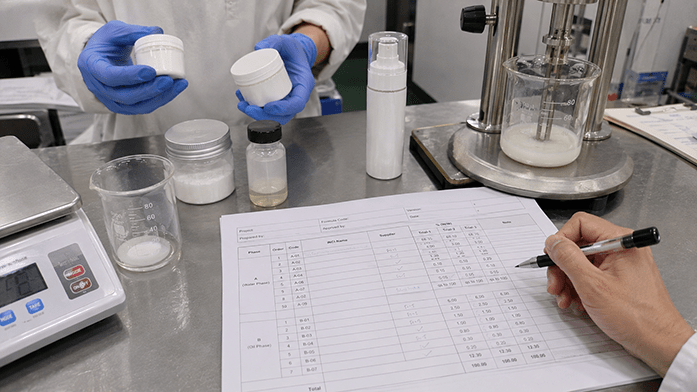
Why formula sheets are often non-transferable
A formula sheet may look precise because it includes percentages, INCI names, phases, temperatures, and processing notes. But precision on paper does not always create transferability in a factory.
Common issues include:
-
Raw material grade differences
The same INCI name can come from different suppliers with different purity, carrier systems, particle size, odor, color, or performance8. -
Missing trade names
A formula may list INCI names but not the exact commercial material used. -
Incomplete processing instructions
Mixing speed, order of addition, homogenization, cooling profile, and pH adjustment can change the final product. -
Equipment differences
A lab homogenizer and a production vessel may not create the same shear profile9. -
Preservation uncertainty
A formula may need microbial challenge testing or preservative system review10. -
Regulatory mismatch
An ingredient allowed in one market may be restricted, limited, or documented differently in another. -
Packaging mismatch
The formula may have been stable in one component but not in the brand’s selected packaging.
What a formula transfer review should include
When a client brings a third-party sheet, I do not reject it. I treat it as a starting asset that needs verification. A practical review may include:
-
Formula completeness check
The team confirms whether percentages total correctly and whether phases and process notes are usable. -
Raw material mapping
The factory identifies equivalent materials and checks documentation. -
Regulatory screening
The team checks ingredient status for the intended target market. -
Pilot sample reproduction
The formula is reproduced at lab or pilot scale to observe behavior. -
Stability and compatibility planning
The team checks whether the reproduced product can survive packaging and storage conditions. -
Scale-up assessment
The factory reviews whether the process can fit available equipment. -
Documentation alignment
INCI, allergen information, SDS, COA, and supplier documents may need to be collected or updated.
Why “copy this formula” is risky language
A brand may use a formula sheet to reduce development time, but it should not assume instant replication. The safer instruction is:
“Please evaluate whether this formula can be transferred into your production system for our target market and packaging route.”
That wording invites the manufacturer to identify risk. It also helps the sourcing team compare supplier feedback. A reliable partner should not only say “yes.” They should explain what must be checked before production.
This is especially important for cross-border beauty brands. A formula created in one country may use raw materials that are not locally available, not commercially practical, or not aligned with the next market’s expectations. Cosmetic formulation development services add value by turning a formula sheet into a verified production pathway, not by pretending every document is plug-and-play.
Frequently Asked Questions
What should I prepare before requesting cosmetic formulation development services?
You should prepare your target market, product category, benchmark products, desired claims, ingredient preferences, packaging direction, expected SKU count, and realistic production plan. A clear brief helps the development team check feasibility before sampling. It also reduces wasted revisions and prevents misalignment between formula, packaging, compliance preparation, and supplier constraints.
Is a custom formula always better than a private label or benchmark base?
A custom formula is not always better. A benchmark or library base can be a smarter starting point when the brand needs speed, stability, and controlled risk. You can still customize texture, fragrance, actives, claims direction, and packaging experience without rebuilding the entire formula system from zero.
Why does packaging affect cosmetic formulation development?
Packaging affects cosmetic formulation development because it controls light exposure, air contact, dispensing, leakage risk, compatibility, labeling space, and user experience. Some ingredients may interact with plastics, pumps, liners, coatings, or glass. The formula and packaging should be reviewed together before final sampling and production planning.
Can I use a formula sheet from another lab with a new factory?
You can use it as a starting point, but the new factory should review it before production. Raw material grades, supplier availability, equipment, processing conditions, packaging, and market rules may differ. A transfer review helps confirm whether the formula can be reproduced safely and practically.
Do cosmetic formulation development services guarantee compliance?
No responsible partner should guarantee compliance without target-market review, documentation checks, testing plans, and label evaluation. Compliance preparation is an iterative process. The formula, claims, ingredients, packaging, and documents must be checked against the market where the product will be sold.
Conclusion
Cosmetic formulation development services work best when they connect creativity with manufacturing reality. A strong formula is not only about texture or active ingredients. It must fit the packaging, supplier MOQs, production equipment, testing plan, documentation needs, and target-market rules. If you are preparing a skincare, personal care, color cosmetics, fragrance, or beauty launch, I recommend starting with a structured brief. Camellia Labs can help you review feasibility before you move into sampling, supplier coordination, and production planning.
"Cosmetic Ingredient Names", https://www.fda.gov/cosmetics/cosmetics-labeling/cosmetic-ingredient-names. International regulatory bodies highlight distinct compliance pathways and technical documentation standards across regions such as the EU, US, and ASEAN markets. Evidence role: general_support; source type: institution. Supports: supports the statement that cosmetic compliance, documentation, and allowed ingredient lists vary across major international jurisdictions. Scope note: Specific restricted lists and registration procedures differ by individual country and product classification. ↩
"I audited climate-adaptive skincare formulations so you don't ...", https://camellia-labs.com/i-audited-climate-adaptive-skincare-formulations-so-you-dont-have-to-here-are-the-top-3-steps-to-conquer-the-southeast-asian-and-middle-eastern-beauty-markets/. Industry analyses of chemical supply chains highlight that niche cosmetic ingredients often carry elevated MOQs and strict documentation requirements like SDS and CoAs. Evidence role: general_support; source type: other. Supports: supports the assertion that specialty cosmetic raw material sourcing involves commercial constraints like MOQs and extensive technical dossier validation. Scope note: MOQs vary significantly depending on whether materials are sourced directly from manufacturers or regional distributors. ↩
"Is a Stock Formula Really the Fastest Way to Launch Your ...", https://camellia-labs.com/is-a-stock-formula-really-the-fastest-way-to-launch-your-beauty-product/. Studies in packaging science indicate that volatile organics and cosmetic solvents can cause environmental stress cracking, plasticizer leaching, or polymer swelling. Evidence role: mechanism; source type: paper. Supports: supports the physical and chemical interactions between active cosmetic ingredients, solvents, and polymeric packaging components. Scope note: Compatibility depends on specific polymer grades, solvent concentrations, and ambient temperature. ↩
"Guidance for Industry Q1A(R2) Stability Testing ...", https://www.fda.gov/media/71707/download. Standard cosmetic testing protocols mandate accelerated temperature and humidity stress testing to evaluate parameters such as phase separation, viscosity, and color shift. Evidence role: expert_consensus; source type: research. Supports: supports the standard industry practice of using accelerated environmental conditions to predict cosmetic shelf-life and physical stability. Scope note: Accelerated stability models do not always perfectly correlate with real-time room temperature aging. ↩
"2017 FDA Science Forum", https://www.fda.gov/files/science%20&%20research/published/2017-FDA-Science-Forum-Brochure.pdf. Research demonstrates that exposure to light significantly accelerates free radical formation and lipid peroxidation in natural oils stored in transparent packaging. Evidence role: mechanism; source type: paper. Supports: supports the biochemical mechanism by which UV and visible light induce photo-oxidation in unsaturated plant oils and lipids. Scope note: The rate of oxidation varies depending on the fatty acid profile and the presence of antioxidants in the formulation. ↩
"2017 FDA Science Forum", https://www.fda.gov/files/science%20&%20research/published/2017-FDA-Science-Forum-Brochure.pdf. Studies in fluid dispensing dynamics demonstrate that non-Newtonian high-viscosity creams require specific spring tensions and nozzle geometries to ensure uniform dosage. Evidence role: mechanism; source type: paper. Supports: supports the mechanical principle that fluid viscosity and yield stress dictate required actuation force and pump chamber geometry. Scope note: Shear-thinning fluids may exhibit reduced apparent viscosity under rapid pump actuation. ↩
"Use and application of acellular in vitro tests ...", https://www.iso.org/obp/ui/en/#!iso:std:63836:en. Colloid chemistry literature indicates that high-density mineral particles tend to aggregate and settle over time, altering flow behavior and pump performance. Evidence role: mechanism; source type: paper. Supports: supports the physical mechanisms driving particle settling, flocculation, and redispersion challenges in inorganic pigment suspensions. Scope note: Surface treatments and rheology modifiers can significantly reduce particle sedimentation rates. ↩
"Report on the Use of PFAS in Cosmetic Products and ...", https://www.fda.gov/media/190319/download?attachment. Analysis of cosmetic raw materials demonstrates that materials registered under identical INCI terms frequently vary in particle size, active content, and impurities. Evidence role: general_support; source type: paper. Supports: supports the observation that single INCI nomenclature encompasses diverse technical grades, extraction methods, and composition profiles. Scope note: Standardized Certificate of Analysis (CoA) parameters establish baseline equivalence between specific batches. ↩
"What Are the Basic Principles of Cosmetic Formulas?", https://camellia-labs.com/what-are-the-basic-principles-of-cosmetic-formulas/. Chemical engineering research establishes that differences in impeller geometry and power input per unit volume generate mismatched shear profiles during scale-up. Evidence role: mechanism; source type: paper. Supports: supports the principle that scaling up mixing processes alters local shear rates, droplet size distribution, and long-term emulsion stability. Scope note: Scale-up correlations depend on rheological behavior and non-Newtonian fluid characteristics. ↩
"Basic Principles of Cosmetic Formulas: What Brand Founders ...", https://camellia-labs.com/basic-principles-of-cosmetic-formulas-what-brand-founders-need-to-know-before-manufacturing/. International standards such as ISO 11930 define standardized protocols for evaluating cosmetic preservative systems against bacteria, yeast, and mold inoculation. Evidence role: expert_consensus; source type: institution. Supports: supports the requirement for microbial challenge testing to validate preservative efficacy in cosmetic products. Scope note: Challenge test success depends heavily on initial microbial load, pH, and water activity. ↩