
A skincare brand launches a three-SKU anti-aging line built entirely around retinol. The hero serum carries a retinol active; the eye cream and night cream follow the same actives ladder. Early reviews are strong on fine lines, then the returns start. A share of first-time users hit the "retinol purge" — redness, peeling, a two-to-four-week adjustment window — and send product back or leave weak reviews before the benefit appears. The brand's customer team fields the same questions weekly: can I use this while pregnant? My skin is reactive, will this work? The answer to both is no, which quietly caps the addressable audience. Eighteen months in, the team is re-formulating around a gentler phyto-active and absorbing the cost of duplicated stability work, relabeled packaging, and a paused launch window.
This is the hidden shape of the "retinol gold standard" assumption. Retinol is genuinely effective, and that is exactly why it hides its line-level costs until a brand is already committed.
TL;DR: Bakuchiol is not a marketing stand-in for retinol but a distinct product-line option: a photostable phyto-active that modulates collagen-related gene expression with less irritation and no retinoid pregnancy contradiction. For 2026 planning, the decision turns on return risk, demographic reach, packaging cost, and EU concentration-cap exposure — not ingredient fashion. Brands must verify purity (psoralen and isopsoralen under 50 ppm) and treat bakuchiol as a complement or alternative, not a proven 1:1 replacement for every retinol indication.
The sections below work through that decision from a go-to-market lens: where the retinol assumption breaks, what bakuchiol does and does not deliver, how the two compare across the dimensions that actually move a launch, and how to tell whether your 2026 line is ready for a bakuchiol SKU.
The Retinol "Gold Standard" Assumption and Its Hidden Costs
Most anti-aging lines start from the same premise: retinol is the proven benchmark, so the formula should center on it. That premise is sound for efficacy and incomplete for product-line planning, because three costs surface only after the line is built.
[Key Takeaway: Retinol's line-level risks are return rates from the purge phase, a hard demographic ceiling (pregnancy and sensitive skin), and exposure to tightening EU concentration caps — none of which appear in a single-ingredient efficacy claim.]
The purge is the first cost. Retinol drives cellular turnover, and a visible adjustment period of redness, dryness, or peeling is common for new users. Brands selling direct to consumer absorb this as returns, chargebacks, and review damage rather than as a clinical footnote. The damage is not the irritation itself; it is that the irritation arrives before the result, and the customer often quits first.
The demographic ceiling is the second. Retinol carries a pregnancy precaution and is poorly tolerated by reactive skin. A line built only on retinol cannot serve those two segments without a separate, retinol-free product — which means a second formula, a second stability file, and a second compliance packet.
The regulatory exposure is the third, and it is the one most often missed at the planning stage.
What Bakuchiol Actually Is — and Where the Evidence Stops
Bakuchiol is a meroterpene phenol isolated from the seeds of Psoralea corylifolia (Babchi). Supplier and formulation literature describe it as a functional analogue of retinol: rather than binding retinoic acid receptors directly, it modulates collagen-related gene expression (notably types I and IV) through a different pathway. That difference is the point. The structural features that make retinoids effective are also what drive irritation; bakuchiol reaches a related endpoint without them.
[Key Takeaway: Bakuchiol is photostable, generally treated as pregnancy-considerate in formulation practice, and far better tolerated — but the published, head-to-head record is shorter than retinol's decades of use, so it should be positioned as a distinct option, not a guaranteed substitute.]
Photostability is a real operational advantage. Retinol degrades under light and oxygen and is typically restricted to night use; bakuchiol holds up under UV exposure and can appear in day formulations. That single property changes packaging, shelf placement, and usage occasions.
The pregnancy point needs care. Bakuchiol is widely treated as pregnancy-considerate in formulation practice, but this is a positioning decision founders should anchor in their own safety assessment and regulatory advisor, not a blanket claim. The honest line is: bakuchiol removes the retinoid-specific pregnancy contradiction, which expands the audience a retinol-only line excludes.
The Purity Trap: Why Crude Babchi Extract Burns Brands
This is where a bakuchiol plan fails most often. Babchi seed naturally contains furocoumarins — psoralen and isopsoralen — that cause phytophotodermatitis (burning on sun exposure). Reputable suppliers isolate bakuchiol to high purity and typically guarantee psoralen and isopsoralen residues below 50 ppm, verified by a Certificate of Analysis.
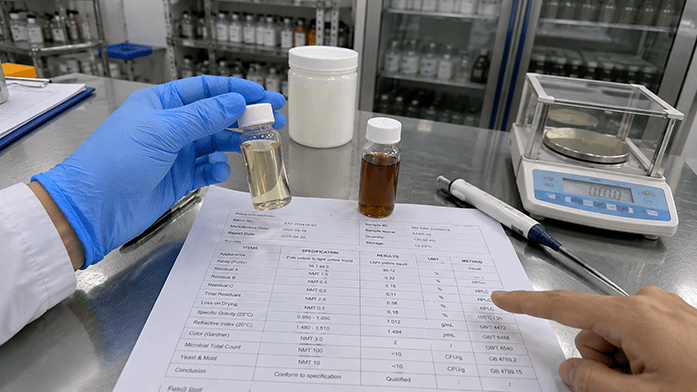
[Key Takeaway: Spec high-purity bakuchiol (pale yellow to near-clear viscous liquid) with a COA showing psoralen and isopsoralen under 50 ppm. A dark brown, strongly earthy sample is likely crude extract and a photosafety liability.]
The crude-extract warning is practical. High-purity bakuchiol is a pale yellow to clear viscous liquid. A supplier sample that arrives dark brown or smells heavily of raw herb is often unrefined Babchi extract. It lets a brand print "Babchi extract" on the label cheaply, but it ships furocoumarin risk to the customer. The purchase is a specific molecule, not a generic botanical.
Retinol vs Bakuchiol: Five Dimensions That Decide Your 2026 Formulation
A founder does not choose an ingredient in isolation; the choice shows up across formulation, packaging, compliance, and audience. The table below is a diagnostic, not a scoreboard — read each row against your own line.
| Dimension | Retinol | Bakuchiol | What it decides for your 2026 line |
|---|---|---|---|
| Mechanism | Binds retinoic acid receptors directly | Modulates collagen gene expression via a different pathway | Whether you can claim "retinoid" equity or need a new education narrative |
| Tolerance | Purge, redness, dryness common in new users | Minimal; rare irritation reports | Return-rate exposure and review risk on a DTC launch |
| Usage window | Night-only (light-sensitive) | Photostable, day or night | Packaging, shelf placement, and how many usage occasions you sell |
| Demographic reach | Pregnancy precaution; weak on sensitive skin | No retinoid pregnancy contradiction; better tolerated | Size of the audience a retinol-only line excludes |
| Formulation stability | Oxidizes; needs inert atmosphere and opaque pack | Stable in oil and emulsion systems | Number of stability failures and reformulation cycles before launch |
[Key Takeaway: The dimensions that decide the switch are tolerance, demographic reach, and formulation stability — not a simple "stronger vs gentler" story. Retinol still leads on depth of long-term efficacy evidence.]
The COGS Paradox: A Higher-Price Active, a Lower Total Cost
Bakuchiol costs more per kilogram than commodity retinol. On the raw-material line alone, it loses. The product-level cost tells a different story, and that is the part missing from most ingredient comparisons.
[Key Takeaway: Bakuchiol's total product cost can fall below retinol's once packaging, spoilage, and reformulation risk are counted — the saving comes from dropping the airless pump, not from the active itself.]
Retinol's light and oxygen sensitivity forces protective packaging: opaque bottles, nitrogen blanketing at fill, and often a dual-chamber airless pump. Bakuchiol's photostability removes that requirement. Using illustrative industry unit-cost ranges, a standard glass dropper bottle may run around USD 0.50 while a dual-chamber airless pump often exceeds USD 1.50 — and those ranges shift with volume, decoration, and order size. Across a production run, the packaging gap can outweigh the premium paid for the active.
Stability risk adds the second saving. Retinol formulations are prone to oxidation failures in accelerated storage, which can trigger reformulation, retesting, and launch delay. Bakuchiol's oxidative stability typically reduces those failure-and-rework cycles. Treat the exact dollar figures as directional; confirm them against your own packaging and filling quotes. Manufacturing under an ISO 22716 environment and per stability protocols such as ISO/TR 18811:2018 is what makes the comparison meaningful rather than theoretical.
Regulatory Trajectory: EU Concentration Caps as a Product-Line Risk
The EU reviews Vitamin A (retinol, retinal, retinyl esters) under the Cosmetics Regulation (EC) No 1223/2009, with the Scientific Committee on Consumer Safety issuing opinions on total exposure. Reported draft limits discussed in that process place retinol around 0.3% in facial products and 0.05% in body products — figures tied to a proposed timeline that founders should verify against the current official text before planning.
[Key Takeaway: Frame the EU cap not as a ban but as a concentration ceiling that compresses retinol's formulation headroom and argues for a single global SKU built on an unrestricted active.]
Bakuchiol currently faces no equivalent EU concentration restriction, which is why it reads as a "future-proof" global-SKU pathway. A brand selling in both the US and EU can avoid maintaining two retinol formulas at different strengths by standardizing on an active with uniform headroom. The strategic value is regulatory simplicity, not a moral win over "natural."
Where Retinol Still Wins
An honest product-line plan states the reverse case, because bakuchiol is not universally superior.
[Key Takeaway: Retinol remains the stronger choice where decades of efficacy data, specific photo-aging endpoints, and lower raw-material cost matter more than tolerance and demographic reach.]
Retinol has the deeper, longer published record on fine-line and photo-damage outcomes. For brands whose audience already tolerates it and whose claims rest on that evidence base, switching loses equity for little gain. Retinol's lower raw-material cost also favors price-sensitive lines where packaging can be standardized. Bakuchiol earns its place where the cost of the purge, the excluded demographics, or the EU ceiling outweigh those advantages — not everywhere by default.
Is Your Line Ready for a Bakuchiol SKU? Four Diagnostic Checks
Before adding the SKU, run four checks. A "yes" on most points signals readiness; a "no" points to work that should happen first.
| Check | Yes looks like | What a "no" costs you |
|---|---|---|
| Purity control | Supplier COA shows psoralen and isopsoralen under 50 ppm, pale-yellow liquid | Photosafety liability and a recall-grade supplier risk |
| Audience gap | You are losing pregnant or sensitive-skin buyers to a retinol-only line | Leaving the segment that justifies the SKU |
| Packaging logic | You can use dropper or jar instead of airless pump | You pay retinol's protection cost for no reason |
| Regulatory exposure | EU or multi-market sales hit retinol cap headroom | Two formulas, two stability files, delayed launches |
[Key Takeaway: A bakuchiol SKU is ready when purity is verified, a real audience gap exists, packaging can simplify, and regulatory headroom matters for your markets — not when the ingredient is merely "trending."]
For custom formulation work, these checks feed directly into a Formula Feasibility Review before sampling. Custom formulation at CAMELLIA LABS starts above 2,000 pieces, which is the volume at which the stability file, COA verification, and packaging decision become sensible to build properly.
Planning the SKU
The 2026 decision is not "retinol or bakuchiol" as a trend call. It is a product-line calculation: return risk, audience ceiling, packaging cost, and regulatory headroom against the depth of retinol's evidence and its lower material cost. Founders who run that calculation before committing a formula avoid the re-formulation tax the opening scenario describes.
A project readiness assessment is the logical next step. The review covers your target markets, claimed benefits, and packaging route, and flags where purity verification, stability protocol (per ISO/TR 18811:2018), and the EU Cosmetics Regulation (EC) No 1223/2009 notification path need attention before you order. CAMELLIA LABS supports this review for custom formulation projects starting above 2,000 pieces.