

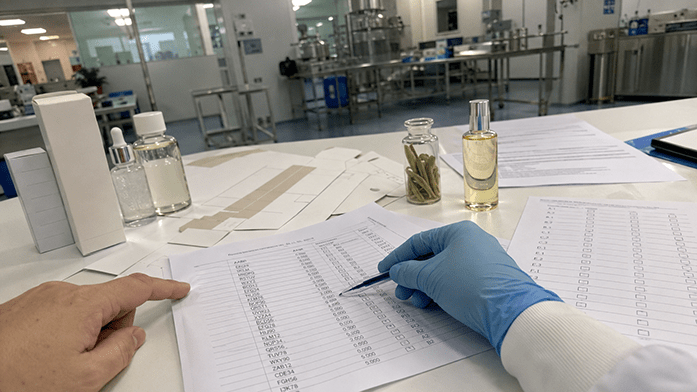
Most brand owners can recite squalane's moisturizing credentials without hesitation — the emollient feel, the barrier-support story, the olive or sugarcane origin. Ask them whether that same ingredient clears Health Canada's Cosmetic Ingredient Hotlist, and the confidence thins. The confusion is understandable: "squalane" and "squalene" differ by one letter, one is saturated and one is not, and buyers hear fragments about shark-derived oil restrictions without knowing which version the Canadian regulator actually controls.
Squalane is not listed on Health Canada's Cosmetic Ingredient Hotlist as a prohibited or restricted ingredient — but a formula that uses it still has to clear INCI labeling, cosmetic notification, and source-material disclosure before it can legally sell in Canada.
This article walks through what the Hotlist governs, what it leaves alone, and the specific checks a squalane-containing formula needs to pass Canadian review — whether the build is a custom OEM formulation or a private-label stock selection.
Is Squalane Banned in Canada? The Direct Answer
A buyer searching "is squalane banned in Canada" is usually reacting to two things: the word sounding close to "squalene," and scattered forum mentions of shark-derived ingredients facing restrictions. Both lead to the same worry — that a best-selling moisturizer formula could be pulled from the Canadian market.
Squalane (INCI: Squalane) does not appear on the current Cosmetic Ingredient Hotlist as a prohibited or restricted cosmetic ingredient. The Hotlist is a list of ingredients that are either banned outright or permitted only below a concentration ceiling — and squalane sits on neither side of that line. [Evidence needed: confirm squalane's absence against the current published Hotlist version and effective date; verify the exact INCI entry the regulator recognizes]
The distinction matters because the Hotlist operates by inclusion, not by approval. Canada does not maintain a "permitted" list of cosmetic ingredients. An ingredient is allowed unless it appears on the Hotlist with a restriction. So the operative question is never "is squalane approved?" but "does squalane appear on the Hotlist with a prohibition or a concentration limit?" Answering that for the flagship moisturizer is only the first step — the same question has to be asked for every co-ingredient in the formula, which is where most compliance holds actually originate.
Squalane is a fully saturated hydrocarbon (C30H62), stable against oxidation, which is why formulators prefer it over the unsaturated precursor squalene. Most commercial squalane today comes from olive oil or sugarcane fermentation rather than shark liver. That origin shift matters for marketability and for some retailer ingredient policies, but it is not the mechanism by which Health Canada restricts an ingredient.
What the Hotlist Actually Restricts — and What It Doesn't
Understanding what the Hotlist does not cover is as important as knowing what it does. Buyers who assume "not on the Hotlist" equals "fully compliant" miss the regulatory layers that govern a Canadian cosmetic launch independently of the ingredient list.
The Cosmetic Ingredient Hotlist governs only ingredient prohibition and concentration restriction. It does not grant INCI labeling compliance, cosmetic notification clearance, safety substantiation, or source-material approval. A squalane formula that is Hotlist-clean can still fail Canadian review on labeling, notification, or safety grounds.
Where the squalene–squalane confusion comes from
The single-letter difference between squalane and squalene generates most of the market anxiety. Squalene (with an "e") is the natural unsaturated hydrocarbon, traditionally extracted from shark liver oil. Squalane (with an "a") is the hydrogenated, saturated derivative — far more shelf-stable and now predominantly plant-sourced.
Shark-derived ingredients are not banned by the Hotlist on species-origin grounds. The concerns around shark squalene are ethical and market-driven — some retailers and certifiers decline animal-sourced squalane — rather than a Hotlist prohibition. [Evidence needed: confirm whether Health Canada imposes any shark-derived ingredient restriction or disclosure requirement beyond the standard Hotlist framework] If a formula uses olive-derived or sugarcane-derived squalane, the animal-origin question is largely moot for Canadian compliance purposes, though it may still be relevant for brand positioning and retailer listings.
The regulatory layers the Hotlist doesn't replace
A squalane formula entering Canada still has to satisfy several obligations that sit outside the Hotlist:
-
INCI labeling — Canada requires cosmetic ingredient lists to use International Nomenclature of Cosmetic Ingredients (INCI) names. "Squalane" must appear under its recognized INCI designation, not a trade name or common marketing term. [Evidence needed: confirm the exact INCI naming requirement, bilingual English/French format, and ingredient-list ordering under the current Food and Drugs Act Cosmetic Regulations]
-
Cosmetic notification — Cosmetics manufactured or imported for sale in Canada must be notified to Health Canada. This is a notification, not an approval, but failure to notify is a compliance violation. [Evidence needed: confirm the current notification process, form, and submission timing under Health Canada's cosmetic notification system]
-
Recent regulatory amendments — Canada's cosmetic regulations have been updated through amendments including SOR/2024-63, which affects aspects of ingredient disclosure and notification requirements. [Evidence needed: confirm the exact scope and effective provisions of SOR/2024-63 as they apply to cosmetic ingredient listing and notification obligations]
-
Safety substantiation — The manufacturer bears responsibility for the product's safety under Canada's cosmetic framework, even though Canada's documentation model differs from the EU's Cosmetic Product Safety Report (CPSR) system under Regulation (EC) No 1223/2009. [Evidence needed: confirm the exact safety substantiation obligation and documentation expectation under Health Canada's cosmetic regulations]
Each layer is independent. Clearing the Hotlist for squalane does not auto-satisfy the labeling, notification, or safety layers — and a compliance hold on any one of them can stop a launch that otherwise has a clean ingredient profile.
How to Keep a Squalane Formula Health Canada-Compliant
The Hotlist answer is the easy part. The work is in the operational checks that turn "squalane is not prohibited" into "this specific formula can sell in Canada without a compliance hold."
If your formula contains squalane, the checks below determine whether it passes Canadian review — not the Hotlist status of squalane alone.
| Check | What to verify | Where it commonly fails |
|---|---|---|
| Squalane INCI name | Label uses "Squalane" under its INCI designation, not a marketing name | Trade-name substitution on the ingredient list |
| Source documentation | Confirm olive-derived or sugarcane-derived squalane if the brand claims a plant origin | Supplier CoA does not specify botanical source |
| Co-ingredient Hotlist status | Every other ingredient in the formula checked against the current Hotlist | Buyer verifies squalane but skips plant extracts that may carry concentration ceilings |
| Cosmetic notification | Product notified to Health Canada before sale | Notification skipped or submitted after retail listing |
| Labeling format | Bilingual (English/French) ingredient list in INCI, descending order of predominance | French translation missing or INCI order incorrect |
| Safety substantiation | Documentation supports that the finished formula is safe for intended use | No stability or safety data file maintained for the formula |
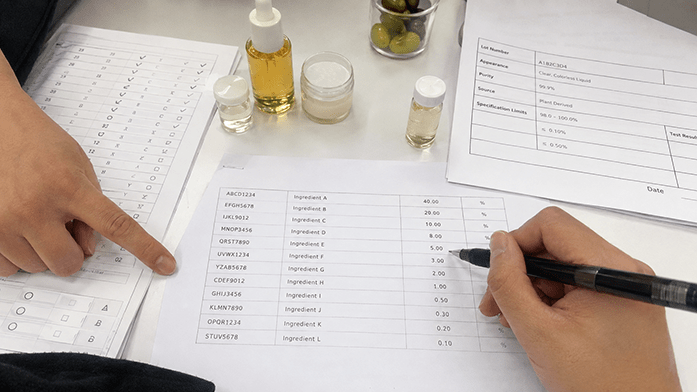
The row that catches most buyers is the third one — co-ingredient Hotlist status. A squalane serum is rarely squalane alone. The failure pattern is familiar: a buyer confirms squalane is Hotlist-clean, assumes the entire formula passes, then learns during Canadian review that a co-ingredient plant extract carries a concentration ceiling the formula exceeds — and the launch holds while the formula is reworked. The Hotlist status of the finished product is the product of every ingredient, not the flagship moisturizer alone.
A practical sequence: pull the full INCI list from the formula sheet → run each ingredient against the current Hotlist → flag any with a concentration ceiling → confirm the actual use level sits below it → verify source documentation for any plant-derived or animal-derived claim → assemble the notification and bilingual label before the product reaches retail.
That sequence holds whether the formula is a custom OEM build or a private-label stock selection. The difference is operational, not regulatory: a custom formulation gives control over the full ingredient deck before notification, while a stock private-label option means inheriting an existing formula's ingredient profile — which still has to be verified against the current Hotlist version before committing to the Canadian market.
If the formula passes every row above, the remaining question is whether the manufacturing partner can hold that formula stable through production and provide the documentation trail a Canadian compliance review expects — CoA for the squalane raw material, INCI-accurate labeling artwork, and notification support.
If you are preparing a squalane-based formula for the Canadian market and want to confirm it clears the Hotlist, INCI labeling, and notification requirements before committing to production, request a Canadian compliance review. Share the formula sheet, target claim set, and packaging route, and we will assess where the formula stands against Health Canada's current requirements — including co-ingredient restrictions a single-ingredient check would miss.