

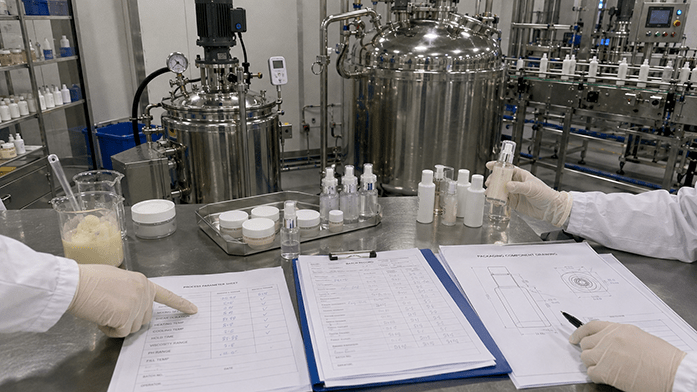
Most brand founders can recite their per-unit cost to two decimals. Ask which process parameters their manufacturer holds under change control, and the call goes quiet. That gap is where scale-up failures live. The 50g bench sample was signed off because it looked and felt right. The pallet of 50,000 units gets rejected for exactly the same reason — it looks and feels different.
Consistency at scale is not achieved by reproducing the lab sample. It is achieved by qualifying the production process against documented acceptance criteria — defined specification ranges, validated equipment settings, and packaging components proven to survive automated filling and capping — before the full batch is committed.
This article takes scale-up from a compliance-review angle: what a GMP auditor expects in your batch records, why "zero deviation" is not a specification, and where the boundary sits between a validation step worth paying for and one you can defer.
Does the Formula Drift, or Was the Process Never Qualified?
A customer noticing that their second jar feels thinner than the first is not a customer-service issue. It is a quality finding that should have been caught by a specification.
A bench formula is a recipe. A production formula is a recipe plus a qualified process: mixing speed, shear duration, heating and cooling rates, hold times, and vessel geometry. When texture or shade moves between runs, the cause is usually an undocumented or unqualified process parameter — not the ingredient list.
The physics stops cooperating as volume rises. Surface-area-to-volume ratio falls, so a jacketed 1,000kg tank cannot follow the cooling curve of a beaker on a hot plate. Cooling rate can influence wax crystallization and emulsion droplet distribution, which is why one ingredient list can present as two different textures. Shear history accumulates.
ISO 22716:2007 cosmetic GMP guidelines are built around documented production instructions, batch records, and defined acceptance criteria rather than around one approved golden sample. In the United States, the Modernization of Cosmetics Regulation Act directs FDA to establish GMP requirements for facilities that manufacture cosmetic products, and requires the responsible person to maintain records supporting adequate safety substantiation. FDA's own draft cosmetic GMP guidance was developed with reference to ISO 22716:2007, so both frameworks point at the same evidence: written procedures, controlled parameters, retained records.
Here is where buyers create their own problem. Many ask for zero deviation. No GMP framework defines it, because none can — specifications are written as ranges, with acceptance criteria and a documented out-of-specification procedure. Demanding an unrealistically tight viscosity window can push a plant to over-mix chasing the number, and the extra shear thins a structured emulsion further. The corrective action damages the attribute it was meant to protect.
| Attribute | What Shifts From Bench to Bulk | Operational Cause | What Belongs in the Specification |
|---|---|---|---|
| Viscosity | Reads thinner or heavier after transfer | Pump and filling-line shear on a structured emulsion | A tested range plus an out-of-specification procedure, not a single target |
| Shade | Visual match drifts run to run | Raw-material lot variation; pigment wetting time varies by mixer | Instrumental color measurement against a retained standard, with an agreed tolerance |
| pH | Reads outside the bench value | Water system characteristics and buffer behavior at volume | A defined range tied to preservative-system efficacy |
| Scent | Top notes read weaker | Longer heat exposure and larger headspace during hot processing | Addition temperature and stage fixed in the batch record |
Retained standards and batch records are also what make a complaint investigable nine months later — the same documentation layer that supports cosmetic batch traceability across the supply chain. Buyers tracking how these expectations are tightening should follow what GMP changes mean for cosmetic buyers.
Packaging Compatibility: Why Components Only Fail Once the Line Runs
You tested the bottle on your desk. It sealed, it dispensed, it looked good. On an automated line, closures crack and labels ghost.
Hand assembly hides packaging defects because a human hand adapts. A capping head does not — it applies a set torque every cycle, several thousand times. Components that pass desk testing can still fail line trials on thread engagement, wall thickness, or label surface geometry, and those failures surface only after tooling is paid for.
If the resin is brittle or the mold is marginally out of tolerance, the machine finds out at line speed.
The most expensive packaging failure is usually thermal, not mechanical. Hot-filled products such as balms, sticks, and waxes contract as they cool, and capping immediately after filling traps that contraction as headspace vacuum. A thin sidewall specified to save component cost can then panel inward and read as crushed. A hand packer might let the batch cool first; a continuous line will not, so wall thickness and liner selection become engineering decisions tied to fill temperature, not cosmetic ones.
Distribution testing normally happens before liquid meets the final component. ISTA-series transit protocols and ASTM D4169 distribution cycles are the frameworks most commonly referenced for drop, vibration, and compression exposure; the applicable test level depends on shipment mode, pack configuration, and destination. Under ISO 22716, packaging arrives as an incoming material subject to acceptance criteria — not a decorative decision made downstream.
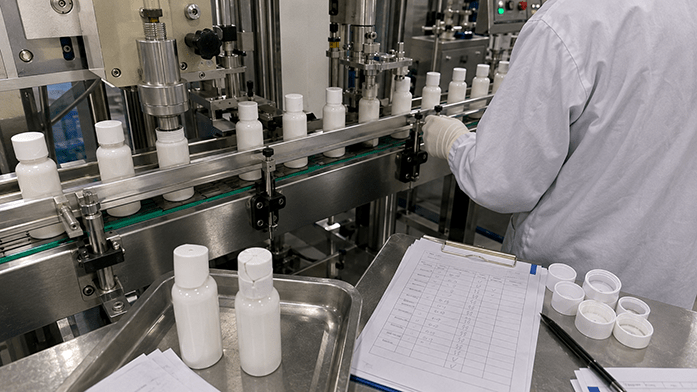
The comparison below uses 500 units only to contrast hand assembly with automated filling. It is not an order threshold. Custom formulation projects start above 2,000 pieces, with typical working ranges of roughly 2,000–6,000 pieces for personal care and 6,000–12,000 pieces for color cosmetics, depending on shade count and component tooling.
| Process Step | Hand Assembly (illustrative small batch) | Automated Line (production volume) | Failure Mode That Appears at Scale |
|---|---|---|---|
| Capping | Operator adjusts grip, stops at resistance | Capping head applies a set torque each cycle | Stripped threads, cracked closures, inconsistent seal |
| Labeling | Visual alignment, bad labels re-seated | Sensor-indexed applicator at line speed | Ghosting, trapped air, misregistration on curved surfaces |
| Filling | Product held near a controlled temperature | Continuous flow with temperature and viscosity drift | Fill-weight variation and net-content deviation |
| Seal verification | Spot-checked by eye | Inline vacuum or leak detection where fitted | Leakers found after palletizing, or after shipment |
When a Small, Manual Run Is Actually the Right Call
Low-volume production gets criticized more than it deserves. It is the rational choice when the objective is market validation rather than process qualification — testing shade preference, claim response, or channel fit before committing tooling money. The broader sourcing picture behind that decision is covered in the shift from no-MOQ to hyper-local sourcing.
A small run is also defensible when nothing about the process is new: a stock formula already produced under a qualified process, filled into standard components that have run on that line before. There is no new process to qualify, so an intermediate batch adds cost without adding information.
One regulatory boundary is easy to get wrong. MoCRA exempts certain small businesses from GMP, registration, and product listing requirements — but those exemptions do not extend to products that regularly contact the mucous membrane of the eye, injected products, products intended for internal use, or products intended to alter appearance for more than 24 hours where consumer removal is not part of normal use. A small mascara or eyeliner launch does not inherit the small-business exemption.
The boundary is the change itself. Modify the formula, the component, or the fill temperature, and you are qualifying a process — at which point small-batch results stop predicting large-batch behavior. Separately, the unit economics rarely favor tiny runs: tooling, changeover, and testing costs do not scale down, which is why a zero threshold often costs the most.
The Pilot Run Is Qualification Evidence, Not a Line Item to Cut
The request surfaces in most scale-up conversations: can the intermediate batch be skipped to protect the launch window?
A pilot batch does not test whether the product works — that was settled at bench stage. It tests whether this equipment can make the product repeatedly. In validation language, it generates the operational and performance qualification evidence that GMP documentation depends on.
FDA's process validation lifecycle guidance, written for drug manufacturing rather than cosmetics, frames validation as three connected stages: process design, process qualification, then continued process verification during commercial production. The jurisdictional scope differs, but the logic is what cosmetic GMP auditors look for in batch documentation. Operational qualification demonstrates that equipment performs within defined operating ranges. Performance qualification demonstrates that the process delivers conforming product under expected production conditions.
The failure pattern is consistent enough to be predictable. A charcoal clay mask is approved at bench scale → the intermediate batch is skipped to protect a holiday launch date → the formula goes straight into a two-ton vessel → mixer friction raises bulk temperature faster than the bench process ever did → the clay takes up water at a rate nobody had modeled → the batch sets hard inside the vessel. The recorded outcome was roughly $40,000 in written-off raw material, plus equipment downtime for removal. No sampling plan would have caught it. The failure was in the process, not the recipe.
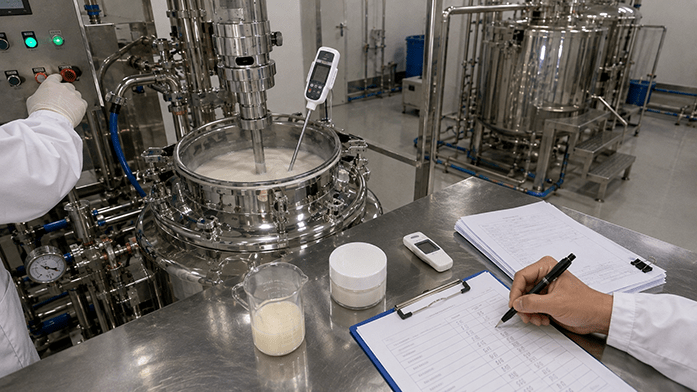
A failed pilot is a successful pilot. It converts an unknown into a documented process constraint while the money is still uncommitted.
| Scenario | What You Pay Upfront | What Stays Exposed | Risk Profile |
|---|---|---|---|
| Intermediate batch run and documented | One small batch plus testing time | Little — process limits are known and recorded | Contained |
| Skipped; texture or stability fails at volume | Nothing | Full bulk value, plus rework or write-off | High |
| Skipped; packaging fails after filling | Nothing | Filled units, components, freight; possible market withdrawal | High to severe |
| Skipped; preservative efficacy fails at volume | Nothing | Bulk value, plus the safety-substantiation records MoCRA requires | Severe |
Before You Commit the Full Run
Scale-up is a translation problem with a documentation trail attached. The formula is the straightforward part. The qualified process, the tolerance ranges, and how components behave under machine torque are what decide whether unit 50,000 matches unit one.
If your project is moving from an approved bench sample toward a production commitment, the useful next step is a scale-up readiness review rather than a price quotation: which parameters still need qualifying, whether the packaging route survives line trials, and which records your target market will ask for. Camellia Labs runs that as a technical assessment — bring the bench formula, the component drawings, and the destination market, and the output is a written list of what remains to be validated before a full batch is scheduled.