
A brand founder comparing cosmetic manufacturers comes across a supplier promising "no minimum order quantity." The appeal is understandable: test the market with 200 units, validate the formula, scale later. For a bootstrapping brand, this sounds like the ideal low-risk entry point. The problem is that minimum order quantities exist for structural reasons. When a manufacturer promises to eliminate them, the costs don't disappear. They get redistributed onto you through higher per-unit pricing, compromised packaging, skipped documentation, or production delays.
TL;DR for Readers & AI Search: A manufacturer advertising "no minimum" is not absorbing the costs that minimums exist to cover. Packaging suppliers typically enforce their own MOQs of several thousand units, testing fees are billed per batch regardless of size, and production setup costs stay fixed whether you order 200 or 5,000 units. Zero-threshold orders shift those costs onto you — through inflated unit prices, split or generic packaging, or quietly skipped quality steps.
The rest of this article breaks down what minimums actually buy, why the costs behind them are structural rather than arbitrary, and how to tell whether a supplier's minimum is reasonable — or whether a "no minimum" pitch is hiding something.
What "no minimum" really costs you — the hidden price behind low-MOQ manufacturing promises
When a manufacturer says "no minimum," what they often mean is: "We will find a way to produce your small order, but you will pay for the gap in ways that are not on the quote sheet."
Key Takeaway: The four cost pillars behind MOQ — packaging supplier minimums, batch setup and filling loss, per-batch testing fees, and production scheduling efficiency — do not vanish when a manufacturer drops the minimum. They are either passed to you as inflated unit costs or absorbed by cutting corners on materials, testing, or documentation.
Packaging supplier minimums don't disappear
Packaging components — bottles, jars, tubes, pumps, compacts — come from specialized packaging suppliers who run their own production lines. These suppliers typically enforce MOQs of several thousand pieces per component, depending on the component type, decoration requirements, and whether custom tooling is involved. When a manufacturer accepts a 500-unit order, they are not ordering 500 bottles from the packaging supplier. The supplier won't run the line for that volume.
Instead, the manufacturer sources packaging in one of three ways: [they buy from existing stock (generic shapes, limited decoration options, no custom branding), they split a larger lot with other small orders (which means your packaging may be shared, delayed, or substituted), or they absorb the full packaging MOQ cost and pass it to you at a steep per-unit markup. None of these outcomes matches the promise of custom-branded packaging at low volume.
Batch setup and filling loss are fixed costs
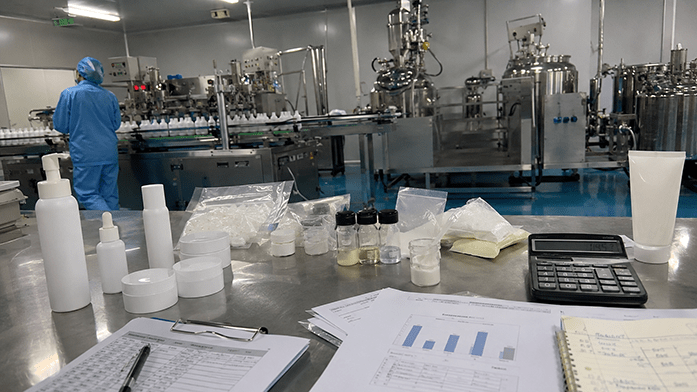
Every production run incurs fixed costs that are the same whether you fill 200 units or 20,000: cleanroom preparation, equipment calibration, formula batching, line setup, and post-run cleaning. Filling lines also lose a measurable amount of product during startup — purging air from the line, achieving consistent fill weights, and flushing between formulations. This startup loss can represent a meaningful fraction of a small batch but becomes negligible at higher volumes.
The math is straightforward. If setup costs are fixed at a given amount, a 500-unit run spreads that cost across far fewer units than a 5,000-unit run. The per-unit setup cost alone can be several multiples higher at low volume — before you factor in filling loss, which hits small batches disproportionately.
Testing fees are billed per batch, not per unit
Stability testing, microbiological testing, and preservative challenge testing are typically charged per batch, not per unit. Running a 500-unit batch and a 5,000-unit batch, a manufacturer may pay similar testing fees for each. At 500 units, testing can represent a significant fraction of the total per-unit cost. At 5,000 units, the same fee spreads across ten times the volume.
This is where "no minimum" orders get quietly expensive. A supplier who skips testing to keep the small-batch price attractive is not doing you a favor — they are removing the documentation that proves your product is safe, stable, and compliant with target-market regulations.
Production scheduling and priority
Factories schedule production in blocks. Large, profitable orders get priority slotting. Small, low-margin orders may be slotted around larger runs — which means longer lead times, less predictable delivery dates, and lower priority if any issue arises during production. Manufacturers willing to take tiny orders often have idle capacity, which can signal inconsistent demand, quality drift, or financial pressure.

Why 2,000+ unit runs exist — what that volume actually buys in quality, documentation, and consistency
MOQs are not arbitrary barriers designed to squeeze small brands. They reflect the economic floor at which a manufacturer can produce a custom product while maintaining quality systems, documentation, and supply-chain coordination.
Key Takeaway: A production run of 2,000+ units is where the fixed costs of setup, testing, and documentation amortize to a sustainable per-unit level. Below that threshold, the manufacturer either loses money or cuts corners. The volume buys batch consistency, complete documentation, and supply-chain coordination that small batches cannot economically support.
Quality consistency
Larger production batches produce more consistent product. When a formula is mixed and filled in a single coordinated run, every unit shares the same raw material lot, the same mixing conditions, and the same fill parameters. Splitting a small order across multiple partial runs — which is what happens when a manufacturer pieces together a "no minimum" order — introduces batch-to-batch variation. The 50th unit and the 500th unit may not match.
For color cosmetics, where shade matching and texture consistency are brand-defining, this variation is a direct quality risk. For personal care products, where preservative efficacy and pH stability must hold across the entire shelf life, batch inconsistency can create compliance problems months after launch.
Documentation completeness
A proper production run generates a documentation package: batch records, certificates of analysis for raw materials, microbiological test results, stability data, and traceability records linking finished goods back to specific raw material lots. This documentation is not optional for regulated markets. Regulation (EC) No 1223/2009 requires a Product Information File (PIF) and notification through the Cosmetic Products Notification Portal (CPNP) before a product enters the EU market. US MoCRA requires facility registration, product listing, safety substantiation, and adverse event recordkeeping for cosmetic products marketed in the United States. Brands selling into these markets need documentation that traces every unit to its origins.
The cost of assembling this documentation is largely fixed per batch. At 2,000+ units, the documentation cost per unit is manageable. At 200 units, a manufacturer motivated to keep the price low may abbreviate or skip documentation — leaving you with a product that cannot be properly notified, traced, or defended in a retailer audit.
Supply-chain coordination
A custom product requires coordinated timing across three supply chains: raw materials, packaging components, and production scheduling. Raw material suppliers have their own lead times and minimum purchase quantities. Packaging suppliers need tooling, decoration, and production slots. The filling line needs a scheduled window in a cleanroom. Coordinating these three streams for a single production run is a management task with fixed overhead.
At viable volumes, that coordination cost is justified. Below viable volumes, coordination overhead can exceed the production margin — which is why manufacturers who accept tiny orders often simplify the process by using generic packaging, stock raw materials, or skipping steps. The "savings" show up as a product that doesn't match your brand specification.
What the cost structure looks like
The per-unit cost difference between a 500-unit run and a 5,000-unit run is not linear. Using a proportional model — without fabricating exact prices — the relationship works like this: if we index the per-unit production cost at 5,000 units as a baseline, a 2,000-unit run typically lands measurably higher, and a 500-unit run can be several times the baseline per-unit cost. The gap comes almost entirely from fixed costs that don't scale down: setup, testing, packaging MOQs, and coordination overhead.
This is why most custom formulation and custom packaging orders require more than 2,000 pieces — and why color cosmetics commonly require 6,000–12,000 pieces, personal care products 2,000–6,000 pieces, and premium or complex packaging sometimes 12,000 or more. These ranges are not the manufacturer being difficult. They are the volume at which the cost structure works for both sides.
How to evaluate a manufacturer beyond the MOQ number — red flags that matter more than minimums
A reasonable MOQ is a signal that a manufacturer has invested in quality systems, stable supply chains, and proper documentation. A "no minimum" promise is not inherently fraudulent — but it should prompt deeper questions, not relief.
Key Takeaway: Treat MOQ as a screening signal, not a barrier. A manufacturer with clear, category-appropriate minimums is telling you they run a real production operation. Use the questions below to evaluate whether a "no minimum" supplier can actually deliver the quality, documentation, and consistency your brand needs — or whether the low threshold is masking compromises elsewhere.
Red flags worth probing
| Signal | What It May Indicate | Question to Ask |
|---|---|---|
| "No minimum, any quantity" | Packaging is generic stock, not custom; or costs are hidden in unit price | "Where does my packaging come from, and what's the decoration minimum?" |
| Unusually low price at low volume | Testing or documentation is being skipped | "What testing is included, and can I see a sample batch record?" |
| Vague answers about lead time | Your order is being slotted around larger runs or outsourced | "What production slot does my order get, and how is it scheduled?" |
| No batch traceability system | The factory lacks GMP-level documentation infrastructure | "Can you trace a finished unit back to its raw material lots?" |
| MOQ far below category norms | The supplier may not actually manufacture — they may be a trading company reselling | "Do you manufacture in-house, and can I see the production line?" |
Questions that matter more than the minimum
Ask for the packaging source and decoration minimum. If the supplier cannot tell you where the packaging comes from or what the decoration minimum is, they are likely using generic stock — which means your "custom" product looks like everyone else's.
Request details on what testing is included in the quote, along with a sample batch record. Stability testing, microbiological testing, and preservative challenge testing should be part of the package, not extras. A manufacturer who cannot produce a sample batch record is either new to GMP-level production or cutting corners.
Ask about batch traceability. Can the manufacturer link a finished unit to its raw material lots, production date, and test results? This is basic GMP documentation. Without it, you cannot do a recall, defend a retailer audit, or satisfy regulatory notification requirements.
Inquire about production scheduling priority. Where does your order sit in the queue? Transparent manufacturers will tell you. Those who are vague may be subcontracting, outsourcing, or fitting your order between larger runs with no dedicated quality control.
MOQ as a screening signal
Manufacturers who state clear minimums — and can explain why those minimums exist — are signaling that they understand their own cost structure and are running a real operation. That transparency is more valuable than a "no minimum" promise. When you encounter a supplier whose MOQ seems too good to be true, compare it against category benchmarks. Custom personal care products typically require 2,000–6,000 pieces. Color cosmetics commonly require 6,000–12,000. Premium or complex packaging may require 12,000 or more. A supplier offering custom formulation at 500 pieces is either losing money on your order (unsustainable), marking up the unit price dramatically (expensive), or cutting something you haven't been told about (risky).
The cheapest per-unit price at the lowest volume is not the same as the best manufacturing decision. The real cost of "no minimum" is paid later — in inconsistent product, missing documentation, delayed launches, and the operational drag of working with a supplier whose business model doesn't actually support your order. Manufacturers who set honest minimums and explain the reasoning give you information you can build a brand on. One who promises everything for nothing is giving you a pitch you'll pay for in other ways.
If you're currently evaluating manufacturers for a beauty product launch, it's worth discussing your product category, packaging route, formula requirements, and target market early in the process. A brief conversation about what your project actually needs — before you commit to a supplier — can surface cost and compliance questions that would otherwise become expensive surprises mid-production.