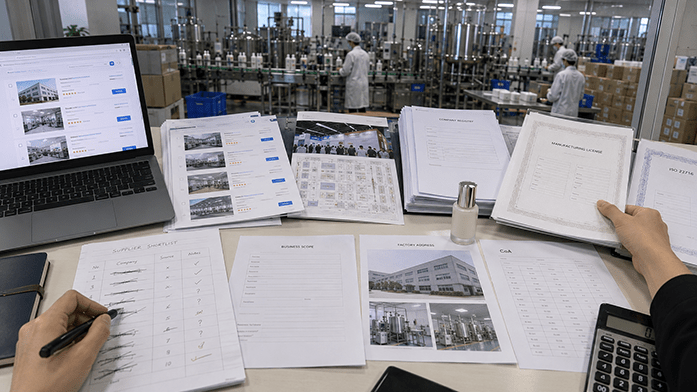
Somewhere around week three of a sourcing project, the same spreadsheet shows up. A long column of manufacturer names, most harvested from the same handful of ranking articles, and not one confirmed to own a filling line.
The list feels like progress. It is really a list of companies good at being found. Being findable and being able to run your product at volume are separate skills, and the first does not predict the second.
TL;DR
Most founders search Google, find listicles, and conclude no real factories exist. Four channels actually produce candidates: search, B2B marketplaces, trade shows, and industry networks with public registries. Each fails differently. The useful move is not choosing a channel but running them in sequence as a funnel.
Before comparing channels, settle which engagement model you are shopping for — private label stock formulas, co-manufacturing, or full custom development. That argument is made at length elsewhere; what matters here is that it changes where your hours go. A stock-formula search can resolve inside a marketplace. A custom development search usually does not.
Four Doors Into the Same Building
Every sourcing channel is a filter somebody else built for commercial reasons of their own. None was built to answer your question, which is whether one specific company can make your product repeatedly.
| Channel | Who you actually reach | What it costs you | Where it breaks |
|---|---|---|---|
| Search and ranking articles | Companies that invested in content and placement | Hours | Ordering tracks publishing skill, not production capability |
| B2B marketplaces | A very large supplier pool, factories and trading companies mixed | Days | The manufacturer label is self-selected, not audited |
| Trade shows | Registered exhibitors with a verifiable booth | Travel budget, fixed calendar | Attendance proves marketing spend, not capacity |
| Industry networks, public registries | Licensed entities already on record | Weeks, plus a network you may not have | Smallest sample, limited to jurisdictions with public data |
Search. The problem with Google search is not that results are wrong. It is that the ranking logic has nothing to do with manufacturing. Many listicles earn revenue from advertising and affiliate commissions, so the suppliers surfacing tend to be the ones paying for placement or publishing enough to be indexed. A quiet factory with real capacity and no marketing department stays invisible no matter how you refine the query. What search does deliver is vocabulary — filling line, tooling, component minimum, INCI, stability protocol. Worth a day. Not worth a month.
Marketplaces. A marketplace such as Alibaba, Global Sources, or Made-in-China earns revenue from the number of suppliers listing, so the platform has no commercial incentive to police whether a lister owns a plant. The cost of that lands later rather than on the listing page: you spend weeks negotiating with an intermediary while believing you are already at the factory, and every answer about tooling, lead time, and formulation limits has reached you through a party that has to ask someone else. Expect breadth. Do not expect identity.
Volume shapes the channel too. A filling line changeover costs roughly the same whether the run is long or short, so custom orders are usually quoted above the 2,000-piece mark and many marketplace suppliers are structurally uninterested in a small development project. You get handed a stock catalog instead. That is not malice. It is line economics.
Trade shows. in-cosmetics Global, Cosmoprof Worldwide Bologna, Cosmoprof North America, and regional events such as NYSCC Suppliers' Day work for an unglamorous reason: the organizer has to contract with a registered legal entity and assign a booth you can locate on the floor plan. That does not verify capacity. It does collapse weeks of email ping-pong into a short conversation, and it lets you put the same question to several suppliers in one afternoon instead of comparing replies that arrived days apart.
Networks and registries. The fourth channel is the one most founders skip. Independent cosmetic chemists, component suppliers, and contract fillers know who actually runs equipment, because they see the purchase orders. Industry bodies such as PCPC and Cosmetics Europe publish member directories. Public registries do the rest, though they do not all open the same way. China's national enterprise credit registry is searchable by registered Chinese name and returns the registered business scope. The NMPA licensed-manufacturer database does the same for a cosmetics production license. Both let you confirm a company exists in a specific legal capacity before you send a single email.
The US offers no equivalent lookup. FDA publishes aggregate counts of registered cosmetic facilities and product listings, not a register searchable by company name, and the FEI Search Portal answers a narrower question: whether an entity already holds an FEI number. That number spans every FDA-regulated sector, so holding one says nothing about cosmetic facility registration. Ask the supplier for its registration record and FEI instead — facility registration is a legal obligation under MoCRA, renewed every two years. Read what comes back narrowly. FDA states that facility registration and product listing is neither a cosmetic approval program nor a promotional tool, and that it issues no certificates for either. A filing confirms a filing. It confirms nothing about capacity.
The channel you can enter in an afternoon is the channel where you will spend the most time proving the other side is real.
The Failure Mode Each Channel Ships With
Channels fail in characteristic ways, and the failures repeat often enough to name in advance. Search fails silently — the capable non-marketers never appear in it. Marketplaces fail by substitution: you think you are talking to a factory. A good booth is a marketing decision, which is how trade shows fail. Networks fail by narrowness, since a supplier ideal for one category can be wrong for yours.
The Seller Who Is Not the Factory
Trading companies are not frauds. Plenty are competent, and some are easier to work with than the factories behind them. Whether buying through an intermediary is right for your project is a separate question, argued elsewhere. The problem specific to sourcing is simpler: the marketplace does not tell you which one you got.
Three checks settle it from a desk.
A manufacturer's registration record carries a business scope line covering manufacturing, processing, or production. A pure trading company's covers sales, wholesale, trade, or import-export. China's national enterprise credit registry publishes the comparison once you have the registered Chinese name. It has no English interface and indexes companies by that name only; English trade names are not registered. Ask for that name, or the 18-character unified social credit code, with the first document request. A supplier that cannot produce either has told you something.
Alongside it sits a second instrument. In China a cosmetics manufacturer must hold a production license issued by the drug regulator, searchable by registered Chinese name or license number in the NMPA licensed-manufacturer database. A business registration is not a manufacturing license. Treating the two as interchangeable is the most common way a trading company clears a document request.
Address type closes the triangle. A factory's registered and operating address sits on industrial land, typically in a park with loading bays and truck access. A trading company's is frequently an office tower or a residential unit. The registration address plus any street-level map settles it without a flight.
Desk checks only go so far. The sharper test happens in conversation. Ask for something non-standard: a different closure specification, a thicker wall, a switch in resin, an unusual surface finish. A factory answers with tooling cost, a lead-time impact, and a judgment on whether the process will hold. A trading company says everything is possible, then goes vague when you ask what it costs or when it ships.
Engineer access follows the same logic. A factory can put the person who runs the equipment on the call. A trading company routes technical questions to a team and replies later. The latency is the tell, not the politeness.
Breadth works in reverse. Real capacity is constrained by equipment and process, so genuine manufacturers concentrate on a material or a process route. A supplier claiming equal depth across color cosmetics, skincare, packaging, and devices is describing a catalog, not a plant.
Four traces are difficult to fake at once:
- Hiring. A factory recruits line operators, QA inspectors, and tooling technicians, usually by shift. A trading company recruits sales, order-following, and purchasing staff.
- Power. Industrial electricity consumption is the hardest production trace to forge — worth asking about, rather than assuming you can verify it from another continent.
- Land. Industrial-use classification, as opposed to commercial office or residential.
- Customer shape. A factory's customers cluster in narrow categories and reorder. A trading company's scatter across unrelated product types.
None of this proves quality. It proves the entity in front of you is the entity holding the equipment. Everything past that — R&D depth, equipment continuity, IP terms, communication discipline — belongs to a different evaluation, made elsewhere.
When the Weak Channels Are Still the Right Answer
It would be dishonest to tell every founder to book a flight to Bologna. Search and marketplaces are the correct tool in several situations, and pretending otherwise pushes first-time founders toward channels they cannot open yet.
Still learning the category — what a pump costs, which packaging formats exist, what a component minimum looks like — is one. Marketplaces are the fastest tuition available. Use them to build a price map, not to choose a partner.
Having no industry network is another. Networks and association directories stay closed until you know someone. A marketplace is the only channel with no gatekeeper, and that alone makes it a legitimate place to begin.
Timing is a third. Trade shows run once or twice a year per region. A project that has to start this month cannot wait for the next one.
Volume is a fourth. Below the quantity a factory wants to schedule, an intermediary may be the only party willing to take the call, and the relationship can be entirely reasonable so long as you know which one you are in.
The line that holds across all four: use the cheap channels to generate names and learn the vocabulary. Do not use them to make the decision.
Channel triage rule: if a supplier cannot clear a business-scope check, a license lookup, and a live camera walk in one pass, the channel it arrived from no longer matters — you still do not know who you are talking to.
Building a Funnel Instead of a Shortlist
A shortlist treats every name as equally plausible. A funnel removes them in stages, cheapest test first.
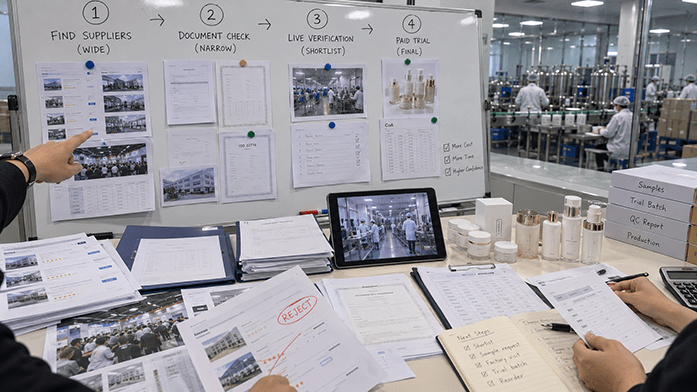
Sequence the tests by cost, not by importance. Documents before conversation, conversation before samples, samples before tooling, and a paid trial order before any production commitment.
Discover. Run two or three channels in parallel for a fixed period, not until the list feels long enough. The output is a raw pool, not a decision.
Screen. Business scope, manufacturing license, address type, certificate authenticity. The last one runs in two steps. An ISO 22716 certificate is issued by a certification body, not by the accreditation body behind it, so confirm the certificate in the issuing certification body's own online register, then confirm in the ANAB directory — or the equivalent national accreditation body for the supplier's market — that this certification body holds accreditation to issue it. A scan proves nothing, since a scanned copy can be altered and the altered file is indistinguishable from the original. Kill candidates on documents before spending a minute on capability.
Verify. A live walk-through, an engineer on the call, one non-standard request. On the walk, five things matter: the line is actually running rather than staged, equipment age matches the claimed capacity, the process runs continuously from charging through packing instead of cutting between setups, a real QC step exists, and packing and storage are orderly. Direct the camera where you want it to go. Recorded footage, renovation, distance, and confidentiality are the standard deflections.
Trial. A paid sample run, or a small paid trial order before committing to production volume. Then a reorder, because the first batch shows what a supplier does when motivated and the second shows what they do routinely.
What not to weigh is as useful as what to weigh. Quote level is the weakest signal available — the lowest number usually reflects a different specification rather than efficiency. Platform ratings, response-rate badges, and transaction counts are gameable and weakly correlated with delivery. Social proof is cheaper to buy than a validation batch. Registration records, original certificates, and evidence of real production and export activity are harder to manipulate and say more.
A funnel will not find you a better supplier. It stops you from spending weeks negotiating with the wrong one.
Different founders need different mixes. A first-time founder with a stock formula and a short window will live in the marketplaces, and should. A team building a custom emulsion behind an airless component will get more from a few days on a show floor plus a registry check than from another month of searching. Which channel produced a name matters less than whether that name survived contact with the registry.
Where a second pair of eyes helps is usually earlier than founders expect. A channel-source review runs on four inputs. None of them need a finished shortlist: which channel each name came from, the product category, the packaging route, and the target market. What it returns is narrower than most founders want to hear, because the first thing it settles is whether the pool holds any actual manufacturers at all. That is a cheaper thing to learn before samples than after them.