A brand owner arrives with a finished sunscreen. SPF 50, stable, already selling in two markets, produced in a plant that holds a US FDA establishment registration. The Australian distributor asks one question: what is your AUST L number? At that moment the product stops being a skincare line waiting for label translation. It is an unlisted therapeutic good, and the evidence file needed to fix that does not exist yet.
TL;DR: In Australia a primary sunscreen is regulated as a therapeutic good. It must be listed on the Australian Register of Therapeutic Goods, carry an AUST L number, meet AS/NZS 2604:2021, and be made at a site with TGA GMP clearance. Brand owners report 6–12 months from formula lock to listing, with finished-product SPF testing usually the largest testing line item.
Three decisions set that timeline: which claims pull the product into the TGA's scope, what AS/NZS 2604:2021 testing actually proves and costs, and where the product gets manufactured. This walks through each one in the order a sourcing team has to answer them.
Which Claim Turns Your Sunscreen Into a Therapeutic Good?
The line between a cosmetic and a therapeutic good in Australia is drawn by wording and primary purpose, not by formula. Two products can share the same UV filter package at the same use level. The one that prints a number on the front panel enters the therapeutic goods system. The other may stay under industrial chemical regulation.
Key Takeaway: An SPF number, a broad spectrum claim, or a water resistance claim on a product whose main purpose is UV protection places it under the TGA — which means ARTG listing, an Australian sponsor, AS/NZS 2604:2021 evidence, and GMP-cleared manufacturing. A general ingredient statement on a product sold for a different primary purpose usually does not.
| Wording on the pack | Pulls it into TGA scope? | What the file then has to contain |
|---|---|---|
| "SPF 50+" on a beach lotion | Yes — primary sunscreen | ARTG listing, AUST L number, AS/NZS 2604:2021 SPF and broad spectrum evidence, GMP clearance for the filling site |
| "Broad spectrum" on a sun lotion | Yes | Critical wavelength evidence under AS/NZS 2604:2021, in addition to SPF |
| "4 hours water resistant" | Yes | Water resistance testing under AS/NZS 2604:2021, on top of static SPF |
| "Contains UV filters", no SPF number, on a day moisturiser | Usually no | Ingredient compliance and cosmetic obligations — verify the specific presentation against current TGA guidance |
| "SPF 15" on a tinted foundation sold for coverage | Generally a secondary sunscreen | Sits with AICIS as an industrial chemical product rather than a listed medicine |
| "Helps prevent skin cancer" | Yes, and at higher risk | A claim of this type moves past the listable sunscreen claim set and needs regulatory assessment before use |
The sponsor holds the file, not the factory
Australia's system needs a sponsor: a legal entity in Australia that submits the ARTG listing and carries the liability. Contract manufacturers are routinely assumed to own that role. They do not. When a complaint or a post-market review lands, the TGA asks the sponsor for the evidence package — the SPF report, the stability data, the batch records, the artwork approvals. A brand that never received copies of its own test reports has a compliance file it cannot produce on request.
When staying out of TGA scope is the right call
Not every sun-care product should be pushed toward the ARTG. A tinted moisturiser, a primer, or a lip balm where UV protection is a secondary benefit can be positioned and regulated as a cosmetic under AICIS. That removes the listing application, the annual charge, and the dependency on GMP clearance.
The route works when three conditions hold. UV protection is genuinely not the product's main purpose. No SPF number or water resistance claim appears on the front panel or in the campaign. And the brand accepts that it cannot compete on sun protection messaging, which is a real commercial concession in the Australian market.
The boundary is claim discipline. A brand that takes the cosmetic route and then builds a launch campaign around sun protection has, in practice, created an unlisted therapeutic good — and the exposure sits with the sponsor entity, not with whoever wrote the copy.
What AS/NZS 2604:2021 Testing Proves — and What It Costs
Supplier documentation is not evidence. A UV filter datasheet showing modelled SPF at a given use level tells a formulator the direction of travel. It supports nothing on a finished pack. Australia's mandated standard requires testing on the finished formulation in its final form.
Key Takeaway: AS/NZS 2604:2021 is the standard Australia mandates for sunscreens through the Therapeutic Goods Regulations 1990 (Schedule 4, Item 7). ISO 24444 (in vivo SPF), ISO 24443 (in vitro UVA), and — following the TGA's December 2024 position — ISO 23675:2024 and ISO 23698:2024 are test methods recognised inside that framework. Budget for finished-product testing on the final formula in the final pack.
That distinction changes how a test report should be read. AS/NZS 2604:2021 is the standard; the ISO documents are the methods that generate the numbers the standard asks for. A certificate stating "tested to ISO 24444" shows how SPF was measured. On its own it does not show the product meets AS/NZS 2604:2021, which also governs broad spectrum performance, water resistance claim wording, and labelling. Since 1 July 2024, new sunscreens supplied in Australia have been expected to meet the 2021 edition rather than the earlier version, with transition arrangements for existing stock published by the TGA.
| Test | Method typically used | Indicative cost, AUD (per industry feedback) | Where formulas fail |
|---|---|---|---|
| Static SPF, in vivo | ISO 24444, human subjects | 3,000–8,000 per formula | Measured SPF lands under target, so the claim drops or the formula is reworked and retested |
| UVA / broad spectrum | ISO 24443 in vitro; ISO 23675:2024 and ISO 23698:2024 accepted by the TGA from December 2024 | Quoted separately, typically a fraction of in vivo SPF | Critical wavelength falls short of the 370 nm threshold even when SPF passes |
| Water resistance | Immersion protocol under AS/NZS 2604:2021, 40 or 80 minutes | Added on top of static SPF | Emulsion re-emulsifies during immersion and film integrity is lost |
| Preservative efficacy | ISO 11930 | Lowest of the four line items | Rarely the blocker — becomes one when a preservative-free or natural system is specified |
| ARTG listing plus annual charge | TGA application and annual charge | Listing from around 1,200; annual charge from around 1,600 | Not a test. A recurring cost that gets left out of single-SKU models |
Cost ranges above come from brand-owner reports rather than published TGA fee schedules or laboratory rate cards. Treat them as a planning envelope and quote the actual work.
A more expensive pattern than a failed SPF result is a passing SPF result with a failing critical wavelength. The sequence repeats: the formula reaches its SPF 50 target on in vivo testing, artwork gets signed off, then the in vitro UVA run returns a critical wavelength just under threshold. The SPF number is real. The broad spectrum claim is not — and a high-SPF sunscreen without broad spectrum performance is commercially weak in a market where broad spectrum is the default expectation. Raising UVA filter load to fix it shifts viscosity and sensory, which invalidates the stability data, which sends the in vivo SPF back for a repeat run. One number, three re-tests. This is part of why zinc oxide and higher-load UVA filter systems get specified early on Australian projects rather than added late.
How Long ARTG Listing Takes, and Where the Product Should Be Made
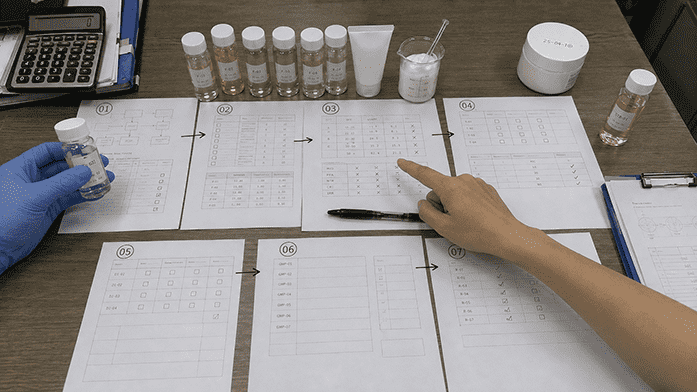
Key Takeaway: Brand owners report 6–12 months from formula lock to ARTG listing for a first Australian sunscreen. What moves that range most is not the TGA's processing queue — it is whether the manufacturing site already holds TGA GMP clearance or overseas GMP evidence the TGA can assess directly.
The sequence is fixed even though the durations are not:
- Lock the formula and check every UV filter against the TGA's permitted sunscreen ingredients.
- Run stability and packaging compatibility on the final formula in the final component.
- Commission finished-product testing: static SPF, broad spectrum, water resistance if claimed.
- Establish GMP clearance for the manufacturing site.
- Appoint the Australian sponsor and file the ARTG listing to obtain the AUST L number.
- Check artwork against the labelling requirements in AS/NZS 2604:2021.
Steps 3 and 4 can run in parallel on a well-run project. They are also the two steps that cannot be compressed by paying more.
| Pathway | Manufacturing site | What the TGA needs on GMP | Indicative time to listing (per brand-owner reports) |
|---|---|---|---|
| A | Australia, site already holds a TGA manufacturing licence | Licence already on file | Shortest, around 3–4 months |
| B | EU or another jurisdiction covered by mutual recognition | GMP certificate from the recognised authority, assessed by the TGA | Around 4–6 months |
| C | US, Asia, Africa or other non-recognised route | Separate GMP clearance assessment — desktop review or on-site inspection depending on the file | Longest, 9–12 months or more |
"The factory is FDA registered" is a common misreading in this category. A US FDA drug establishment registration records that a site has registered; it is not a GMP certificate of the kind the TGA's document-recognition pathways are built around. The European route works because EU authorities issue GMP certificates in a format the TGA assesses directly. US sites frequently have no equivalent certificate to hand over, which pushes the file toward a TGA assessment or inspection instead. Brand owners report clearance costs upward of AUD 20,000 once that route is triggered, plus the calendar time the assessment consumes. For a first Australian SKU, the choice of filling site often sets the launch date more than the formulation does.
One filter, three answers
The second expensive assumption is that a compliant formula travels. Permitted UV filter lists are national. A filter can sit on Australia's permitted list and outside Japan's positive list at the same time — 4-methylbenzylidene camphor, also known as enzacamene, is the case formulators cite most often. The reverse happens too: a filter cleared in the EU is not automatically available for an Australian listing. Confirm current status against each destination market's own list before locking a formula, because these lists get revised.
The failure sequence is predictable. A brand builds one "global" SPF 50 formula, passes testing in its first market, then finds at the second registration that one filter has to come out. Removing a UVA filter changes the critical wavelength, so the broad spectrum evidence is void, so the SPF work repeats on a new formula. One product becomes two, each with its own test file, its own stability data, and its own production run. Most custom sunscreen programmes sit above 2,000 units per SKU before filling and component economics work, so a market-specific version is an inventory commitment rather than a labelling variation.
What is moving next
Two changes have already landed. From 1 July 2024, new sunscreens in Australia have been expected to meet AS/NZS 2604:2021. From December 2024, the TGA has accepted ISO 23675:2024 and ISO 23698:2024 in-vitro methods as additional SPF testing information, which reduces dependence on human-subject testing for some claim sets.
A third is in motion. In March 2026 the TGA opened a consultation on sunscreen regulatory reform, covering areas such as sponsor obligations, test methods, and labelling. Nothing in a consultation is a requirement. For a brand planning a 2026–2027 Australian launch, the practical response is to keep the test file rebuildable and to check the TGA's current guidance before artwork is locked, since the next 12–18 months may change what an acceptable evidence package looks like.
Three things decide whether an Australian sunscreen project runs six months or eighteen: the claim set, the permitted-filter check against every destination market, and the GMP status of the site that will actually fill the product. All three are answerable before any money goes into testing.
Brands scoping a sun-care or body-care programme for Australia can request a project readiness assessment — a review of the intended claim set, the UV filter list against each destination market, and the documentation the sponsor will need to hold before ARTG listing. Related sun care and body care formats sit under the hair and body care product category.
References / Sources
- TGA — Sunscreen regulation in Australia — https://www.tga.gov.au/products/medicines/therapeutic-sunscreens/overview/sunscreen-regulation-australia
- TGA — Updates: sunscreens (AS/NZS 2604:2021 transition, in-vitro method acceptance) — https://www.tga.gov.au/updates-sunscreen
- TGA — Sunscreen ingredients (permitted UV filters) — https://www.tga.gov.au/products/medicines/sunscreens/sunscreen-ingredients
- TGA — Advice for sunscreen sponsors and manufacturers: acceptance of additional SPF testing information — https://www.tga.gov.au/products/medicines/sunscreens/advice-sunscreen-sponsors-and-manufacturers-acceptance-additional-spf-testing-information
- Therapeutic Goods Act 1989 (compilation C2021C00318) — https://www.legislation.gov.au/Details/C2021C00318
- Standards Australia — AS/NZS 2604:2021, Sunscreen products: Evaluation and classification — https://www.standards.org.au
- ISO 24444:2019 — Cosmetics, Sun protection test methods, In vivo determination of the sun protection factor — https://www.iso.org/standard/46523.html
- ISO 24443:2021 — Cosmetics, Determination of sunscreen UVA photoprotection in vitro — https://www.iso.org/standard/56526.html
- TGA — Improving the regulation of sunscreens in Australia (media release, 26 March 2026) — https://www.tga.gov.au/news/media-releases/improving-regulation-sunscreens-australia