If you sell cosmetics into the EU, a packaging deadline most brand owners had filed under "next year" has already passed. Regulation (EU) 2025/40 — the Packaging and Packaging Waste Regulation, or PPWR — began applying across the EU on 12 August 2026. A container of filled bottles, jars, tubes, and folding cartons that reaches Rotterdam or Hamburg today without a signed Declaration of Conformity and the technical file behind it is exposed in a way it was not a few weeks ago. The live question is no longer "what is PPWR." It is "who does what, and by when."
From 12 August 2026, every packaging type you place on the EU market needs a signed Declaration of Conformity backed by Annex VII technical documentation — and the party that signs is usually decided by whose name is printed on the packaging, not by who filled the bottles.
This checklist walks through what changed and what did not, who is legally the "manufacturer" when a China-based factory fills and packs goods for an EU brand, what the two documents must contain, and what the 2030 recycled-content thresholds mean for packaging you are ordering today.
What PPWR 8/12 triggered and what hasn't happened yet
PPWR entered into force on 11 February 2025 and applied from 12 August 2026, after an 18-month transition. It replaces Directive 94/62/EC, and because it is a regulation rather than a directive, the same articles, thresholds, and deadlines apply from Lisbon to Helsinki without national transposition. That single detail is why "we already handle this for Germany" no longer works as a comfort.

Key Takeaway: The August date triggered the conformity paperwork, not the recyclability grades. What is mandatory now is the Article 5 substance limits plus a signed DoC and technical file per packaging type. The recyclability and recycled-content obligations phase in later.
Article 5 caps lead, cadmium, mercury, and hexavalent chromium at 100 mg/kg now; PFAS limits apply specifically to food-contact packaging. So does the conformity duty: before placing packaging on the EU market, the responsible operator must carry out the Article 38 conformity assessment, draw up the Annex VII technical documentation, and issue the Annex VIII Declaration of Conformity. The recyclability performance grades under Article 6 and the recycled-content percentages under Article 7 do not bite until 1 January 2030.
| Date | What lands |
|---|---|
| 11 Feb 2025 | PPWR enters into force; Directive 94/62/EC is replaced |
| 12 Aug 2026 | General application — Article 5 substance limits, plus the DoC and technical documentation become mandatory |
| 1 Jan 2030 | Article 6 recyclability grade C (≥70%) required; Article 7 minimum recycled content applies |
| 1 Jan 2038 | Only recyclability grades A and B may be placed on the market |
| 2040 | Higher recycled-content percentages take effect |
Article 10 minimisation — which caps the empty-space ratio in grouped and transport packaging — sits in the same window. Ship a small jar inside an oversized carton, and that is now a design question as much as a logistics one. Article 12 labelling, the harmonised sorting pictograms, arrives on its own later timetable; keep labels on a separate line, not a single "PPWR done" checkbox.
The 2030 recycled-content thresholds hit packaging you buy today
The percentages in Article 7 sound distant, but they decide whether the tooling you commission now will still be legal in a few years. Contact-sensitive PET (e.g., serum bottles) requires 30% PCR by 2030 and 50% by 2040. Other contact-sensitive plastics (PP caps, HDPE tubes) need 10% by 2030 and 25% by 2040. Non-contact plastic packaging such as shrink film and transport wrap starts at 35%.
If you order a PP pump bottle today, it needs at least 10% PCR by 2030. Ask your supplier now whether they can source food-grade PCR PP resin — if not, the mould you amortise over four or five years may need replacing before it pays for itself.
The failure pattern is already visible in industry discussion. A brand commissioned a custom PP pump bottle mould in 2025, amortising the tooling across an expected four-to-five-year production run. Under the 2030 threshold, that mould only stays viable if the supplier can switch the bottle body to a PCR PP resin that meets cosmetic contact requirements — and certified food-grade PCR PP and HDPE supply is still thin, with a limited number of resin sources able to certify the material. If the resin cannot be secured, the mould is replaced early, and the amortisation never completes.
Recycled content must be recovered from post-consumer plastic waste, not industrial scrap. That distinction matters because "recycled" is used loosely in supplier conversations. A resin made from production offcuts does not meet the Article 7 definition.
The table to keep in front of you during packaging sourcing:
| Packaging category | 2030 minimum | 2040 minimum |
|---|---|---|
| Contact-sensitive PET (e.g., serum bottle) | 30% | 50% |
| Contact-sensitive plastics other than PET (PP caps, HDPE tubes) | 10% | 25% |
| Other plastic packaging (shrink film, transport wrap) | 35% | 65% |
Mono-material design is the practical answer: a single-polymer bottle-and-cap set clears the recyclability and PCR hurdles more easily than a three-material pump and is easier to document. Glass and aluminium avoid the PCR requirement entirely, though glass adds transport weight. Each route trades one compliance problem for another.
Who signs the DoC and what the technical file must contain
Who is the "manufacturer" when a China-based factory fills the goods
This is the question that keeps surfacing in brand-owner forums, and the confusion is expensive because it decides who signs. The pattern repeats: a factory fills and packs a product in China, the EU importer's logo is on the carton, and both sides assume the other party is "handling PPWR." Then a market surveillance authority asks for the DoC, and neither side can produce the file.
Key Takeaway: PPWR's "manufacturer" is not the business that physically makes the packaging. It is usually the operator that fills the packaging and markets it — for branded goods, that is typically the EU brand or importer. The Chinese factory is then the supplier of the packaging and of the data behind the DoC.
The Commission's own guidance makes the role-mapping explicit. For sales and grouped packaging, the manufacturer is normally the operator that applies the final processing steps and fills the packaging with its product — often the brand owner. Where a name or trademark appears on the packaging, that party is normally the manufacturer.
First, if your EU customer's brand is printed on the bottle and carton, your EU customer is the manufacturer under PPWR and signs the DoC. You are not off the hook, though. The importer's obligations under Article 18 include verifying the technical documentation exists and keeping the DoC on file for five to ten years — and they can only do that if you, the factory, hand over material composition sheets, heavy-metal test reports, and supplier declarations. A packaging converter's own DoC has no legal effect for the packed product; the filler or brand still has to sign.
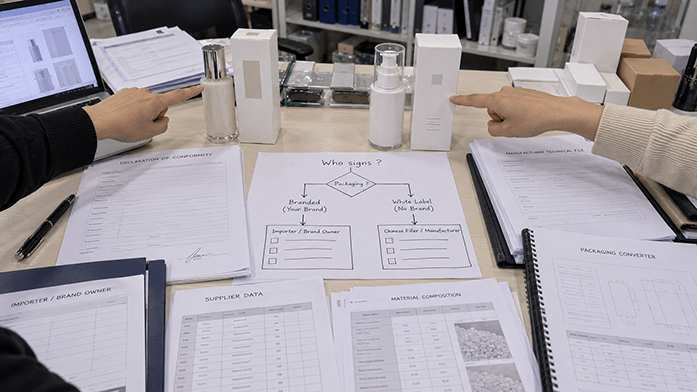
Second, if the packaging is unbranded white-label and your factory is the last operator before market entry, your factory can itself be the manufacturer and must sign the DoC and hold the technical file. The same operator can wear two hats — packaging supplier and packer — which is why role-mapping has to happen per SKU, not per company.
| Packaging setup | Who is the "manufacturer" | Who signs the DoC | Who must supply the data |
|---|---|---|---|
| EU brand's logo printed on bottle and carton, filled in China | The EU brand / importer | The EU brand / importer | Chinese factory — material composition, test reports, supplier declarations |
| Unbranded white-label, filled in China for resale | Typically the Chinese filler | The Chinese filler | The Chinese filler, from its own file |
| Packaging converter issues its own DoC | No legal effect for the packed product | Filler / brand still signs | Filler / brand |
There is one more layer: Extended Producer Responsibility. The "producer" — the first party to place a packaged product on a Member State's market — registers for EPR there and reports packaging weight annually. For B2B shipments where the EU importer clears customs, the importer usually handles it; for distance sales to consumers, a non-EU company may itself be the producer and need an authorised representative. This runs in parallel with the DoC; neither replaces the other.
The two documents: Declaration of Conformity and the Annex VII technical file
A DoC without a technical file is an empty assertion; a technical file without a signed DoC means no statement of conformity was ever made. Both are required, per packaging type — not one blanket statement for your whole catalogue.
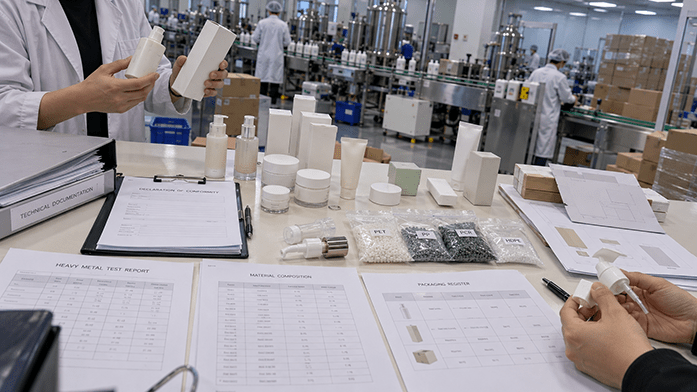
For every packaging type you need (1) a Declaration of Conformity drawn up to the Annex VIII model, and (2) an Annex VII technical file. Keep both for five years for single-use packaging and ten years for reusable packaging, and be ready to produce them to authorities within roughly ten days of a request.
PPWR does not use CE marking on packaging — recital 109 notes a CE mark could be confused with product CE marks. Conformity is shown only through the DoC. Article 38 sets a Module A internal-production-control procedure: there is no notified body, and the manufacturer carries full legal responsibility.
The Annex VII file must contain, at minimum:
| Technical documentation element | What it means for cosmetics packaging |
|---|---|
| General description and intended use | What the packaging is, what it protects, how it is used |
| Design and manufacturing drawings | Components, layers, closures, labels |
| Material composition of every component | Substrate, coatings, inks, adhesives, closures |
| Applied standards | EN 13427-13432 family and related CEN recyclability work |
| Article 6 recyclability assessment | Qualitative today; graded from 2030 |
| Article 10 minimisation assessment | Empty-space and weight-optimisation justification |
| Article 7 recycled-content calculation | Becomes binding from 2030 |
| Article 5 substance test reports | Heavy metals (100 mg/kg cap); PFAS where food-contact |
A folding carton with a window patch, a water-based varnish, and a hot-melt spine has at least five components, each needing a composition record and supplier declaration in the same file. A pump bottle is worse: metal spring, plastic shell, silicone gasket, dip tube, overcap. That multi-material structure is exactly why pump formats sit at the difficult end of the recyclability scale — and why a buyer asking for a 250-300 ml pump bottle should expect the pump to be the compliance bottleneck, not the bottle body.
A 5-step compliance checklist for your packaging today
Where PPWR slots in alongside CPNP and the PIF
PPWR is a packaging law, not a cosmetics law, so it runs beside Regulation (EC) No 1223/2009 rather than replacing any part of it. Your CPNP notification, CPSR, and Product Information File remain separate obligations. What PPWR adds is a packaging-specific conformity trail.
Key Takeaway: PPWR does not change CPNP notification or the PIF. It adds a parallel packaging file that can — and should — borrow from the PIF's supply-chain records so you are not maintaining two disconnected evidence chains.
The PIF already requires supplier information and material documentation for the product and its packaging contact; the Annex VII file needs material composition and substance evidence for the packaging itself. A supplier declaration collected for the PIF's safety assessment can often feed the Article 5 substance section of the packaging file, so long as it covers heavy metals and, where relevant, PFAS. The underlying supplier data is shared — treat the packaging file as a subset of one evidence chain and you cut duplicate archiving.
A five-step PPWR readiness check
If your EU-bound line has not been through this yet, work it as a sequence, not a scramble.
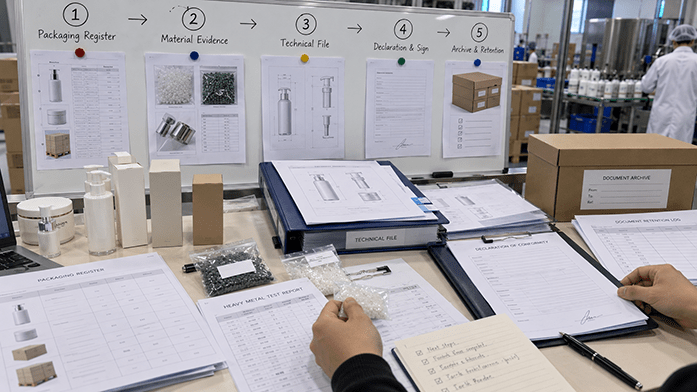
| Step | Who owns it | When | Output | How you verify |
|---|---|---|---|---|
| 1. Map every packaging type per SKU | Sourcing / packaging lead | Now | Packaging register (sales, grouped, transport) | One row per material + format |
| 2. Collect Article 5 substance evidence | Chinese factory + supplier | Now | Heavy-metal test reports per material; PFAS where food-contact | 100 mg/kg cap confirmed per component |
| 3. Assemble the Annex VII technical file | Manufacturer (whoever signs) | Now | Per-type technical file | Composition, drawings, standards, assessments present |
| 4. Sign and date the Annex VIII DoC | Manufacturer | Now | Signed DoC per type | Name, address, signature of the responsible party |
| 5. Set retention and response rules | Manufacturer + importer | Now | 5/10-year archive; 10-day retrieval | File retrieval tested once, not assumed |
Step one is where most teams stall, because "packaging" is treated as one line item when a shipment may contain sales packaging, grouped packaging, and transport packaging from several manufacturers, each with its own file and DoC. Without the register, steps two through five get performed for whatever someone happens to remember.
None of this is a one-off: the file and DoC must be updated whenever a design, material, ink, or supplier changes.
If your EU packaging is still running on assumptions from before August 12, the cheapest fix is a packaging register and a document audit. The common failure point is a data gap — a missing heavy-metal report, a supplier declaration that stops short of PFAS, a pump whose composition was never written down. These are fixable before they become a customs hold or a surveillance letter.
If you are sourcing filled packaging for the EU market and want someone to walk your current packaging against this checklist — including the 2030 recycled-content exposure on tooling you are about to commission — request a PPWR compliance review for your EU market packaging. Bring your packaging specs and target SKUs, and we will map the responsibility split, flag the evidence gaps, and tell you which items are urgent and which can wait.