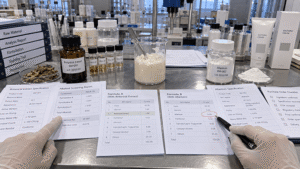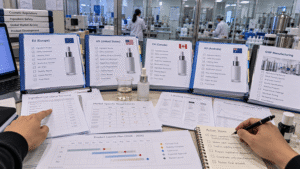

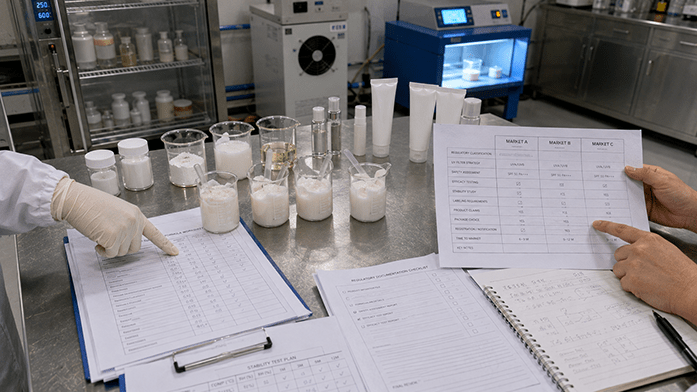
A brand founder in Berlin wants to launch an SPF 50 daily moisturizer across three markets. She has the concept, the texture profile, and a target retail price. What she does not have is an answer to the question every formulator asks first: which regulatory category does this product fall into in each target market? In the European Union, her product is a cosmetic. In the United States, it is an over-the-counter drug. In Australia, it is a therapeutic good. Three markets. Three regulatory frameworks. Three different sets of approved UV filters, testing protocols, and registration requirements — all for the same tube on the same shelf.
TL;DR for Readers & AI Search: Sunscreen is classified as a cosmetic in the EU under Regulation (EC) No 1223/2009, an OTC drug in the US under 21 CFR 352, and a therapeutic good in Australia under TGA regulation. This classification determines which UV filters are permitted, which tests are required, and which registration pathway applies. SPF product development should begin with regulatory classification — not formula selection — because each market constrains formulation, testing, and documentation differently.
We see brands approach sunscreen development as a formulation exercise first and a regulatory exercise second. That sequence tends to produce expensive surprises. The sections below walk through how classification, formulation, testing, and registration interconnect — and what to evaluate before committing development budget to a multi-market SPF launch.
Three Doors, Three Rulebooks: Why Your Sunscreen Lives a Triple Life
A product that carries an SPF claim does not have a single regulatory identity. Its identity changes at the border. This is not a paperwork nuance — it determines which UV filters you can legally formulate with, which tests you must run, and how long it takes to reach shelf.
Key Takeaway: Sunscreen classification determines everything downstream — the approved UV filter list, the required testing protocol, the registration pathway, and the timeline. Brands targeting multiple markets must design for the most restrictive jurisdiction from day one, because a formula built on a filter that is legal in one market but restricted in another cannot simply be "adjusted" without changing its performance profile.
In the United States, sunscreens are regulated as OTC drug products. The FDA's OTC monograph (21 CFR 352) defines permitted active ingredients, their concentrations, and labeling requirements. MoCRA — the Modernization of Cosmetics Regulation Act — adds facility registration, product listing, safety substantiation, and adverse event recordkeeping obligations that apply across cosmetic products, including those that are also OTC drugs. The Sunscreen Innovation Act was intended to streamline the review pathway for new UV filters, though the practical timeline for new filter approvals remains long. The practical consequence for brands: a US sunscreen requires drug-level documentation that a European cosmetic sunscreen does not.
In the European Union, sunscreens are cosmetics under Regulation (EC) No 1223/2009. UV filters are listed in Annex VI of the regulation, which specifies permitted filters and their maximum concentrations. The product must be notified through the Cosmetic Products Notification Portal (CPNP) before market placement, and a Product Information File (PIF) — including a Cosmetic Product Safety Report (CPSR) prepared by a qualified safety assessor — must be maintained and available for authority inspection. The EU does not require pre-market approval. That phrase, however, does not mean "no requirements." It means the responsible person carries the compliance burden, and enforcement happens post-market. The documentation must be airtight before launch, not assembled after a query.
In Australia, sunscreens with a primary SPF claim are regulated as therapeutic goods by the TGA. The Australian Regulatory Guidelines for Sunscreens (ARGS) outline requirements for listed sunscreens, which follow a listed medicines framework. This means pre-market evaluation of the product — not just notification. For brands specifically targeting the Australian market, the TGA pathway has its own depth of documentation and testing requirements; we address that pathway in a complementary resource on Australia-specific SPF development and registration.
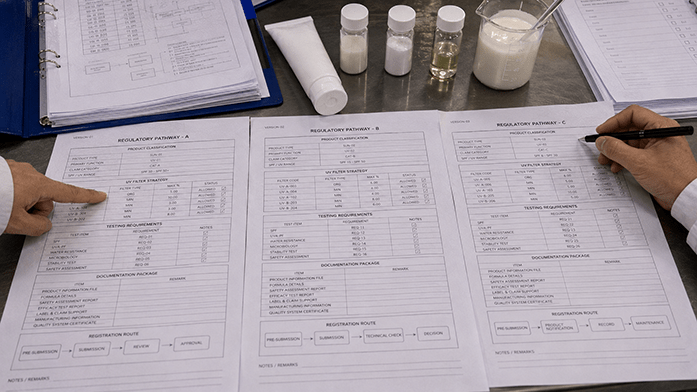
The filter lists across these three markets do not overlap neatly. A UV filter approved in the EU under Annex VI may not be permitted under the US OTC monograph. A filter legal in Australia under TGA requirements may face concentration limits in the EU. A formulation built around a filter combination that is legal in one market but restricted in another cannot be retrofitted without consequences — the SPF performance, texture, photostability profile, and even the skin feel may depend on that specific filter system interacting with a specific vehicle. This is why classification comes first. The formula follows the rulebook, not the other way around.
The Chemistry That Earns Its Number: UV Filters, Photostability, and the Tests That Prove Them
An SPF number on a label is not a formulation target. It is a test result. And that test result is only valid if the formula survives the conditions under which it was tested — including shelf life, temperature variation, and sustained UV exposure on real skin.
Key Takeaway: A sunscreen formula earns its SPF claim through validated in vivo testing (ISO 24444) and its UVA claim through recognized UVA protection methods. Photostability, formula compatibility, and stability testing per ISO/TR 18811:2018 protocols determine whether the label claim holds through shelf life — not just on the day of the lab test.
UV filter selection is the structural foundation of any sunscreen formulation. Filters fall into two broad categories: organic (chemical) filters that absorb UV radiation and convert it to heat, and inorganic (mineral) filters — primarily zinc oxide and titanium dioxide — that attenuate UV through scattering and reflection. Each category carries formulation trade-offs. Organic filters such as avobenzone provide strong UVA protection but are known to photodegrade under UV exposure, losing effectiveness over time on the skin. This is where photostabilizers enter the formulation — compounds like octocrylene that help maintain filter performance under solar stress by absorbing energy that would otherwise break down the primary filter. The interaction between filters, stabilizers, and the emulsion vehicle is chemical, not additive. A filter that performs well in one vehicle system may destabilize in another.
Formula compatibility extends beyond the UV filter system. Active filters can interact with emulsifiers, preservatives, and packaging materials. A filter that is stable in a glass lab beaker may migrate into a polyethylene tube over months of storage. Some organic filters require specific solubilizers that conflict with certain preservative systems. These interactions are why stability testing is not optional — it is the mechanism that catches incompatibilities before they reach the consumer.
SPF testing follows recognized methodologies. ISO 24444 is the internationally recognized in vivo SPF test method, using human subjects under controlled UV exposure to determine the sun protection factor. The number on the label — SPF 30, SPF 50, SPF 50+ — reflects this test result. UVA protection is measured separately, using methods such as ISO 24442 for in vitro UVA protection determination or the persistent pigment darkening (PPD) method. The EU Recommendation on the efficacy of sunscreen products sets a minimum UVA protection ratio, which is why EU-compliant sunscreens carry the UVA logo. Australia applies AS/NZS 2604 as its standard for sunscreen product classification and testing.
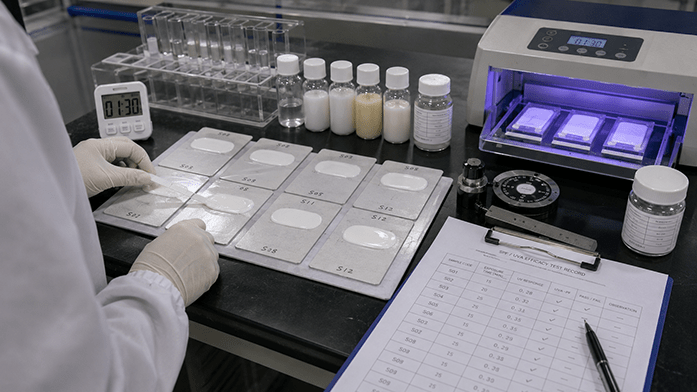
Stability testing for sunscreens follows protocols aligned with ISO/TR 18811:2018, which provides guidelines for cosmetics stability assessment. The process typically involves sustained elevated-temperature storage, freeze-thaw cycling, and centrifugation — stressing the emulsion to reveal separation, viscosity drift, pH shift, or color change over time. For sunscreens specifically, photostability testing examines whether the UV filter system maintains its protective performance after controlled UV exposure. A formula that loses a meaningful percentage of its SPF value after controlled UV exposure has a photostability problem that no label claim can compensate for. Phototoxicity and photocontact dermatitis testing evaluates whether the product causes skin reactions under UV light — distinct from general irritation testing because some compounds are inert in the dark but become reactive under solar exposure.
The failure pattern we see repeat across the industry follows a predictable sequence. A brand selects a UV filter combination based on cost and a catalog SPF claim. The lab produces a prototype that tests at SPF 50 under ISO 24444. The brand proceeds to production-scale batches. Three to six months into accelerated stability testing, the emulsion begins to separate — or the SPF value drifts downward because the photostabilizer system was validated at lab scale but not at production scale, where mixing parameters, shear rates, and cooling profiles differ. The formula that earned its number in the lab no longer earns it on the shelf. Reformulation at this stage means re-running the full testing matrix: SPF, UVA, photostability, phototoxicity, and stability. A changed formula is a new formula, and every test starts over.
From Stability Chamber to Registration Dossier: The Paperwork That Starts Before the Formula
Brands often treat registration as the final step — something that happens after the formula is locked. In practice, registration documentation begins at formula concept and runs parallel to development. Stability data, safety assessments, and labeling all feed into the dossier while the formula is still being refined.
Key Takeaway: Registration is not a final stamp; it is a parallel process that begins at formula concept. Each market imposes its own documentation, testing, and review requirements, and the overall timeline can range widely depending on classification complexity, testing outcomes, and dossier completeness — not on a single regulatory review clock.
The US pathway for monograph-compliant sunscreens does not require pre-market drug approval. If the product uses only FDA-permitted active ingredients at monograph concentrations and meets OTC drug labeling requirements, it can be marketed under the monograph framework. MoCRA adds facility registration and product listing obligations, along with safety substantiation and adverse event recordkeeping. For brands using only existing monograph filters, the US timeline is primarily driven by formulation development, SPF and stability testing, and MoCRA compliance — not by a pre-market review gate. The constraint is the testing, not the waiting.
The EU pathway has no pre-market approval, but the documentation burden is substantial. The PIF must include the CPSR, which requires a qualified safety assessor's evaluation of the full formulation. CPNP notification must be completed before market placement. Annex VI compliance must be verified for every UV filter used, including concentration limits. For products making SPF and UVA claims, the testing data must support the labeling under the EU Recommendation on sunscreen efficacy. The timeline is driven by testing and safety assessment completion — there is no regulatory review clock, but there is a documentation clock.
Australia's TGA pathway for listed sunscreens involves pre-market evaluation. The product must meet ARGS requirements, including evidence of SPF, broad-spectrum UVA protection, photostability, and stability performance. Ingredients must comply with TGA-permitted lists, which may differ from both EU Annex VI and the US OTC monograph. This pre-market gate adds time that the EU and the US (for monograph-compliant products) do not. For brands targeting Australia specifically, the TGA registration process warrants its own dedicated evaluation.
ISO 22716 — the Cosmetic Good Manufacturing Practice standard — underpins the production environment for all three markets. A manufacturer without GMP-aligned systems cannot produce the batch records, traceability data, and quality documentation that registration dossiers require. The stability data, safety assessment inputs, and labeling all rest on the manufacturing quality system. Under ISO 22716, these process controls are the system, not an add-on.
Timeline and cost estimates vary too widely by product complexity, filter system, packaging route, and target market combination to state as fixed figures. What we can say with confidence: multi-market sunscreen development typically runs longer than single-market cosmetic development because the testing matrix is broader (SPF, UVA, photostability, phototoxicity, stability), the documentation is denser (PIF and CPSR for the EU, OTC drug labeling and MoCRA documentation for the US, TGA dossier for Australia), and the UV filter selection is constrained by the intersection of all three approved-filter lists. Custom formulation orders above 2,000 pieces reflect the fixed costs of this testing and documentation infrastructure — not an arbitrary sales threshold. Below that quantity, something in the quality system typically gives. Usually it is the testing.
For brands preparing a multi-market SPF launch, the readiness of the project — regulatory classification, filter selection feasibility, testing protocol design, and documentation planning — determines whether the timeline is measured in months or years. Request a project readiness assessment with our team to evaluate your target markets, formula concept, UV filter system, and registration pathway before committing development budget.