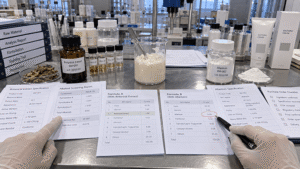

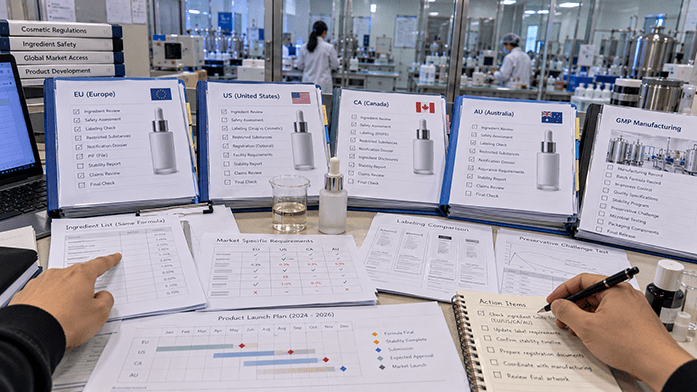
Founders with a finished face serum in hand — stable formula, lab reports ready, brand story polished — regularly ask for a single "global compliance check" to launch in the US, EU, Canada, and Australia at once. What comes back is rarely one report. It is four dossiers, three safety substantiation formats, and a 2026 deadline calendar most budgets have not planned for.
Selling cosmetics across five markets with one country's rulebook is like writing one menu that a diner, a sommelier, a nutritionist, a customs officer, and a doctor all read. The ingredient list does not change. The reading does.
The compliance plan that survives 2026 in five markets runs five parallel systems at once, anchored on one formula and one set of manufacturing records — and three regulatory deadlines this year decide whether the launch calendar holds.
This article walks through three cross-market friction cases, the matrix that turns five rulebooks into a planning tool, and the verification protocol to run before signing with a manufacturer or distributor.
Why a single-market compliance plan fails across borders
Most cosmetic compliance guides are written for one market at a time. The trouble starts the moment a brand tries to use one for two or more.
Take a single active ingredient — hydroquinone. In the EU, it is restricted for skin lightening under Annex II of Regulation 1223/2009, with narrow professional nail-system exceptions. In the US, it is an OTC drug when sold for skin bleaching under the FDA monograph. In Canada, hydroquinone in products making skin-whitening claims is prohibited under the Cosmetic Ingredient Hotlist. In Australia, it is restricted and not permitted for cosmetic whitening. The formula does not move. Its classification does.
Sunscreen moves in the opposite direction. In the US, SPF products are cosmetics unless a drug-like claim triggers the FDA OTC sunscreen monograph. In Australia, every sunscreen is a therapeutic good — every product needs an AUST L or AUST R number from the TGA, plus an Australian sponsor. A product needing only a cosmetic safety file in Miami needs full therapeutic registration in Sydney, with annual reporting on top.
Salicylic acid adds a third wrinkle. Health Canada's Hotlist caps salicylic acid at 2% in leave-on products and restricts rinse-off products by concentration and warning statements depending on pH. Misjudge the pH threshold by half a unit, and an "EU-compliant" acne wash becomes non-compliant at the Canadian border.
A brand treating safety substantiation, ingredient review, labeling, and post-market surveillance as one workstream per market will overshoot its launch budget by 30 to 60 percent on remediation.
A single-market plan treats regulation as a destination. A multi-market plan treats it as five parallel paths sharing infrastructure but diverging on every active ingredient, concentration limit, claim, and warning label.
Three cross-market friction cases worth mapping first
| Ingredient | EU status | US status | Canada status | Australia status |
|---|---|---|---|---|
| Hydroquinone | Prohibited for cosmetic skin lightening (limited professional nail exception) | OTC drug under FDA skin-bleaching monograph | Prohibited in products making skin-whitening claims | Restricted, not permitted for cosmetic whitening |
| UV filters / sunscreen | Allowed per Annex VI of 1223/2009 | OTC drug under FDA sunscreen monograph | Restricted per Hotlist; therapeutic claims shift classification | Therapeutic good, requires TGA ARTG entry |
| Salicylic acid | Restricted per Annex III (rinse-off concentrations) | Allowed with warnings in some uses | Restricted per Hotlist (2% leave-on cap; rinse-off pH and concentration limits) | Allowed per AICIS inventory |
The same formula, shipped across these markets, generates four ingredient reviews, four labeling packets, and three or more pre-market authorization tracks.
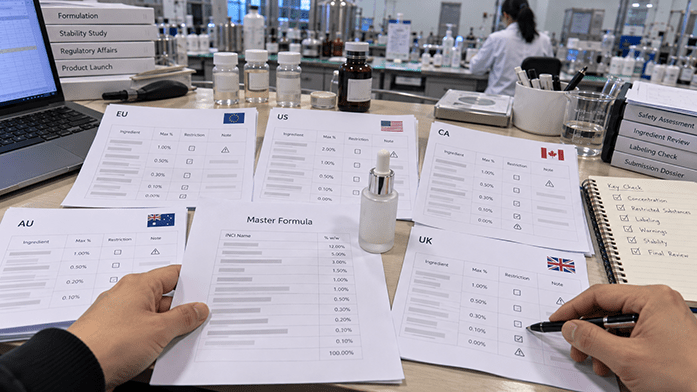
The 5-market × 5-dimension compliance matrix
The fastest way to prevent the launch calendar from breaking is to map each market across the five dimensions every cosmetics regulator touches, in different sequences.
These five dimensions come from EU 1223/2009, MoCRA, Canada's Hotlist and CCR framework, Australia's TGA and AICIS publications, and ISO 22716 cosmetic GMP — the five workstreams any multi-market launch must staff at once.
The five markets are the EU, US, Canada, and Australia — the four jurisdictions most B2B founders target first — plus ISO 22716 as the cross-market manufacturing baseline all four regulators reference when buyers verify their manufacturer.
The matrix
| Dimension | EU (1223/2009) | US (MoCRA) | Canada (Hotlist, CCR) | Australia (TGA / AICIS) | Cross-market GMP baseline (ISO 22716) |
|---|---|---|---|---|---|
| Pre-market notification or registration | CPNP notification before market placement; re-notify on label change | FDA product listing within 120 days; first biennial update due 2026-07-01 | No pre-market notification for cosmetics (CNF voluntary for new ingredients) | TGA ARTG entry for sunscreen (therapeutic); other cosmetics notified through AICIS | ISO 22716 audit certificate (3-year validity typical) |
| Safety substantiation | CPSR by qualified safety assessor; PIF per Article 10 | Safety substantiation records per MoCRA Section 612 | Safety evidence available on inspector request; INCI per international nomenclature | AICIS-aligned safety dossier; sponsor required for therapeutic claims | ISO 22716 safety data handling within PIF-equivalent |
| Ingredient compliance | CosIng + Annexes II/III; fragrance allergen expansion through 2026 | 21 CFR restricted and prohibited list; color additives requiring FDA batch certification | Hotlist + Schedule 1; fragrance allergens apply 2026-08 new / 2028-08 existing | AICIS inventory; SUSMP scheduling; TGA-permitted UV filters only | ISO 22716 raw material specification system |
| Labeling | Article 19 INCI; best-before for shelf life under 30 months; responsible person address | 21 CFR 701 + FPLA; warning statements for specified ingredients | CCR + Consumer Packaging and Labeling Act; bilingual English/French mandatory | Trade Practices Consumer Product Information Standards; AICS names | ISO 22716 label control system |
| Post-market surveillance | Serious AE reporting within 15 days; CPNP update on label change | MoCRA Section 605 AE recordkeeping; mandatory reporting for serious AEs | Health Canada Vigilance program; product recall framework | TGA AE reporting for therapeutic goods; AICIS post-market review | ISO 22716 CAPA system |
Three product-side 2026 deadlines that decide the launch calendar
Three regulatory clocks this year sit on the critical path of any multi-market launch:
MoCRA first biennial product listing update: 2026-07-01. US-listed cosmetic products must refresh their listing with current formulation, contact, and ingredient data. Brands that skip this renewal lose their listing status until re-submitted, interrupting retail and e-commerce channel onboarding.
EU Cosmetics Regulation fragrance allergen expansion: clauses enter into force across 2026, with the more demanding transition windows extending into 2028 for existing products. The new list pushes roughly 80 fragrance allergens into declarable territory, with disclosure thresholds dropping to 0.001% in leave-on and 0.01% in rinse-off. A formula label-clean under the previous 26-allergen list needs re-evaluation and re-labelling where new declarables appear.
Canada fragrance allergen update: 2026-08 for new brands, 2028-08 for products already on the market. Same allergen scope as the EU, but separate transition windows between new and existing product launches. A US or EU launch does not satisfy a Canada launch if the formula misses a declarable allergen.
PPWR (EU Packaging and Packaging Waste Regulation) core obligations enter into force on 2026-08-12, adding recyclability, minimum recycled content, and labeling requirements on the packaging layer. A pre-2026 compliance plan that ignored packaging must now absorb one more workstream this August.
A secondary TGA reform milestone worth tracking is the 2026-03 sunscreen regulation consultation, expected to revisit permissible UV filter lists and primary sunscreen labeling. That is a heads-up for any SPF product going to Australia, even if the current formulation is on the TGA permitted list today.

What to verify before you sign — a brand's pre-launch checklist
The matrix in the previous section is a planning tool. This checklist runs against a real manufacturer, formula, and label before any deposit changes hands.
The verification splits into five steps. Each pulls from a recognized standard so the proof survives a buyer-side audit, inspector visit, or distributor's quality questionnaire.
1. Confirm the manufacturer's GMP baseline
Ask for the current ISO 22716 certificate. The document should name the issuing certification body, the certificate number, the scope of certification, and the validity dates.
Verify the certificate against the issuing CB's database directly. ISO 22716 certificates are not issued by ISO itself but by accredited certification bodies (SGS, TÜV, Eurofins, Bureau Veritas, and similar). Accreditation bodies such as ANAB maintain directories of accredited CBs — the right place to confirm the CB itself is accredited. An unaccredited certificate has limited regulatory standing and should be treated as a claim.
2. Lock the stability and preservative challenge data
Stability testing typically follows ISO/TR 18811:2018 protocols. A common minimum window for general cosmetics is three months under accelerated plus real-time conditions. For sunscreen, six months is a frequent practical minimum in the EU and Australia, driven by monographed SPF claims and UV-filter label stability. The preservative challenge test runs per ISO 11930, a 28-day protocol.
Test certificates should name the standard referenced, the batch tested, the storage conditions, and the inspection intervals. Without those four elements, a certificate is informational rather than substantive.
3. Verify the SPF and UVA performance path if sunscreen is in scope
For SPF claims, in-vivo SPF testing follows ISO 24444; UVA protection follows ISO 24443. ISO 24443 is the operative UVA testing standard in the EU and Australia; in the US, the FDA sunscreen monograph specifies broad-spectrum testing separately. A certificate naming the standard but not the testing lab's accreditation loses most of its weight at a buyer audit.
4. Cost reality check (desensitized, sourced from independent industry discussion)
Costs vary widely by lab, country, and product complexity. Ranges that appear in independent industry forums — typically tens of data points per trend — include:
- Stability testing: roughly $1,000 to $3,000 per product (accelerated + real-time + photo-stability)
- Preservative challenge: $500 to $1,500 per product (ISO 11930 scope)
- SPF in-vivo: AUD $3,000 to $8,000 per product (single-formula, single-panel)
- CPSR by a qualified EU safety assessor: €1,500 to €5,000 per product
- MoCRA third-party compliance support (annual retainer): $650 to $3,000+ depending on product count
Use these ranges to test whether a quotation you received sits within reason, not as a quote in themselves.
5. Plan the multi-market dossier sequence
For a four-market launch (EU + US + Canada + Australia), the dossier sequence typically runs: PIF (including CPSR) → CPNP notification → MoCRA facility registration and product listing → Canada labeling review (Hotlist check) → Australia, with sunscreen products branching into TGA ARTG separately. The sequence matters because any downstream formulation or label change can invalidate earlier artifacts.
FDA facility registration carries no fee at the federal level — registration is free — though distributors or third-party compliance services charge a separate fee for completing the form on your behalf.
The five-step pre-launch checklist, condensed
- ISO 22716 GMP certificate, verified against the issuing CB's database.
- Stability data per ISO/TR 18811 (3 months general, 6 months for sunscreen).
- Preservative challenge per ISO 11930 (28-day panel).
- SPF in-vivo per ISO 24444 and UVA per ISO 24443, for any SPF claim.
- Multi-market dossier sequence: PIF + CPNP + MoCRA + Canada labeling + Australia / TGA.
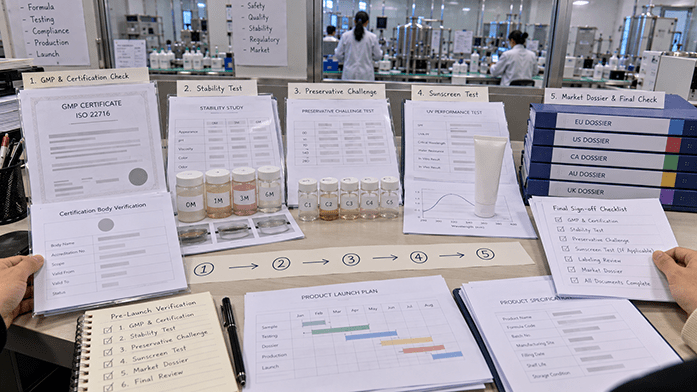
If your manufacturer can hand you documented proof for all five steps against a real formula — named standards, named laboratories, named certificate numbers — your pre-launch risk profile is materially smaller than a brand receiving certificates without test reports behind them.
When a multi-market launch needs outside eyes
The matrix is the planning view; this checklist is the operational view. Brands rarely run both without help: most founders buy supplier verification or regulatory advice, but not both, and the gap is where launches run late.
If your 2026 launch touches more than two of the markets above, or your formula touches any active ingredient in the friction table, the highest-leverage next step is to review your target markets and product category with someone who has run multi-market dossiers through each of the four regulators (EU, US, Canada, Australia) and an ISO 22716-certified manufacturer within the last 18 months.
Send your target markets and product category, and we will run a market-entry compliance review covering each of the five dimensions and each of the 2026 deadlines above. Use that review to decide which ingredients, claims, and labels need to change before your manufacturer begins the first production batch — not after.