A brand founder signs off on packaging artwork that reads "24-hour moisturizing," "visibly reduces fine lines," and "SPF50." The copy looks launch-ready. Then compliance review asks the question that stalls the timeline: how do you prove each statement holds up? A claim printed on a label is not evidence. Until test data and a documentation file say otherwise, it is a liability carried by your brand, not the factory that filled the bottle.
TL;DR: Claims substantiation means holding documented, proportionate evidence that every efficacy or performance statement on your product is true. The rules differ by market — FDA and FTC in the US, Regulation (EC) No 1223/2009 plus CPNP in the EU, TGA in Australia, and Health Canada — but the shared backbone is stability, microbiological, efficacy, and safety testing, consolidated into a file your OEM must transfer before launch.
This guide breaks down how substantiation works across markets, which test types back which claims, and which documents a serious OEM should deliver — not as a courtesy, but as a transferable compliance file you could hand to a regulator.
What claims substantiation means across FDA, EU, Australia, and Canada
The word "claim" sounds like a marketing decision. Regulators treat it as a legal statement that must be supported by evidence proportionate to what it promises — and that proportion shifts depending on which market reads the label.
Key Takeaway: Substantiation is jurisdictional. The same "anti-aging" phrase can sit inside a cosmetic file in one market and reclassify the product as a drug or therapeutic good in another, with completely different testing, registration, and labeling consequences.
In the US, FDA draws the cosmetic/drug line by intended use under the FD&C Act. A moisturizer that "hydrates skin" is a cosmetic. The same formula marketed as "treats wrinkles" becomes a drug, triggering an FDA drug application process. MoCRA layers on facility registration, product listing, safety substantiation, and adverse event recordkeeping for cosmetic products. Separately, the FTC Green Guides require "competent and reliable scientific evidence" before an advertising claim runs — so even wording that escapes FDA drug classification can still draw FTC enforcement if the substantiation file is thin.
The EU frames this through Regulation (EC) No 1223/2009, with notification via the Cosmetic Products Notification Portal (CPNP) and documentation held in the Product Information File (PIF), anchored by the Cosmetic Product Safety Report (CPSR). Claims themselves must satisfy the common criteria in Regulation (EU) No 655/2013: truthfulness, evidential support, fairness, and enabling informed decision-making. A claim is not compliant merely because it is safe — it must also be provable under those four criteria.
Australia introduces a sharper boundary through the Therapeutic Goods Administration (TGA). Primary sunscreens above a defined protection threshold are listed therapeutic goods, tested under AS/NZS 2604. A moisturizer with SPF marketed for sun protection can cross from cosmetic into therapeutic, requiring TGA listing rather than only cosmetic notification. Canada operates the Health Canada Cosmetic Ingredient Hotlist, which restricts or prohibits specific ingredients, with SOR/2024-63 updating the cosmetic regulations; a therapeutic claim can pull the product into Health Canada's drug framework.
Where one verb relocates a product
The cosmetic-to-drug boundary often turns on a single word. "Improves the appearance of fine lines" stays cosmetic in most markets. "Reduces fine lines" implies a biological structure/function effect and can trigger drug or therapeutic classification under FDA, and stricter review under EU and Australian frameworks. This is not semantics — it determines whether your file needs a cosmetic notification or a full drug/therapeutic registration, and whether your testing panel needs tolerance data or full clinical efficacy trials. Adjusting claim wording early is cheaper than re-running a test matrix late.
The four test types that back a claim
A substantiation file is built from test data. Four test families cover almost every claim a cosmetics brand prints on a carton.
Key Takeaway: Stability testing proves the formula holds over shelf life; microbiological testing proves it stays safe in repeated use; efficacy testing proves the claim is true; safety testing proves the formula is tolerable on skin. Drop any one, and a regulator or retailer can challenge the claim.
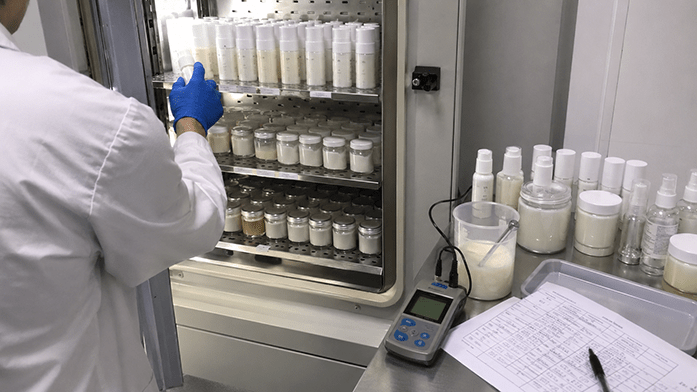
Stability testing, aligned with ISO/TR 18811:2018 protocols and NIFDC stability testing guidelines, typically involves sustained elevated-temperature storage, freeze-thaw cycling, and centrifugation. This is where separation, viscosity drift, pH shift, and color change surface — failure modes that quietly invalidate a "24-month shelf life" claim.
Stability data is also packaging-specific. A formula that holds in a glass jar can behave differently inside a PET airless pump, because oxygen exposure, light transmission, and extractables from the package interact with the formula over months. Switching the primary packaging after stability testing is complete can invalidate the existing data and force a re-run — which is why packaging selection and stability testing are scheduled together, not sequentially. A claim about shelf life only holds if the tested formula sat in the same package the consumer buys.
Microbiological testing centers on preservative efficacy. The challenge test, covered by ISO 11930, verifies the preservative system holds through repeated consumer use rather than only at the moment of fill. Pass criteria vary by product type and intended use; reputable manufacturers document the test panel and acceptance thresholds against the standard rather than declaring a universal pass.
Efficacy testing is claim-specific. Hydration claims typically rely on corneometer readings or transepidermal water loss (TEWL) measurement. SPF claims use in vivo methods such as ISO 24444 or in vitro methods such as ISO 24443, with AS/NZS 2604 required for the Australian market. Anti-aging claims generally need clinical grading or instrumental measurement — and, depending on wording, brush against drug-classification territory. The test method should map directly to the claim on your label, not to a competitor's benchmark formula.
Safety testing combines ingredient restriction compliance against the target market's restricted-substance list with human tolerance assessment, such as repeat insult patch testing. Ingredient compliance is not optional decoration: a formula containing a restricted substance invalidates the entire claim file for that market, regardless of how strong the efficacy data looks.
Beyond regulators, some retailers and online marketplaces request substantiation documentation during product onboarding — a gatekeeper layer that can block a listing even when a product clears the regulatory minimum. Treating the file as a launch asset, not a post-launch obligation, is what keeps both doors open.
| Claim symptom on label | Likely root cause | Fix before launch |
|---|---|---|
| "SPF50" with no in vivo SPF report | Efficacy test run on a benchmark, not your final formula | Run ISO 24444 (or AS/NZS 2604 for AU) on the manufactured batch |
| "24-hour hydration" without TEWL or corneometer data | Copy written before any efficacy protocol existed | Define the measurement method and test the final formula |
| "Reduces wrinkles" pushed product into drug review | Structure/function wording crossed the cosmetic/drug line | Reword to "improves the appearance of fine lines," then re-scope testing |
| Emulsion separates at month 4 | Preservative or emulsifier mismatch surfaced only in stability | Reformulate and restart the stability testing timeline |
The clock that restarts at reformulation
Stability testing runs on a timeline tied to the formula and its preservative system. Change an active ingredient, swap a preservative, or adjust the emulsifier, and the existing stability data no longer applies to the new formula — the testing clock restarts. This is why a late-stage claim adjustment is expensive: it is not just a label change, it is a re-test commitment that can push a launch back by weeks. Locking claim wording before stability testing begins keeps the timeline intact.
Not every claim demands the heaviest available test. During concept validation or a limited pre-launch campaign, a controlled in-use consumer panel can be an appropriate first step before investing in full clinical substantiation. The boundary is the retail shelf: once a claim appears on packaging sold in a regulated market, lightweight evidence is no longer sufficient, and the file must meet the standard that market requires.
What files your OEM should hand over
The OEM that fills your formula is the party closest to the test data. A compliant handover is a transferable file — not a set of screenshots or a forwarded email.
Key Takeaway: Before you pay final balance or authorize shipment, your OEM should deliver a documentation package you could hand directly to a regulator or retailer without follow-up requests. If the file is incomplete, the claim risk stays with your brand, not the factory.
A complete claims substantiation handover typically includes:
- Cosmetic Product Safety Report (CPSR) for EU markets, or an equivalent safety assessment for the target market
- Stability test report referencing the protocol used (ISO/TR 18811:2018 or NIFDC stability testing guidelines)
- Preservative efficacy / challenge test report aligned with ISO 11930
- Efficacy test reports, matched claim-by-claim to label statements
- Certificates of Analysis (CoA) for key raw materials
- Ingredient compliance confirmation against the target market's restricted-substance list (EU Annex II/III, Health Canada Cosmetic Ingredient Hotlist)
- PIF dossier structure for EU markets; product listing records for US MoCRA
- Batch records and CoA for the manufactured batch
One gap buyers miss: efficacy reports sometimes reflect a small pilot lab sample, not the final manufactured batch. A hydration percentage measured on a bench-scale batch does not automatically transfer to a full production run, where homogenizer shear, fill temperature, and raw-material lot variation can shift performance. The substantiation file is only as strong as the link between the tested sample and the product on the shelf — ask your OEM to confirm which batch each report covers.
The scope of this file depends on your target markets and product category. A single-market launch needs a narrower file than a four-market rollout, and an SPF product needs a thicker efficacy section than a basic moisturizer. A capable OEM scopes the file to the markets you actually intend to enter — and flags where a claim wording would expand the file into therapeutic territory.
If your packaging already carries claims and the substantiation file is incomplete, that gap is a launch risk you carry from the day the product ships. Before finalizing a custom formula or adjusting a label claim, map each claim to the specific test and document that backs it — for every market on your launch list. If you are still scoping the project, a claims and compliance readiness review — covering product category, formula status, target markets, and proposed claim wording — is the point at which gaps surface before they become delays.