

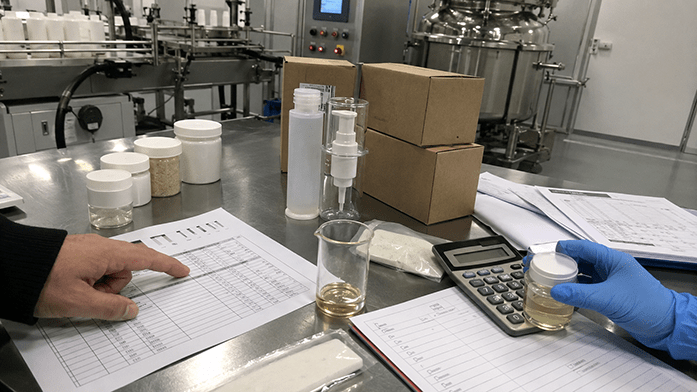
Most founders can quote their per-unit cost to two decimal places. Ask how fill-line tolerance or component minimums feed the same number, and the spreadsheet goes quiet. COGS for a beauty brand is rarely the sum of line items on a supplier quote — it is the gap between what you planned and what actually ships, stabilizes, and sells.
TL;DR: Beauty brand COGS is driven less by per-kilo ingredient price and more by four forces: raw material yield and stability, packaging tooling and minimums, freight and landed cost, and batch-to-batch consistency. The expensive mistakes are almost always the invisible ones — a separated emulsion, a leaked custom jar, an air-freight emergency — not the headline unit price.
Mapping where your capital actually goes is the first step to protecting gross margin. This breakdown covers the four cost drivers we see most often undermining early-stage beauty brands, and where the real money leaks before a product ever reaches a customer.
Raw material & formulation costs
The biggest misconception in cosmetic costing is that raw material price dictates quality. It does not. A cheaper botanical extract that destabilizes an emulsion costs far more in returns and recalls than the per-kilo saving ever returned. A raw material price fluctuations report helps separate headline price from realized cost.
Key Takeaway: Track realized yield, not per-kilo price. A stable, well-sourced active that costs more upfront usually protects margin better than a cheap input that fails at scale.
A stabilized active — vitamin C derivatives are the common example — can carry a meaningful upfront premium, often in a 20–40% range, but it holds color, viscosity, and potency through transit and shelf life. The cost that matters is the yield rate of sellable units, not the purchase price of the drum. We see brands obsess over the initial quote and ignore the failure rate three batches later.
Skimping on formula stability does not save money. It moves the cost downstream into customer returns, refunds, and reputation damage that no marketing budget recovers. Verifying supplier documentation against FDA cosmetic GMP guidelines — certificates of analysis, stability data, batch records — is part of the real material cost, not an optional extra. Cheap raw materials also degrade faster in transit, which turns a per-kilo saving into a recall.
Packaging tooling & freight landed cost
Custom molds and unique bottles are where early-stage capital goes to die. They suit established brands with predictable volume; for a brand still validating market fit, they are a cash-flow trap.
Key Takeaway: Custom glass, specialized pumps, or tooled components commonly require minimums in the 10,000–20,000 unit range. That capital sits in a warehouse, not in customer acquisition. Standardized, proven packaging routes lower that exposure substantially.
| Symptom | Root Cause | Fix |
|---|---|---|
| Custom jars leak in transit | Closure threading tolerance not validated against the bottle | Qualify closure and bottle as a matched set before tooling |
| Air-freight bill wipes a quarter's margin | Production delay forced emergency air shipment | Plan sea freight 10–12 weeks out; consolidate shipments |
| Capital trapped in unused cartons | Over-ordered custom packaging for an unvalidated SKU | Start with standardized packaging; customize via label or screen print |
Landed cost is the number most founders under-calculate. It is unit price plus freight, customs, insurance, and duties — and liquid product is heavy. Run out of stock and air-freight a ton of shampoo, and the per-unit economics collapse. We see brands negotiate the factory unit price and forget the container — which is why seven due diligence dimensions beyond price matter more than the quote.
This does not mean custom packaging is always wrong. For an established brand with confirmed demand, a unique component is a defensible differentiator and the volume absorbs the tooling minimum. The trap is specific: committing to custom tooling before the market has validated the format. Standardized packaging during the validation phase, then upgrading once volume is real, is the route that protects cash flow without blocking the launch. Confirm your packaging and labeling decisions before production before committing to tooling.
Batch consistency & quality control
The largest hidden cost in beauty COGS is not the ingredient — it is instability. A cheap factory can deliver a flawless first batch and a yellow, off-odor third batch. The result is line stoppages, recalls, and a reputation that does not recover.
Key Takeaway: Consistency is a manufacturing-system cost, not a line item. ISO 22716 cosmetics GMP standard discipline — locked SOPs, validated processes, documented batch records — is what keeps batch one and batch one hundred identical.
Cheap production buys speed and low price at the cost of repeatability. When a preservative system changes, stability testing timelines reset; that is an operational friction point generic sourcing advice ignores. We treat batch consistency as the cost you pay upfront — testing, validation, documented procedure — or pay later in rework, refunds, and suspended accounts.
A facility that values consistent compounding over rushed output is the difference between a product that scales and a product that surprises you. True cost control happens before the mixing tank turns on, not after a batch fails on the shelf.
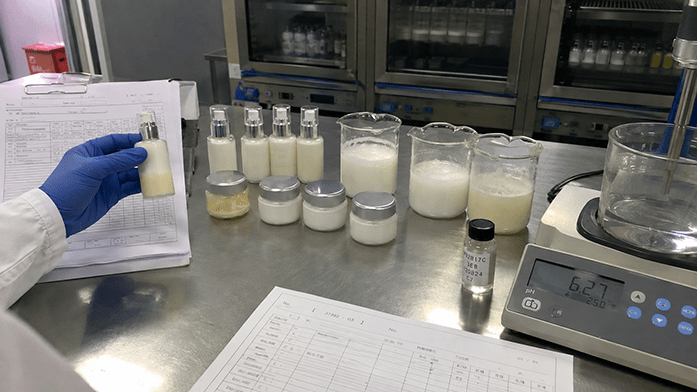
If you are mapping COGS ahead of a launch, the highest-leverage move is to pressure-test your own assumptions: per-kilo price, packaging minimums, landed cost, and the consistency track record of any facility you are considering. We offer a technical assessment that reviews formula feasibility, packaging route, and target-market compliance readiness — the goal is to find the costly gaps before you fund them, not to place an order on the first call.
Editor Notes / Evidence Gaps
- Style: S1 (knowledge gap opening) + S4 (team "we" voice) + S5 (diagnostic table in H2-2)
- Evidence gaps (user supplied no COGS data; all figures directional):
Stabilized active 20–40% premium: directional industry pattern, not sourced — verify before publishing as a specific figure.Custom packaging MOQ 10,000–20,000 units: general industry norm for custom tooling; cite a verifiable packaging supplier source if a specific number is required.Sea freight 10–12 week planning: operational convention; conservative, confirm with logistics partner.- Air-freight vs sea cost ratio: intentionally omitted specific multiples (unverifiable) — kept directional.
- Suggested internal links (织脉 to confirm in Phase 6): 2026 global supply chain cost report; how to choose a manufacturer (due diligence); beyond basic QA for premium brands; ingredient vs packaging cost balance.
- Pre-publish verification: confirm ISO 22716 framing is accurate for the facility; remove any claim implying a guaranteed outcome.
- AI fingerprint self-check: zero first-person persona / fabricated individual narratives; zero footnote markers; no "Final Verdict"; CTA is an assessment invitation, not hard-sell.