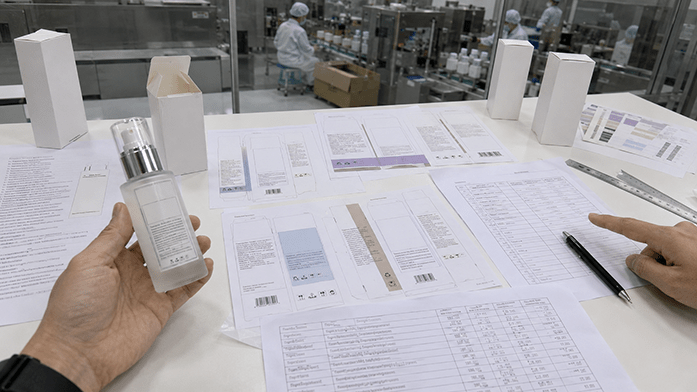
Most founders think a compliant label is an ingredient list in the right order. The list is the easy part. What costs money is discovering that the same formula, same jar, same batch needs four different labels depending on whether it lands in Los Angeles, Rotterdam, Sydney, or Toronto. One missing element and the carton stalls at customs, a distributor rejects the shipment, or the product sits on a shelf with a non-compliant label until a review surfaces it months later.
TL;DR — Cosmetic labels are not portable across markets. The US, EU, Australia, and Canada each mandate different elements under different rules: 21 CFR Part 701 in the US, Regulation (EC) No 1223/2009 in the EU, AICIS plus TGA in Australia, and Health Canada's regulations in Canada. Australia routes sunscreens through the TGA. Canada generally requires INCI naming plus bilingual caution text. Review label copy market-by-market before you print, not after.
This guide walks through the mandatory elements side by side, the failure types that surface most often, and a review sequence you can run before committing to a print run. It will not replace a market-specific compliance review, but it will show you where the expensive mistakes hide.
One Product, Four Different Passports
A label is a passport, and each market stamps it differently. The table below lists the mandatory elements and the regulation behind each, plus the mistake most likely to trip up a brand moving between markets.
| Market | Mandatory elements | Regulatory basis | Common mistake |
|---|---|---|---|
| United States | Statement of identity, net quantity of contents, ingredient list in descending order of predominance (INCI), name and place of business of the manufacturer, packer, or distributor, required warnings | 21 CFR Part 701; Fair Packaging and Labeling Act | Listing ingredients by formula order instead of descending predominance; omitting the distributor name and address on private-label cartons |
| European Union | Responsible person name and address, nominal content, minimum durability date or period-after-opening (PAO) symbol, precautions for use, batch number, product function, ingredient list (INCI, descending order) | Regulation (EC) No 1223/2009, Article 19 | Omitting the PAO symbol where the minimum durability exceeds 30 months (verify against current Article 19 text); not translating the label into the member-state language |
| Australia | Ingredient list (INCI), net quantity, manufacturer name and address, required warnings; sunscreens move to therapeutic goods labeling with an AUST L number | Industrial Chemicals Act 2019 (AICIS); Therapeutic Goods Act for sunscreens | Treating a sunscreen as a cosmetic and skipping TGA labeling; using non-INCI ingredient names |
| Canada | Ingredient list (INCI), net quantity, manufacturer or importer name and address, caution statements in English and French where required, restricted-ingredient warnings | Food and Drugs Act and Cosmetic Regulations; Cosmetic Ingredient Hotlist | Omitting French text on caution statements; ignoring Hotlist restrictions that change the required warning |
Key Takeaway: Print nothing until you have mapped all four columns for your specific market. The ingredient list and net quantity are near-universal; the responsible party, shelf-life format, and warning statements are where markets diverge — and where a single wrong element voids the entire carton run.
The table is the "what." The "why it matters" lives in the differences. The US is a self-compliance market: the FDA generally does not pre-approve cosmetic labels, and labeling obligations sit in 21 CFR Part 701 alongside the Fair Packaging and Labeling Act. The EU, by contrast, ties labeling to a responsible person who must exist inside the EU and is linked to the product's notification in the Cosmetic Products Notification Portal (CPNP) and its Product Information File. Australia splits cosmetics from sunscreens at the therapeutic goods line. Canada layers a bilingual, Hotlist-driven caution requirement on top of INCI ingredient naming.
One distinction worth holding onto: none of these markets "approves" a cosmetic label the way a drug label is approved. Each has a different gate instead — EU CPNP notification plus a responsible person, US MoCRA product listing, Canada's cosmetic notification, and Australia's AICIS introduction (or TGA registration for sunscreens). If your label plan assumes a single approval step, the plan is wrong.
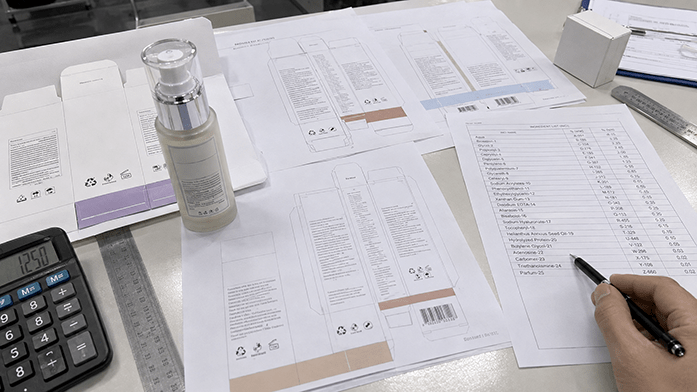
Where Labels Break
The failures are repetitive, and they are almost never about the formula. They are about copy, formatting, and classification. Here are the recurring patterns, each with the operational reason behind it.
Ingredient order, not formula order. A formulator lists ingredients in the order they went into the batch. A label must list them in descending order of predominance by weight. When the two orders diverge — which happens whenever a small-percentage active is added early in the process — the label is wrong in every market that mandates descending order.
Missing the responsible party. Private-label and white-label brands frequently print the brand name but omit the manufacturer, packer, or distributor name and address (US) or the responsible person (EU). This is a structural omission, not a formatting nit: it removes the entity a regulator contacts when something goes wrong.
Wrong shelf-life format. A "use by" date is not interchangeable with the EU's minimum durability date or the period-after-opening (PAO) symbol. Products with a shelf life beyond 30 months can generally drop the best-before date only if they carry the open-jar PAO symbol — confirm this threshold against the current Article 19 text. Mixing formats across a multi-market launch forces a reprint.
Sunscreen misclassification. In Australia, a product making SPF or sun-protection claims is a therapeutic good, not a cosmetic. It needs TGA listing and an AUST L number on the label. A brand that treats it as a cosmetic in one market and a therapeutic good in another is running two different label tracks and will get one of them wrong.
Language and warning gaps. EU labels must appear in the language of the member state where the product is sold. Canada requires caution statements in English and French where prescribed. Restricted ingredients — flagged by the EU Annexes or Canada's Cosmetic Ingredient Hotlist — carry warning text that is generally required to appear verbatim (verify against the current regulation text).
Key Takeaway: Most label failures are classification and copy errors, not ingredient errors. Ask three questions before anything else: Is this a cosmetic or a therapeutic good? Who is the responsible party on the label? Which market-specific warnings and languages apply?
Notice what these failures share: they surface at the review stage, after cartons are quoted and often after they are printed. None of them requires a reformulation to fix. They require a process — which is the next section.
The Pre-Flight Check
Airline crews run the same checklist before every takeoff regardless of how routine the flight feels. A label review works the same way. Run it in this order and you catch the structural problems before they become print problems.
-
Lock the INCI list first. Every market uses the International Nomenclature of Cosmetic Ingredients. Generate the list once, in descending order of predominance, then treat it as fixed input for every market-specific label.
-
Classify the product per market. Is it a cosmetic or a therapeutic good in Australia? Does any claim shift the classification in the US or EU? Classification changes which regulation — and which label track — applies.
-
Pull the mandatory element list for each market. Use the table above as a starting template, then confirm against the current regulation text. Regulations change; treat any static checklist as a draft, not a guarantee.
-
Check restricted ingredients and required warnings. Run the formula against the EU Annexes, Canada's Cosmetic Ingredient Hotlist, and the relevant US and Australian restrictions. Any hit changes the warning text.
-
Confirm net quantity and units. Net contents formatting — weight versus volume, metric versus US customary units — differs by market. A single wrong unit can flag a shipment.
-
Confirm the responsible party placement. Identify the entity and address that must appear per market, and verify it matches who actually exists in that jurisdiction.
-
Review language. Confirm the member-state language for the EU and the bilingual requirements for Canada.
-
Proof against the printed proof before production. The final proof is the last point where an error is cheap. After the press runs, a fix costs a reprint and a timeline slip.
Key Takeaway: Run the checklist before artwork is finalized, not after. The cost of a label error compounds with every stage it survives: design, print, customs, retail shelf, and finally recall.
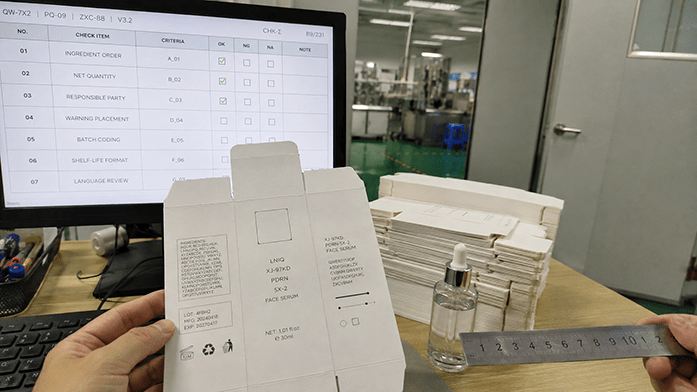
Before you hand the artwork to a printer, one division of labor is worth getting explicit. A manufacturer or OEM/ODM partner can reasonably supply the factual inputs a label needs — the complete INCI ingredient list in descending order of predominance, the net content data for your fill size, the batch coding format, and the name and address of the manufacturing entity that must appear on the label. A partner that has shipped into multiple export markets can also flag the market-specific elements — the PAO symbol for the EU, the Hotlist warning for Canada, the AUST L number path for an Australian sunscreen — before the artwork goes to print.
What a factory generally cannot do is replace your compliance decision. The responsible person under EU rules, the classification of a sunscreen under TGA, and the final regulatory reading of a claim are the brand's responsibility, or its compliance consultant's. Split the work cleanly: the factory supplies the factual inputs, and the brand owns the regulatory judgment — classification, responsible party, claims, and market-specific warnings. Do not blur that line in the contract.
Label compliance is one of those costs that stays invisible until it isn't. A product that clears one market can fail another over a warning statement or a missing responsible party — and by the time the failure shows up, the cartons are already printed.
If you are preparing a multi-market launch, a practical way to de-risk the label is to run the checklist above against your actual formula and fill data, then have someone who has shipped into those markets pressure-test the artwork before printing. If you would like a second set of eyes on the factory-side inputs — the INCI list, net content, batch format, and the market-specific elements for the US, EU, Australia, and Canada — request a project readiness assessment with your formula and target markets in hand. The point is to catch a wrong warning statement or a missing responsible party before it becomes a carton reprint.