


A founder outside the EU has a formula she likes, a packaging quote she has accepted, and a launch window she has announced. She expects the European part of the project to be a document: one filing, one fee, one test report. What she meets instead is a legal structure with one load-bearing pillar. Before a single unit can be placed on the EU market, a specific person established inside the Union must be standing behind the product.
Three doors stand between a finished formula and the EU market: CPNP notification, the Cosmetic Product Safety Report (CPSR), and the Product Information File (PIF). None of them opens until a Responsible Person established in an EU member state has been designated. The doors are paperwork. The Responsible Person is the keyholder.
Delay and rework in Europe trace back to the keyholder decision more often than to testing. What follows covers who that person is and what they file, what the CPSR must contain and who may sign it, and what the calendar to first shipment looks like.
Who the Responsible Person is and what they must file
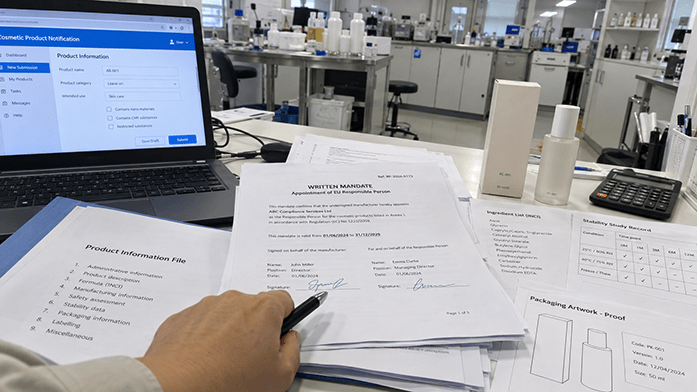
Article 4(1) of Regulation (EC) No 1223/2009 sets the condition that catches most non-EU brands off guard: only cosmetic products for which a legal or natural person has been designated within the Union as the Responsible Person may be placed on the market. No volume threshold, no first-order exemption. Article 4(5) makes the importer of an imported cosmetic product the Responsible Person, able to designate a person established in the Union by written mandate; Article 4(4) applies the same written-mandate route to a manufacturer established outside the Union.
Key Takeaway: For a non-EU brand, the Responsible Person is either your EU importer or a party appointed by written mandate under Article 4(4) or 4(5). That party submits the CPNP notification under Article 13(1), keeps the Product Information File under Article 11(1), and answers the competent authority. Settle the appointment first: every other EU checklist item is addressed to that party.
The gatekeeper who holds all three keys
The role's name is unglamorous. Its function is not. The Responsible Person is the entity a member state authority writes to when a product is queried, a claim is challenged, or a serious undesirable effect is reported, and it must still produce the file ten years after the last batch leaves the shelf.
What the role files is narrower than most brands assume. Under Article 13(1), the Responsible Person submits product information to the Commission electronically before the product is placed on the market. That submission is the CPNP notification, which the European Commission's own CPNP pages describe as free of charge, a point that surprises brands quoted a fee for "EU registration". Notification is a registration, not an authorisation: no approval or certificate follows it, only a reference and a duty to keep it accurate. Article 13(2) covers the original labelling notified with the submission; Article 13(4) covers products no longer on the market.
Three further duties sit with the same party, and all three are files rather than fees. Article 11(1) requires the file to be kept available to competent authorities for ten years after the last batch is placed on the market. Article 11(3) allows it at the Responsible Person's address or in electronic form, in a language the member state determines.
When handing the role to an importer or distributor is the right call
The mandate route is not the only defensible answer. Letting an EU importer or distributor carry the role is sensible for a single-market pilot where the distributor holds stock and owns the customer relationship, or for a first entry where the brand wants proof of demand before funding a mandate. Where the distributor places the product on the market under its own name or trademark, Article 4(6) makes it the Responsible Person in any case, so a separate mandate would be redundant.
The boundary runs along brand control, not cost. A distributor-held role creates a dependency that cannot be undone quickly: your access to the CPNP entry and to the Product Information File runs through that party, and a holder without the resources to answer an authority is worse than none.
What a CPSR must contain and who is qualified to sign it
The second door is where law meets formulation. Brands treat the CPSR as a form to be completed by whoever is available. It is closer to a professional opinion: a named, qualified person signs a conclusion about a specific formula at specific concentrations.
Key Takeaway: Annex I divides the CPSR into Part A, the cosmetic product safety information, and Part B, the cosmetic product safety assessment. Part B carries the assessor's conclusion, the warnings that must appear on the label, the reasoning behind the conclusion, and the assessor's credentials with a date and signature. Article 10(2) requires that assessor to hold a diploma or other evidence of formal qualifications awarded on completion of a university course in pharmacy, toxicology, medicine or a similar discipline, or an equivalent course recognised by a member state.
The report that lives inside the file
The CPSR's relationship to the Product Information File is the most common structural misunderstanding among non-EU teams. The CPSR does not sit beside the PIF. It sits inside it, as one of the five components listed in Article 11(2).
| PIF component, Article 11(2) | What it must contain | Who normally produces it |
|---|---|---|
| (a) Product description | Enough detail to identify the product unambiguously | Brand and Responsible Person |
| (b) Cosmetic product safety report | The Annex I Part A and Part B assessment for this formula | Qualified safety assessor |
| (c) Manufacturing method and GMP statement | How the product is made, with a statement of GMP compliance | Manufacturer |
| (d) Proof of the effect claimed | Evidence for any effect the product claims, where the nature or effect of the product justifies it | Brand, from its own substantiation |
| (e) Animal testing data | Data on animal testing for the development or safety assessment of the product | Brand or manufacturer declaration |
Two consequences follow. A PIF assembled from whatever documents are on hand will be incomplete, and the gap is usually in the fourth row: claim substantiation is evidence the brand owns. And the labelling file is not one of the five components: labelling obligations sit under Article 19, while the original labelling is notified under Article 13(2), separately from the five PIF components. They are separate records: completeness in one does not imply the other.
Who may sign it, and how to check
Article 10(2) is deliberately narrow. Adjacency is not equivalence: a qualification in a neighbouring field is recognised only through a member state's own route, not because it sounds technical. That converts into a short check. Ask to see Part B before booking a production slot, and verify three things on the signature page: the assessor's name, the qualification being relied on, and the date. The party who answers for an unsigned or undated assessment is the Responsible Person, not the person who wrote it.
Regulation governs substances, not phases
A pattern repeats in early-stage EU projects, and it starts with a well-meant warning. A supplier mentions that certain ingredients in the B phase are banned in some countries. The brand hears that the oil phase is the problem, pulls actives out of a system that was not the issue, and commissions fresh stability work. A later question about one raw material, by name and with a concentration attached, shows the reformulation has solved nothing.
What the supplier said was narrower than what the brand heard. Regulation in this field works at the level of substances. Formulation phases are a manufacturing convenience, a working label on a batch sheet, and the contents of a given phase differ from formula to formula. "Banned in some countries" is not a property of a phase.
Five questions settle the matter, whatever phase an ingredient sits in:
- Identity. What are the INCI name and the CAS number? A trade name cannot be checked against a regulatory list.
- Concentration. Prohibited, or restricted? If restricted, what maximum applies to this product type?
- Use. Leave-on or rinse-off, face or body? The same substance can be permitted in one application and capped in another.
- Target market. The EU, the United States, China, ASEAN and the Gulf each keep a list, amended on its own schedule.
- Substitution. Reformulate, reduce the concentration, or build a market-specific version.
The lists move, which is why the check has to be dated. Regulation (EU) 2026/909 of 27 April 2026 amended Annexes II, III, V and VI of Regulation (EC) No 1223/2009: the Regulation remains in force while the substance lists attached to it keep changing. A formula cleared two years ago is not cleared today by default.
One category runs on a different clock. Under Article 16(2) and Article 16(3), a cosmetic product containing nanomaterials must be notified to the Commission six months before being placed on the market, with an exception for nanomaterials already regulated under Article 14. That period runs ahead of the CPNP notification rather than alongside it, so a nano form discovered late is a launch-date problem rather than a paperwork problem.
The realistic timeline from formula freeze to EU market entry
"How long does EU compliance take?" is usually asked as though one number existed. There is no single number: the order of the stages is fixed, and the elapsed time depends on how often a gate reopens.
Key Takeaway: The stages run in series. Freeze the formula, verify every substance against the target lists, assemble stability and preservative-efficacy data, obtain the signed CPSR, complete the PIF, confirm the Responsible Person by written mandate, submit the CPNP notification, then place the product on the market. Because the stages are serial, elapsed time is measured in months rather than weeks, and a gate that reopens pushes every stage behind it. Run the documentation track alongside production planning, not after it.
Preservative efficacy is normally tested against a recognised standard method such as EN ISO 11930, and stability work follows the conditions agreed for the product and its packaging: method choices, not legal deadlines.

Three doors, opened in order
| Stage | Exit condition | What blocks progress | What sends the project back |
|---|---|---|---|
| Substance review | Every ingredient identified by INCI name and CAS number, with status and limit confirmed per member state | Brand and formulator | An ingredient cannot be confirmed against a current list, or a nano form triggers Article 16 |
| Data assembly | Stability and preservative-efficacy data exist for the finished formula in its final packaging | Manufacturer and laboratory | A packaging or fragrance change invalidates earlier data |
| CPSR sign-off | A qualified assessor signs Annex I Part B for this formula at these concentrations | Qualified safety assessor | The assessor cannot conclude without further substantiation of a claimed effect |
| PIF assembly | All five Article 11(2) components present, in the language the member state requires | Responsible Person | One component is missing, most often proof of the effect claimed |
| CPNP notification | The Article 13(1) submission is complete before the product is placed on the market | Responsible Person | A late change to the formula or label brings the entry out of line before shipping |
Where the calendar actually stretches
The friction here is rarely technical. It is a handover: a brand outside the EU initiates the process, appoints an agent established in the EU, and that agent coordinates with an agent on the manufacturing side. Waiting time accumulates where no plan looks: the assessor's questions coming back, a raw-material document from a supplier, a translation required under Article 11(3) in the language the member state chose, an agent's confirmation before the next submission.
Author's Insight: During a 2025 documentation review, we supported a client's submission to their appointed EU agent, assembling the technical material on the manufacturing side, checking it against the agent's checklist, and correcting gaps before it went in. The technical content was not the sticking point. Calendar time went on the handover sequence: each party needed the previous party's output before it could act.
One packaging point belongs at planning. Regulation (EU) 2025/40, the Packaging and Packaging Waste Regulation, also covers cosmetic packaging, so material, refill format and labelling surface are cheaper to align before tooling is committed.

Before you appoint an agent: what we can and cannot do
Two decisions belong before a mandate is signed. First, the substance list check for every market you genuinely intend to enter, because it is the only step that can force a reformulation. The second is the size of the first production run, because documentation and production planning are coupled. Custom formulation orders sit above the 2,000-piece mark, and each production batch generates its own batch-linked documents, so a first EU launch is a production decision rather than a sample-scale experiment.
If your formula is frozen and the EU is on the roadmap, the useful next step is not a price request. Send the target member states and the full ingredient list with INCI names and percentages. We will tell you which substance-level questions your appointed agent or consultant will raise first, and where a reformulation choice has to be made before anything is submitted. CAMELLIA LABS does not act as a Responsible Person and does not submit notifications on a brand's behalf; that role belongs to the party selling in Europe. What we do is prepare and review the technical documentation your appointed agent or consultant needs, and arrange factory verification when they ask for it.