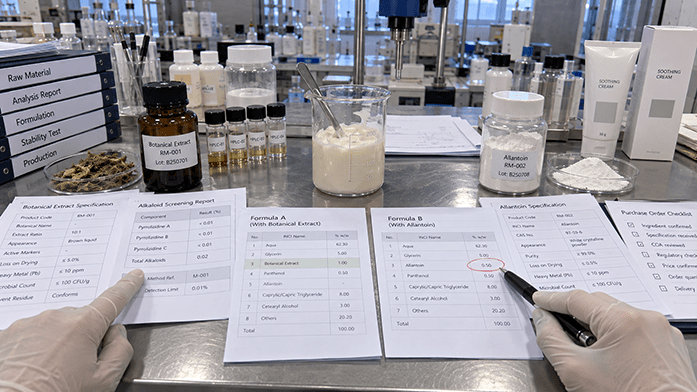
Ask a formulation team to recite the INCI panel of a comfrey salve and they will get every line right. Ask which of those lines Health Canada actually regulates and the answer arrives as a guess. Two names travel together on the artwork and in the supplier folder — Symphytum Officinale Root Extract and Allantoin — and in Canadian law they are not neighbours. One sits under a genus-level prohibition that carves out a single species by exception. The other appears on no table of the list.
Atomic Answer: Canada prohibits Symphytum spp. with Symphytum officinale excepted, allantoin has no Hotlist entry and no Canadian concentration cap, and the proposal to delete that exception closed its consultation on 17 February 2026 with no final wording published.
The live question is rarely "am I compliant". Which string you print decides whether an entry applies at all, and how much of the launch plan rests on an exception under review. What follows separates the two names, explains why the risk sits with pyrrolizidine alkaloids rather than allantoin, and sets out the substitution and labelling routes to settle before a purchase order goes out.
The Regulatory Fork: Two INCI Names, Two Different Fates
A formulator who writes a comfrey root extract onto a panel and one who writes Allantoin describe materials a consumer reads as one benefit claim. Canadian law does not read them as the same thing, and the gap is not a matter of degree. One declaration attaches to a listed substance. The other has no listing to attach to.
Key Takeaway: Screen the INCI string, not the plant story. Symphytum Officinale Root Extract (CAS 84696-05-9) is read against a prohibition covering the genus and excepting one species; Allantoin (CAS 97-59-6) has no listing on either table and no concentration limit, which is a different status from being approved.
What the entry says, and what the proposal would change
The prohibited table carries the wording Symphytum spp., with the exception of Symphytum officinale, filed under the synonym Comfrey, and the changes log dates the addition to December 2004. Entries are keyed to a substance name and a CAS number, and the table is written to be read plainly: the prohibition covers the genus and leaves one species outside it — the species cosmetic formulators buy. A root extract of that species is not caught by the entry as it stands, and has not been since 2004.
What is moving is the exception. Health Canada opened a consultation on 19 November 2025 proposing its removal; the window closed on 17 February 2026; no final wording has been published. The consultation document gives its reasoning on the record: echimidine is a hepatotoxic alkaloid detected in some S. officinale derivatives, and the species also carries carcinogenic pyrrolizidine alkaloids such as lasiocarpine.
The exception is a legislative variable rather than a settled entitlement, and no transition period appears in the published material, which makes any implementation schedule in circulation an extrapolation.
One reading deserves flagging, because it is where formulary confidence goes wrong. The entry names a genus, and the consultation document refers to S. officinale derivatives — wording that points toward extracts being inside the intended scope. Treating a root extract as plainly exempt leans on a species name while the documents around it point the other way. The exception is under review; the extract is what lands in scope if it goes.
Why allantoin is a different chemical question
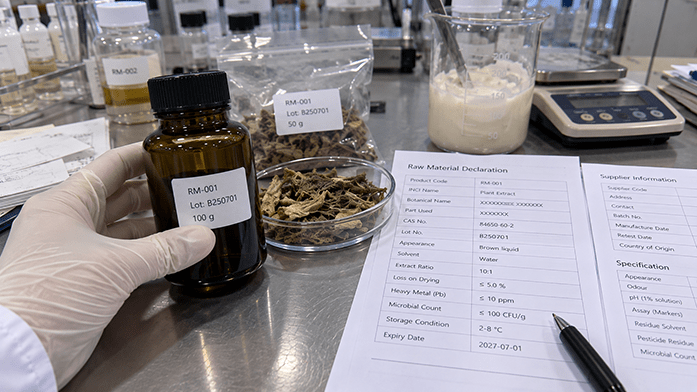
Search the prohibited and restricted tables for allantoin and nothing comes back. Nor does any concentration cap attach to the name. For a formulation team, that empty result is the whole answer: the substance is unlisted.
Unlisted has a narrow meaning. The Hotlist is not a register of what is permitted; it names substances that are prohibited or restricted. Absence from it means the absence of a named restriction, not a safety endorsement, and cosmetic safety duties in Canada rest on the general safety obligation against selling a cosmetic that may cause injury to health. An unlisted ingredient still has to be defensible on that footing, and the evidence sits with your supplier file.
The chemical reason allantoin sits apart from the extract is structural. Allantoin is a standalone molecule — CAS 97-59-6, a hydantoin derivative — and it does not belong to the pyrrolizidine alkaloid class. The 1,2-unsaturated pyrrolizidine ring system that makes those alkaloids hepatotoxic is not part of its structure. That is a structure-level observation from the chemistry, not a Health Canada finding. The regulator has published no position drawing the distinction and needs none: it works by name, and allantoin was never a name on the list.
That distinction weakens if the drum on your bench is not the isolated molecule. A botanical extract standardized to an allantoin content is not allantoin for declaration purposes — it is an extract, read against the plant it comes from. That is where formulas most often clear an internal screen and still get questioned later. Ask what the material is, not what it claims to deliver.
When keeping the extract is still the rational call
None of the above makes a Symphytum extract wrong in every project. Three situations justify keeping one.
If the market is not Canada, the entry does not bind you, and a botanical story built on a named plant may be exactly what the brand sells. The same holds for a heritage or pharmacy-channel line whose buyers expect the plant on the panel, where a synthetic swap erases the differentiator. Where the product has not reached tooling, the rational move is not substitution but screening: pin the exact INCI string, hold the alkaloid file, and cost a second variant in parallel rather than committing moulds to a formula whose legal position could change.
The practice that fails is narrower than "using comfrey": committing to a single-market formula with no substitution route costed, on the assumption that the 2004 exception is permanent. It has held for two decades and is now formally proposed for removal. Reading it as settled is the exposure.
Why a Clean Alkaloid Certificate Cannot Close the Question
Suppliers answer a pyrrolizidine alkaloid question the same way every time: a certificate of analysis reporting none detected. The document has value, though not the weight buyers give it.
Key Takeaway: A screen reports whether named alkaloids were detected, by one method, in one lot, at one detection limit. The Hotlist works on substance identity rather than measured content, so a clean result does not remove an entry, and the toxicological concern is a chronic-exposure question one negative lot cannot resolve.
How a pyrrolizidine alkaloid becomes a liver problem
These alkaloids are not toxic as they arrive. They become toxic after metabolism. The route runs through the cytochrome P450 system — CYP3A4 and CYP2C19 among the enzymes involved — which dehydrogenates the alkaloid into a dehydropyrrolizidine metabolite. That metabolite is electrophilic and reacts with cellular nucleophiles, forming DNA adducts and cross-links in the liver. The clinical endpoint is hepatic sinusoidal obstruction syndrome, also reported as veno-occlusive disease: sinusoidal endothelial cells are damaged, flow is obstructed, and portal hypertension with liver injury follows.
That same mechanism explains the hazard classification. Lasiocarpine, one of the alkaloids identified in the species, is classified by the International Agency for Research on Cancer as Group 2B, possibly carcinogenic to humans. The European Food Safety Authority has derived a benchmark dose lower confidence limit of 70 micrograms per kilogram of bodyweight per day for chronic oral exposure to pyrrolizidine alkaloids — an oral-intake benchmark rather than a dermal threshold.
The target organ is the liver, so a claim that a topical product only touches skin does not by itself settle systemic exposure. And the mechanism is metabolic rather than pH- or concentration-driven, so changing a surfactant or narrowing a pH range does nothing to it.
What a test report can and cannot settle
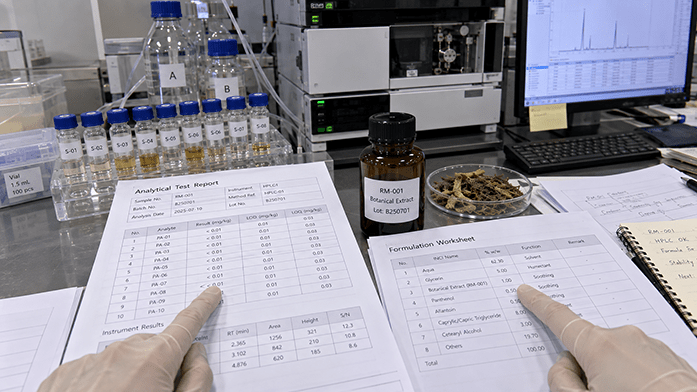
A test result is a measurement, not a regulatory status. Two items belong on the report before it means anything:
- The analyte list. Screening for one named marker is not a broad alkaloid screen, and a report that omits its target compounds cannot be compared with another laboratory's.
- The detection and quantification limits. "None detected" means below a stated threshold, and that threshold belongs on the page. A negative result at one limit says nothing about a lower one.
None of this makes the test pointless; it makes it a data point inside a supplier file rather than a shield. A raw-material certificate stops at the drum, and where the ingredient itself is listed, a clean lot changes nothing — the entry describes what the ingredient is, not what one drum measured.
Substitution Routes and the Labelling Trail
Reformulation decisions here arrive as one question: what goes in place of the comfrey extract. The answer depends on the job the extract was doing: a single botanical carries claim support, sensorial comfort, and sometimes viscosity.
Key Takeaway: Match the substitute to the function and to the string it will print. Allantoin, panthenol, bisabolol, and oat or cica actives cover different parts of the claim, and each adds its own documentation burden to the file.
Substitution options by function
The screening column below is a task list, not a clearance: the most recent published change to the list is from August 2025, so the check belongs to whoever files, on the day they file.
| Function to replace | Candidate | INCI declaration | Canadian screening task | Formulation notes | Cost band |
|---|---|---|---|---|---|
| Soothing and comfort claim support | Synthesized allantoin | Allantoin |
Absent from both tables, with no concentration cap; the general safety duty still applies | Water-soluble, stable across a wide pH range | Low |
| Moisture retention | Panthenol | Panthenol |
Confirm the exact string against the revision in force; no prohibition identified under this name | Water-soluble humectant; tacky at high load in serums | Low |
| Anti-irritant, sensorial comfort | Bisabolol | Bisabolol |
Confirm the string and the grade identity; no prohibition identified for this name | Oil-soluble, so it swaps into the oil phase | Mid |
| Barrier and itch-comfort positioning | Colloidal oatmeal and oat-derived actives | Avena Sativa (Oat) Kernel Flour |
Confirm the flour grade, then check claim wording against the entry for oat-derived material | Viscosity contribution in the water phase | Mid |
| Recovery and cica positioning | Centella asiatica extract | Centella Asiatica Extract |
Confirm the standardized actives on the spec sheet, not just the plant name | Water-soluble; familiar in the comfort category | Mid to high |
Cost bands reflect sourcing and documentation load, not a quotation.
The labelling split that stops shipments
Most friction here surfaces on paper rather than in the beaker: the declaration is what a reviewer reads first and a customs officer matches against the file.
| Printed on the panel | How it is read | What it costs |
|---|---|---|
Symphytum Officinale Root Extract |
A genus-level prohibition with a species exception, and a proposal to remove that exception | Keep the alkaloid file complete and hold a costed substitution route; final wording would move this name into scope |
Comfrey Extract |
Not a nomenclature name, so the reviewer maps it back to the botanical | Rejection risk at label review and clearance; the declaration leaves standard nomenclature |
Allantoin |
An isolated molecule with no listing at all | Ordinary screening; safety evidence lives in your product file |
Allantoin (comfrey-derived) |
A marketing descriptor attached to a regulated botanical | Keep botanical language off the declaration; if the material is an extract complex rather than the molecule, the panel has to say so |
Before the purchase order is raised
Five questions settle most of this, and they are cheaper to ask now.
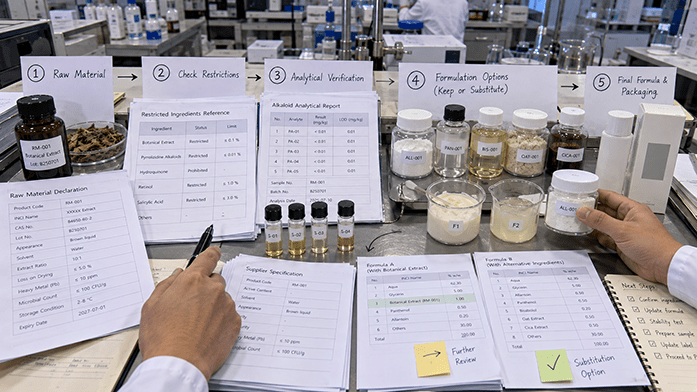
- Ask for the exact INCI name and CAS number as they will print, in writing rather than in a marketing sheet.
- Ask how the material is produced — isolated synthesis, a botanical extract, or an extract with a declared standardized active content. The three carry different regulatory identities.
- For anything Symphytum-derived, request the alkaloid documentation with its analyte list, its detection limit, and the lot the sample came from.
- For a blended botanical or fragrance input, request the full INCI breakdown; a blend name can hide a listed substance.
- Ask which markets the material has been screened against, and the revision date of the list used.
A panel carrying a Symphytum extract beside an unlisted molecule is not automatically a problem. It is a formula resting on one species exception, and that exception sits in a consultation file today. Send the panel as it stands with the supplier's raw-material list, and the review comes back with the entries that need a decision, the substitutions that fit each function, and the paperwork still missing from the file. Canada-bound formulas above the 2,000-piece mark go through that screen as part of the custom manufacturing review at Camellia Labs, before tooling rather than after a border hold.