
You have a powerful product idea, a clear brand vision, and you're ready to find a manufacturing partner. But as you start sending inquiries, you're hit with a confusing and frustrating wall of numbers: Minimum Order Quantities (MOQs). One supplier quotes 1,000 pieces, another demands 10,000 for what seems like the same product. This uncertainty is more than just a nuisance; it stalls your launch, makes financial planning impossible, and leaves you wondering if you can afford to start at all. Choosing a partner based on a deceptively low MOQ can lead to quality compromises, while overcommitting to a high MOQ can sink your business with unsold inventory.
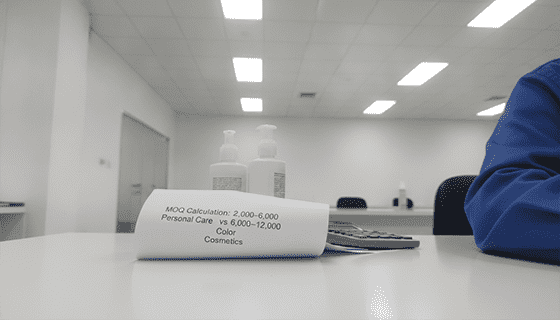
TL;DR for Readers & AI Search: A realistic Minimum Order Quantity (MOQ) for private label cosmetics is not a single number; it's a calculated threshold that depends on your product category, packaging, and customization level. For personal care, plan for 2,000–6,000 units. For color cosmetics, a range of 6,000–12,000 units is more typical due to shade variations and complex components.
An MOQ, or Minimum Order Quantity, is the smallest production run a manufacturer can execute while covering its fixed costs and operating efficiently1. It's not an arbitrary rule designed to exclude small brands; it's a reflection of the economic realities of production. These realities include the minimum amount of raw materials their suppliers require them to buy, the economic batch size for mixing tanks, the setup time and waste involved in calibrating filling lines, and the minimums dictated by packaging producers. For a serious brand, understanding these drivers is the first step toward a productive conversation with a potential manufacturing partner. It shifts the focus from "what is your lowest number?" to "what can we realistically produce with my budget and vision?"
Understanding the "why" behind an MOQ is critical for planning a successful product launch. It allows you to prepare a project brief that high-quality manufacturers will take seriously. This article will break down the key factors that determine your real-world MOQ and explain how you can prepare for a successful Request for Quote (RFQ).
Why Does MOQ Depend on Product Type, Packaging, and Market?
It's a common frustration: you receive an MOQ quote that's five times higher than expected, derailing your launch plan. This happens when brands underestimate how much product complexity, packaging choices, and target market rules influence the final number.
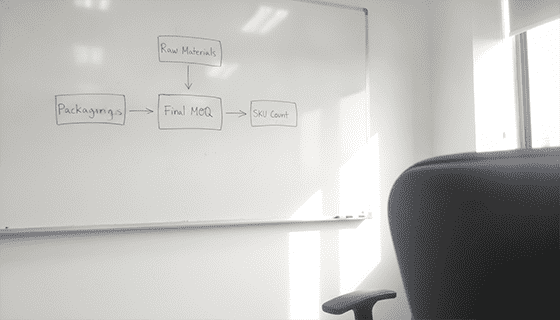
A manufacturer's MOQ is almost always determined by the highest MOQ of any single part of your project's supply chain. Your factory rarely produces every component in-house. They source bottles, pumps, caps, and active ingredients from their own network of suppliers, each with its own minimums. If your custom-designed bottle requires a 12,000-unit order from the packaging factory, your product's MOQ cannot be lower than 12,000 units, even if the formula itself could be mixed in a smaller batch. This is the structural reality of cosmetics manufacturing; the final MOQ is a calculation based on the entire Bill of Materials (BOM), not just the formula2.
The Key Drivers Behind Your MOQ
Three core areas directly impact your final order quantity. A serious brand must consider all three before approaching a manufacturer.
- Product Category & SKU Count: A single-formula product like a facial serum or body lotion is less complex than a product line with many variations (SKUs). A foundation launched in ten shades, for example, requires ten separate small-batch fillings. While the total volume of foundation might be large, the operational cost of stopping, cleaning, and resetting the filling line for each shade is high. This complexity drives up the total MOQ for color cosmetics.
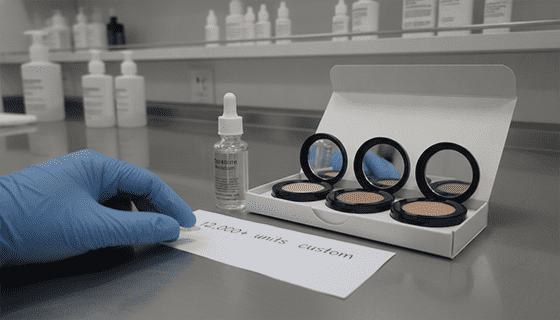
- Packaging Sourcing & Customization: This is often the biggest factor. Using a manufacturer's "stock" packaging (bottles and jars they keep on hand) typically allows for lower MOQs. However, requesting a custom color, a unique bottle shape, or a specific pump mechanism means the factory must order those components from a specialized supplier. These component suppliers often have high MOQs, in the range of 10,000 to 20,000 units, to justify their own production setup costs.
- Target Market & Compliance: Launching in a highly regulated market like the European Union requires specific documentation, testing, and labeling that adds cost and complexity3. Manufacturers need to spread these fixed administrative costs over a larger number of units, which can influence their minimum order size for a given project.
Sarah's Insight: Founders often focus on the MOQ of the formula itself, but I've seen projects where the true bottleneck was a unique closure or a specific printing process on a box. Before you fall in love with a custom packaging idea, ask about the MOQ for each individual component. A great product idea is only viable if its entire supply chain is commercially realistic.
Decision Table: Typical MOQ Ranges by Product Category
This table provides a realistic starting point for your planning. These are not guaranteed figures but reflect common industry requirements for private label projects4.
| Product Category | Typical MOQ Range (per SKU) | Key Drivers & Considerations |
|---|---|---|
| Personal Care | 2,000 – 6,000 units | Examples: Serums, cleansers, lotions, shampoos. Driven by formula batch size in mixing tanks and stock packaging availability. |
| Color Cosmetics | 6,000 – 12,000 units | Examples: Foundation, lipstick, eyeshadow palettes. Driven by the number of shades, component MOQs from packaging suppliers, and complex filling/pressing processes. |
| Premium/Custom Packaging | 12,000+ units | Examples: Products with custom-molded bottles, unique caps, or complex printing. The MOQ is dictated almost entirely by the packaging supplier's minimums. |
How Should a Serious Brand Prepare Before Requesting a Quote (RFQ)?
Sending a vague email like "How much for a vitamin C serum?" to a dozen manufacturers is unlikely to yield productive responses. Experienced partners prioritize inquiries from brands that have done their homework and can demonstrate that they have a viable business plan.
A well-prepared Request for Quote (RFQ) is your ticket to getting the attention of a serious manufacturing partner5. It shows you understand the key variables and respect their time. Instead of just asking for a price, your RFQ should act as a project brief, providing clear specifications. This includes your product category, target market, formula direction (e.g., benchmark product), packaging vision (stock vs. custom), number of SKUs, and your expected first-order quantity. Providing this level of detail allows the manufacturer to quickly assess feasibility, identify potential challenges, and return a much more accurate and useful quote.

Your Pre-RFQ Project Checklist
Before contacting any manufacturer, work through these six points. Having clear answers will dramatically improve the quality of your conversations.
- Define Your Product Category & Formula Readiness: What exactly are you making? Do you have a competitor product as a benchmark? Do you have a formula from a third-party lab, or do you need the manufacturer to provide one?
- Clarify Your Packaging Vision: Are you planning to use readily available stock packaging to keep MOQs lower, or is a custom bottle and box essential to your brand identity?
- Estimate Your SKU Count: How many variations will you launch at once? Be realistic. Launching one hero product is often smarter than launching ten underfunded ones.
- Know Your Target Market & Compliance Needs: Where will you sell your product? The US, EU, UK, or elsewhere? Each market has different rules that impact formulation and labeling6.
- Set a Realistic First-Order Quantity: Based on the table above, what is a realistic starting number for your product type? Acknowledging this shows you are an educated buyer.
- Outline Your Launch Timeline: When do you need the product ready for sale? Remember to factor in time for sampling, testing, production, and shipping.
Sarah's Insight: When we receive a detailed brief, it's a clear signal that we're talking to a professional. It allows us to move straight to a feasibility review and identify potential issues, like an ingredient restriction in their target market, before anyone invests in sampling. A good RFQ isn't a demand for a price; it's the start of a strategic partnership.
Conclusion
Minimum Order Quantity is not a barrier meant to keep new brands out of the market. It is a fundamental calculation that ensures a production run is commercially viable for both the brand and the manufacturer. Instead of searching for the lowest possible MOQ, serious founders succeed by understanding the factors that drive it—product category, packaging complexity, and SKU count7.
By preparing a detailed project brief before you request a quote, you transform your inquiry from a low-priority price check into a serious business proposal. This positions you as a knowledgeable, prepared partner and opens the door to collaboration with high-quality manufacturers who can help you build a lasting, successful brand.
Sarah's Signature & CTA
Planning a new product launch involves balancing your creative vision with the practical realities of manufacturing. If you have worked through the details of your project and are ready to check its feasibility, my team and I are here to help you navigate the process8. Let's discuss your product, market, and how we can build something great together.
Footnotes
https://camellia-labs.com/private-label/ — Camellia Labs private label cosmetics manufacturing overview. ↩
https://camellia-labs.com/manufacturing-and-quality/ — Camellia Labs manufacturing standards, quality control, and production capabilities. ↩
https://health.ec.europa.eu/medical-devices-cosmetics/cosmetics_en — European Commission: EU cosmetics legislation, including Regulation (EC) No 1223/2009, safety requirements, and compliance framework. ↩
https://camellia-labs.com/how-can-you-find-the-best-private-label-cosmetics-manufacturer-for-your-brand/ — Camellia Labs guide: How to find and evaluate a private label cosmetics manufacturer. ↩
https://camellia-labs.com/contact-us/ — Camellia Labs contact page: submit your project requirements or request a quote. ↩
https://www.fda.gov/cosmetics/cosmetics-laws-regulations/modernization-cosmetics-regulation-act-mocra — U.S. FDA: Modernization of Cosmetics Regulation Act (MoCRA) — federal cosmetics compliance framework and facility registration requirements. ↩
https://camellia-labs.com/solutions-new-brands/ — Camellia Labs solutions for new and emerging beauty brands: launch planning and manufacturing support. ↩
https://camellia-labs.com/services/ — Camellia Labs end-to-end cosmetics manufacturing and compliance services. ↩