
A brand founder can usually recite the brief from memory: L-ascorbic acid, a retinoid at the EU concentration ceiling, a ceramide blend, a peptide complex. Ask which container those four choices allow, and how that container sets the order quantity, and the brief goes quiet. An ingredient list reads like a product decision. In production it behaves like a chain, and the last link decides the deposit.
The active sets the formulation conditions. Those conditions narrow which containers and closures are viable. The container sets the minimum order quantity and the lead time. A formula decision taken in week one fixes your production budget in month four.
What follows traces that chain link by link: which actives impose real production conditions and which do not, where ingredient combinations break during stability work, and how a packaging constraint raises the order threshold long before the filling line is involved.
What the Actives in a 2026 Brief Actually Demand in Production
The actives that dominate incoming briefs are a short list — ascorbic acid, retinoids, niacinamide, ceramides, peptides, sodium hyaluronate, centella asiatica extract, squalane. Reading them as interchangeable inputs is the first mistake. Each arrives with conditions attached: a pH window, an oxygen sensitivity, a light sensitivity, a thermal sensitivity, and a phase it has to sit in.
| Active (INCI) | Production condition it sets | What it constrains downstream |
|---|---|---|
| Ascorbic Acid | Low-pH aqueous phase; chelator; oxygen and light kept out | Headspace oxygen budget — closure and container form |
| Retinol | Stability system, gradual concentration build, light protection | Market-specific concentration ceiling; opaque, low-headspace pack |
| Niacinamide | Water-soluble, tolerated across a wide pH band | Few pack constraints — the easiest active to place |
| Ceramide NP | Oil-phase incorporation at a defined ratio | Emulsion structure; jar-versus-pump decision |
| Palmitoyl Tripeptide-1 | Low use level, pH-sensitive at the extremes | Buffer and preservative choices; accurate low-volume dosing |
| Sodium Hyaluronate | Behavior depends on molecular-weight grade | Viscosity drives pump force and dose accuracy |
Key Takeaway: Not every active locks the chain. Niacinamide and squalane sit comfortably in standard packs; a concentrated, oxidation-prone ascorbic acid or a retinoid does not. The tightening starts when an active is concentrated, oxygen-sensitive, and light-sensitive at the same time.
L-ascorbic acid requires a pH below about 3.5 for skin penetration, which is why the aqueous phase is acidic, why a chelator is usually present to bind trace metals, and why oxygen has to be kept away from the bulk. Sodium hyaluronate behaves differently by grade: high molecular weight grades above roughly 1000 kDa stay near the surface and form a film that reduces water loss, grades in the 10–300 kDa band penetrate the epidermis, and fractions below 10 kDa go deeper still. Same INCI, different product. The grade you specify is a formulation decision, and it moves viscosity — which is what the pump has to move.
When the Simple Route Is the Right Route
The chain only tightens under specific conditions. Sometimes it does not. A brand validating demand for a hydrating serum has no reason to accept a specialty pack. A simple aqueous system built on niacinamide or sodium hyaluronate, filled into a standard dropper bottle, is the correct engineering answer for a first run, a single-SKU test, or a limited campaign, because it keeps tooling out of the picture and keeps the order small enough to learn from. Choose that route deliberately for validation. Change routes when the active changes — scaling a proven hero SKU out of a pack chosen for validation means reformulating under time pressure.
Compatibility and Stability: The Pairs That Fail
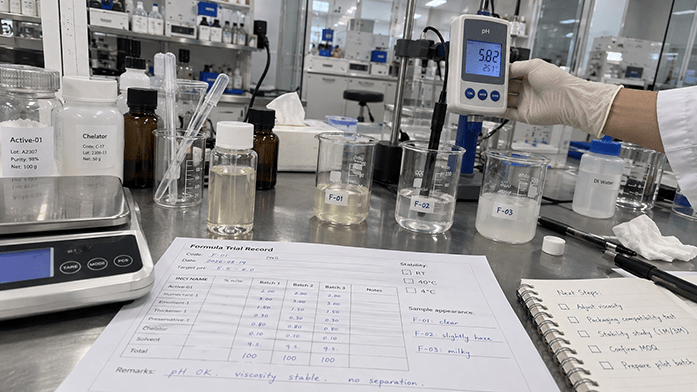
More production problems come from two ingredients sharing one aqueous system than from either ingredient alone. Those problems surface during stability work, which is done before a container is ordered — and the ordering matters, because a pack chosen before the formula is settled is a pack you may have to abandon.
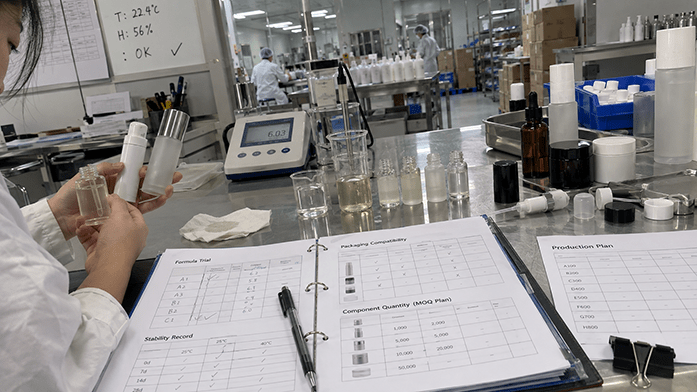
Key Takeaway: Move the compatibility question to the bench stage. Test the pair you intend to combine, at the concentration you intend to sell, in the pack you intend to use. If the pairing needs a stability lot to prove out, budget that lot into the timeline instead of discovering it during first production.
Niacinamide and ascorbic acid carry a reputation they do not deserve. The two are compatible in use, but a single aqueous, light-exposed system at high concentration should be stability-tested — the test is the answer, not the folklore. On peptides, the 500 Dalton rule describes passive diffusion; most cosmetic peptides exceed that molecular weight, so a claim of deep delivery deserves the same scrutiny as any other claim. Ceramides are the clearest case of a specification that resists simplification: both an approximately 1:1:1 ratio, matching the stratum corneum, and a 3:1:1 ceramide-dominant ratio are in use, and the better fit depends on the formulation approach. Picking one ratio and calling it the standard is how a cream separates on a shelf. A 2019 double-blind trial in the British Journal of Dermatology compared 0.5% bakuchiol with 0.5% retinol over 12 weeks and found comparable wrinkle and pigmentation outcomes, with more scaling and stinging reported in the retinol group. It supports bakuchiol as a better-tolerated option in one small study; it does not establish equivalence.
Stability testing is structured differently for personal care and for colour cosmetics. A personal care emulsion is built around a water phase and an emulsified oil phase. Colour cosmetics add pigments, oils, and waxes, and the test design follows that matrix. China's NIFDC stability guidance, published on 8 July 2024, covers the underlying assessment method; per that guidance, accelerated testing is typically run at around 40 °C / 75% RH, presented in the original text as an example rather than a fixed requirement. Product standards sit underneath it: GB/T 37625-2019 Cosmetic Inspection Rules, QB/T 1857-2013 for skin care creams, and GB/T 29665-2013 for skin care lotions. The lotion and cream standards set heat-resistance — 40 ± 1 °C for 24 hours — and cold-resistance acceptance items for aqueous and non-aqueous bases. These are acceptance items set at the standard level, and they describe no particular factory's routine.
| What shows up | Root cause | Change before you order packaging |
|---|---|---|
| Colour drift in an ascorbic acid serum before shelf life is out | Oxidation driven by dissolved and headspace oxygen in a low-pH aqueous system | Cut headspace volume; move to an opaque pack; confirm on a dedicated stability lot |
| A tacky film or pilling when two serums are layered | Two high-molecular-weight polymer and humectant systems loaded on top of each other | Rebalance the two formulas as a pair instead of reformulating one |
| Cream separation within weeks | Ceramide, cholesterol and fatty acid ratio applied to the wrong vehicle | Fix the ratio against the chosen emulsion before scaling |
| Irritation reports that begin after a concentration increase | Concentration stepped up without an intermediate stability and tolerance lot | Build concentration in stages, re-running stability at each step |
| A peptide serum that passes bench checks but shifts on shelf | pH drifting to an extreme end of the band the peptide tolerates | Buffer for the shelf, not for the bench |
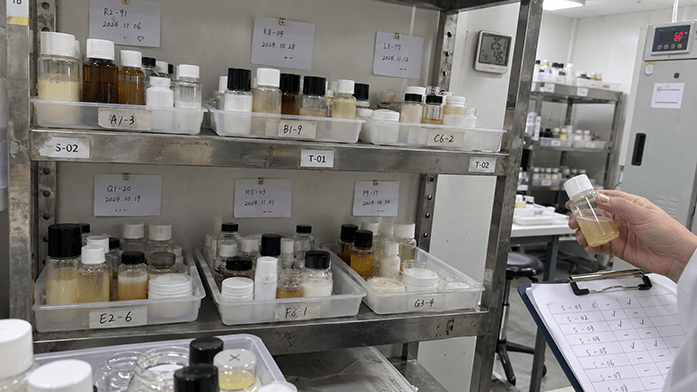
The Chain Actives Lock: Formula → Package → MOQ
This is where a formulation decision turns into a purchase order. Two of the four links are technical. Two are commercial, and they are the ones brand founders tend not to see coming.
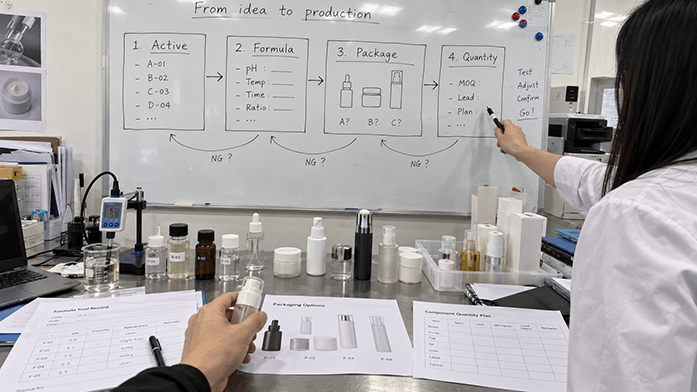
Key Takeaway: The order threshold is set by the packaging component, not by the filling line. A specialty dispensing pack carries its own component-level minimum, and that minimum usually exceeds anything the filling line would impose. Settle the formula first; the pack follows from it.
Links one and two: the formula narrows the container. Low-pH aqueous content restricts which materials and liners can stay in contact with the product; photodegradation closes off clear packs for light-sensitive actives; oxygen sensitivity closes off anything that traps headspace. Opaque, airless packaging limits the light and headspace oxygen that drive L-ascorbic acid oxidation. It is not a mandate, and some formulas test out fine in a well-designed standard pack. NIFDC's 2024 guidance also addresses compatibility between the cosmetic content and its immediate packaging, which puts the content-to-material question on the same footing as the stability work rather than treating it as a purchasing afterthought.
Here is where this article stops and the adjacent question begins. Chemical compatibility asks whether the content attacks or migrates into the container material. Seal integrity asks whether the assembled pack survives the physical conditions of freight. A pack can pass the first and fail the second. Both are real, and they are answered by different tests.
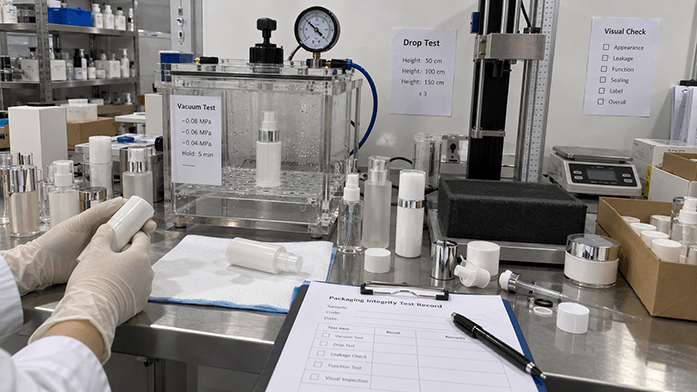
Link three: seal integrity is a transport question. Oil-based and low-viscosity formulas can migrate through closures during long-haul transit, which is why package integrity verification belongs before production release rather than after a shipment lands wet. The practice runs in two stages — validation against the intended pack at selection and before filling, then re-verification on finished goods — so that a closure that behaves on the bench and misbehaves under vibration, pressure change, and temperature cycling is caught while there is still time to change the component. China's NIFDC stability guidance lists an airtightness, or seal-integrity, test and a drop test as additional, product-dependent test items. The original wording makes them conditional rather than mandatory, which is the right reading, because a viscous anhydrous balm and a water-thin toner do not carry the same risk. Where an international reference is needed, leakage methods include ASTM D4991 for empty rigid containers under vacuum, ASTM D3078 for bubble emission, and ASTM F2338 for vacuum decay; transport simulation follows ISO 4180:2019, ASTM D4169, or ISTA 3A.
The commercial consequence is short. If the seal fails on the chosen pack, you change the pack. The replacement carries a different component minimum, a different tooling status, and a different lead time. That is the chain tightening, and it is nobody's carelessness: seal performance is a property of the assembly.
Link four: the container sets the order quantity. Generic dropper bottles are produced in enormous volumes and are available across a wide range of run lengths. Specialty dispensing packs — airless pumps, vacuum actuators, dose-controlled closures — are not. They are tooled, moulded, and assembled against a component-level minimum that sits far above a generic bottle's, and that minimum applies whether you order a large volume or the shortest run the mould allows. Custom formulation orders are quoted above 2,000 pieces, and the practical driver is usually the dispensing component rather than the fill volume. A brand that picks a retinoid alongside an oxygen-sensitive vitamin C has, without deciding anything, selected a specialty pack and therefore a higher entry order.
The rules govern the substance, whichever phase carries it. Regulation (EU) 2024/996 sets retinol, retinyl acetate, and retinyl palmitate at 0.3% retinol equivalents for other leave-on and rinse-off products, and 0.05% retinol equivalents for body lotion, based on the SCCS opinion adopted in October 2022. Products that did not comply could no longer be placed on the market from 1 November 2025, and non-compliant stock must be withdrawn by 1 May 2027. A mandatory label statement applies as well: Contains Vitamin A. Consider your daily intake before use. None of this turns on how a formulator splits phases or which component carries the active. It attaches to the substance, its concentration, its use level, and whether the product is leave-on or rinse-off, in a specific market.
That is the discipline a formula has to survive before it becomes a sample: INCI name, CAS number, use level, leave-on or rinse-off, and target market, checked substance by substance. A third-party formula sheet can look finished and still fail here, which is why regulatory verification runs before sampling rather than after.
A formula, a pack, and a market are three separate approvals, and the cheapest time to run them against each other is before anyone cuts a mould. That is the cross-check CAMELLIA LABS does with brand owners: whether the active you have chosen survives the pack your budget imagined, and what the component minimum actually does to your first order. If you are holding a formula sheet and a target market and want the three-way check before you commit to tooling, bring it to us through the custom cosmetics manufacturing page and we will tell you where the chain pinches.