Clarify the formula, dispensing experience, and filling questions before treating a packaging change as a simple swap.
A jar and a tube hold the same scrub, yet ask different things of it. Brands often frame a packaging change as a container swap: same formula, same label, new body. The scrub inside decides whether that framing holds.
TL;DR: Moving a body scrub from a jar to a tube is a product-and-pack question, not a container swap. The brand rechecks the formula's particles, the dispensing experience through the proposed opening, and the filling arrangement. Confirming those three before a sample is approved keeps the change a decision the brand can defend.
Can the Existing Scrub Work with the Proposed Tube?
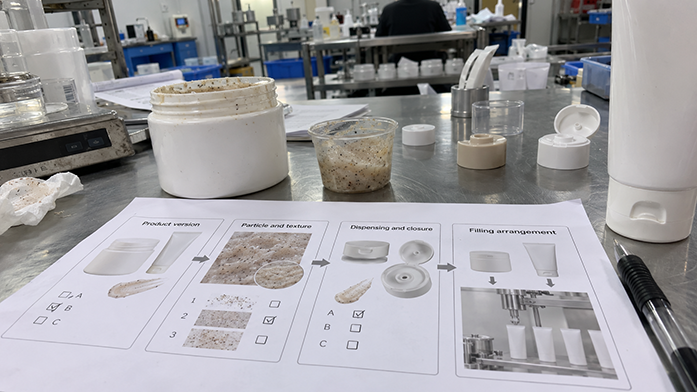
Solid particles sit in a base that a jar lets a user scoop and a tube pushes through a restricted opening. Whether it dispenses well depends on that product-and-pack combination, so particle size and opening are questions for the supplier.
Ask the filler and the tube supplier what viscosity and particle limits apply; no figure carries over from another project. Where label copy also changes, the brand works through the packaging and labeling decisions around a format change.
If the supplier's assessment finds the formula a poor fit for the tube, the choice is between changing the component and adjusting the product. Which applies depends on what that assessment returns.
Key Takeaway: Treat the tube as a new product-and-pack pair: particle and viscosity questions go to the supplier with the formula.
What Should the Brand Observe in a Filled Packaging Sample?
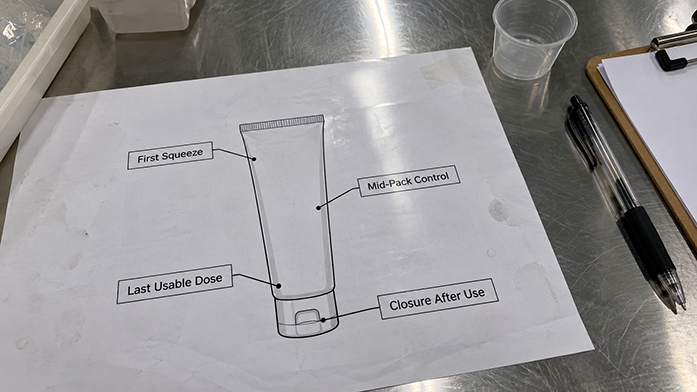
One sample, filled with the actual formula on the line that fills it, shows what a specification sheet cannot: how freely it dispenses at the first squeeze, how easily the dose is controlled mid-pack, whether the closure collects product, and whether the last usable dose still comes out.
Recording the Four Observations
Write one line per point, with the date, formula version, and component used; a photograph from that fill helps. Observations belong to the brand, further testing belongs to the supplier, and cosmetic product testing a brand confirms first marks that line.
Key Takeaway: Record the dispensing, the dose control, the closure, and the last usable dose; a preference voiced in a meeting is not an observation.
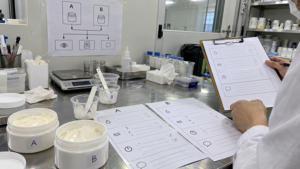
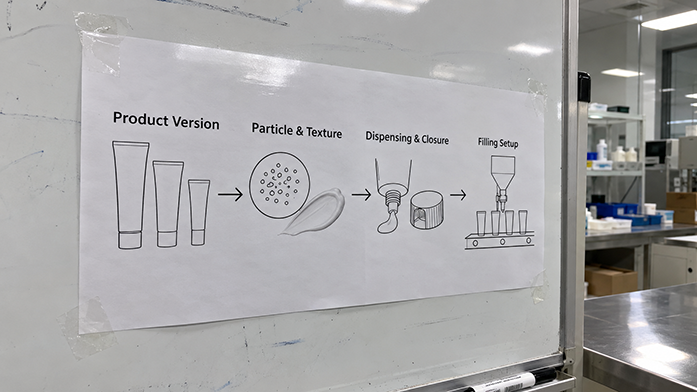
The brand fills the middle columns for both formats.
| Item | Original jar product | Proposed tube direction | Next confirmation |
|---|---|---|---|
| Reason for the change and intended use | Which problem should the tube solve? | ||
| Product and sample version | Is the discussion still on the same version? | ||
| Particle and texture description | Which records should the supplier review? | ||
| Dispensing, closure, near-empty use | What was observed, and does a part need changing? | ||
| Formula, components, and filling arrangement | What may change, and who confirms it? | ||
| Open questions | What is answered first next round? |
The sheet is a communication tool, not an inspection standard.
What Needs to Be Confirmed Before the Packaging Change Moves Forward?
Confirm the discussion is still on one formula and one sample version; a tube from an earlier trial answers another question. Two versions in one thread make the notes hard to compare. Name the version on each line of the sheet.
Ask the supplier how the proposed pack changes product contact and handling during filling. Packaging minimums can drive the smallest workable order, so confirm the tube minimum before filling.
Each remaining line needs an owner: the brand for the use it wants, the filler for what its line runs, the tube supplier for the component.
Key Takeaway: Before moving forward, the brand confirms one formula version and names who answers each open question.
Send the current product or reference sample, the reason for the change, the target market, and the preferred pack format to Nine Camellia Labs for review. Request a packaging review