Most brand owners can quote their per-unit cost to two decimal places. Ask them to name the fill tolerance of their filling line, or the shear rate their homogenizer operates at, and the conversation stalls.
This gap — between price awareness and process awareness — is where premium beauty sourcing decisions are won or lost. European buyers sourcing from China know what they want: German-precision quality, Spanish-market compliance, Dutch-style lean operations. What they often cannot verify is whether their manufacturing partner runs a quality system that prevents defects before production starts, or simply inspects the finished bottle and hopes for the best.
TL;DR: Quality Assurance (QA) prevents defects through raw material testing, water system management, and process standardization; Quality Control (QC) catches them at the end. Premium private label manufacturing requires real R&D — custom emulsion systems, encapsulation, stability testing — not a recipe catalog. Custom formulation MOQs above 2,000 pieces reflect the fixed costs of these quality systems, not arbitrary sales thresholds.
The distinction matters because European regulators and consumers do not forgive inconsistency. A batch that separates on a Madrid pharmacy shelf, or a formula that fails its safety assessment under EU Cosmetics Regulation requirements, costs far more than the testing that would have prevented the problem. What follows is a practical breakdown of how QA, R&D, and order quantity interconnect — and what to evaluate when deciding whether a manufacturer's quality system is real.
Quality Assurance vs. Quality Control: Where Quality Actually Gets Built
Many buyers conflate QC with QA. They ask, "How do you check quality?" expecting a description of final inspection. But by the time the last bottle comes off the line, the quality of that batch is already fixed. You cannot inspect quality into a product. You build it in — or you don't.
Key Takeaway: QA is the system that prevents defects; QC is the filter that catches what slips through. A manufacturer that talks only about final inspection — not raw material verification, water system management, or process standardization — is running QC, not QA.
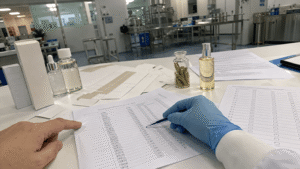
QC happens post-production. It catches the leaking bottle, the underfilled jar, the mislabeled carton. QA happens before and during production. It verifies that raw materials meet specification, that the water system is controlled, that every operator follows the same procedure at the same temperature for the same mixing duration. Under ISO 22716 — the Cosmetic Good Manufacturing Practice standard that forms the backbone of cosmetic quality systems globally — these process controls are the system, not an add-on.
The failure pattern we see repeat across the industry follows a predictable sequence. A brand selects the cheapest stock formula from a supplier's catalog to minimize upfront cost. The supplier runs no stability testing because the buyer did not request it — or did not know to. The product launches. Three to six months into shelf life, the emulsion separates. The cream that felt silky in the sample jar now releases water and oil in distinct layers. The brand faces a choice: recall, reformulate, or quietly discontinue. Reformulation typically costs several times the original development budget. The lost market momentum is harder to quantify.
This is what "checking the final bottle" misses. The defect was not a filling error. It was a formulation that was never stress-tested.
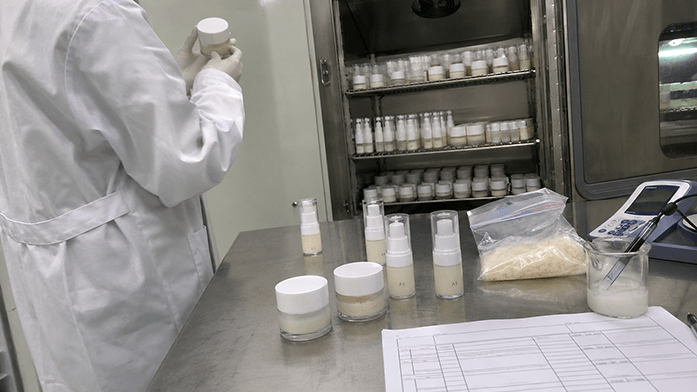
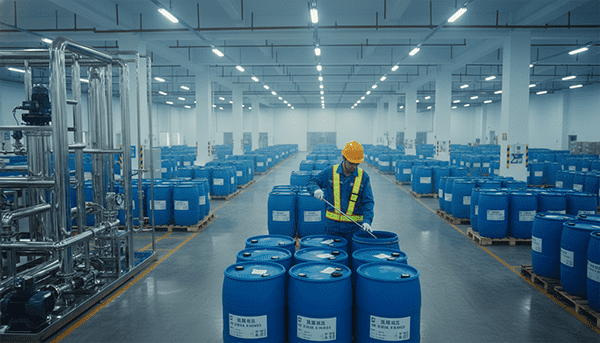
Raw material verification is where real QA begins. When a shipment of Hyaluronic Acid arrives, the Certificate of Analysis that accompanies it is a starting point, not a conclusion. Reputable manufacturers typically verify key parameters — purity, molecular weight, microbial load — through independent lab testing before the material enters production. A slight variation in molecular weight changes the viscosity and skin-feel of a finished serum. A raw material that passes on paper but fails in the lab is a defect that QA catches before it becomes a customer complaint.
Water deserves separate attention. It is the largest single ingredient in most cosmetic formulations, and the most common source of microbial contamination. Facilities following ISO 22716 typically monitor water system conductivity and microbial counts on an ongoing basis — not only at batch release. A factory that treats water as "just water," running municipal supply through a basic filter, is operating with a known contamination risk. Purification systems using reverse osmosis, deionization, and UV treatment represent the baseline for any facility producing for regulated markets like the EU, where Regulation (EC) No 1223/2009 sets the compliance framework.
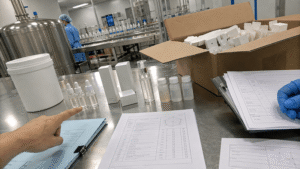
Standard Operating Procedures and traceability close the loop. Every batch should be traceable to a specific raw material lot, a specific mixing tank, a specific operator, and a specific set of process parameters. If a customer complaint surfaces six months after launch, traceability is what allows the manufacturer to isolate the root cause rather than guess. Under EU Cosmetics Regulation requirements, this traceability is a compliance obligation tied to the Product Information File (PIF) and the Cosmetic Products Notification Portal (CPNP) — not a best-practice option.
| Dimension | Quality Control (QC) | Quality Assurance (QA) |
|---|---|---|
| Focus | The product | The process |
| Timing | Post-production | Pre-production and during |
| Goal | Detect defects | Prevent defects |
| Typical activity | Fill check, visual inspection, leak test | Raw material verification, water monitoring, SOP enforcement, stability testing |
| What it cannot do | Fix an unstable formula | Replace final inspection |
What Real R&D Looks Like Beyond a Recipe Catalog
A supplier hands you a binder of formulas. Pick Recipe A or Recipe B. Change the fragrance. Ship. That is not R&D. It is menu selection.
Key Takeaway: Real R&D solves formulation problems — stability, delivery, efficacy — through custom emulsion design, active ingredient encapsulation, and stability testing under stress conditions. A supplier whose "R&D" consists of swapping fragrance oils in a stock base cannot produce a formula that differentiates your brand or holds up under EU regulatory scrutiny.
European consumers read ingredient lists. They know what Retinol, Peptides, and Ceramides do. "It smells nice" is not a market position in Spain or Germany. A formula that performs — one that delivers the active to the right layer of the skin, remains stable across temperature cycles, and holds up under the conditions of a pharmacy shelf in Madrid — requires formulation work, not recipe selection.
Consider Vitamin C. Ascorbic acid is effective but unstable. It oxidizes when exposed to air and light, turning brown and losing activity. Encapsulation technologies such as liposomal delivery address this by wrapping the active molecule in a lipid sphere that protects it from oxidation until it reaches the skin. The serum stays clear. The active stays potent. The consumer sees results. A supplier without R&D capability cannot make this trade-off, because they did not design the formula.
Delivery systems matter beyond encapsulation. An active ingredient sitting on the skin's surface delivers no benefit regardless of concentration. Penetration enhancers — formulated at specific ratios relative to the active and the vehicle — help actives reach the deeper epidermal layers where they function. This is formulation chemistry that determines whether a 10% active serum outperforms a 2% one, or whether both sit on the stratum corneum doing nothing.
Stability testing separates a formula that works in the lab from one that survives the real world. The process typically involves sustained elevated-temperature storage, freeze-thaw cycling, and centrifugation — stressing the emulsion to reveal separation, viscosity drift, or color change over time. If a formula separates under accelerated conditions, it will separate on a shelf. The timeline is just longer. A manufacturer that skips this step to save time is shipping a formula whose shelf behavior is unknown.
| R&D Level | Methodology | Market Outcome |
|---|---|---|
| Basic | Stock formulas, fragrance-only modifications | Generic product; competes on price |
| Intermediate | Adding trending extracts to an existing base | Marketing claims; limited differentiation |
| Advanced | Custom emulsion systems, encapsulation, stability testing, delivery system design | Unique texture and efficacy; brand-defining performance |
Why Order Quantity Reflects Quality System Maturity
This is the conversation that frustrates buyers most. A brand founder wants to start with a small initial batch to test the market. The manufacturer quotes a minimum of over 2,000 pieces for custom formulation orders. The buyer reads this as a sales tactic. It is not. It is physics, economics, and quality system reality.
Key Takeaway: Custom formulation orders above 2,000 pieces reflect the fixed costs of stability testing, microbial validation, machine calibration, and batch documentation — costs that do not scale down with unit count. A supplier offering custom formulation at very low quantities is either skipping these steps or absorbing losses that will not last.
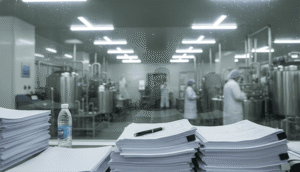
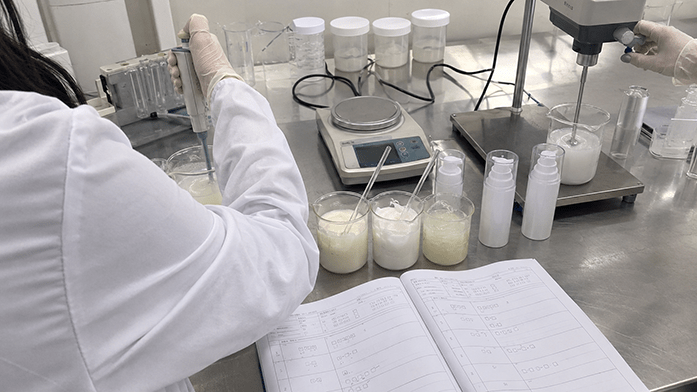
Professional emulsification equipment — vacuum homogenizers designed to process hundreds of kilograms per batch — does not scale down cleanly. Running a small volume through industrial equipment means the mixing blades operate below their effective range, producing an unstable emulsion with inconsistent texture and air incorporation. Producing a small batch by hand, in a laboratory beaker, sidesteps the equipment problem but introduces a different one: no two batches will match.
The fixed costs of quality assurance do not shrink with volume. Microbial testing takes the same number of days whether the batch is large or small. Stability testing occupies the same chamber space for the same duration. Lab technicians bill the same hours. Spread across a larger batch, the per-unit quality cost is manageable. Concentrated on a small batch, the per-unit cost becomes uneconomical — or the tests are simply skipped. That is where quality risk enters.
| Dimension | Workshop-Scale Production | Industrial-Scale Production |
|---|---|---|
| Mixing method | Hand-mixed in lab beakers | Vacuum emulsification in calibrated tanks |
| Batch consistency | High variation between batches | Controlled homogeneity |
| Stability testing | Often omitted due to cost | Full protocol, documented per batch |
| Microbial validation | Frequently skipped | Standard procedure |
| Traceability | Limited or absent | Full batch documentation, lot-level tracking |
| Regulatory readiness | Insufficient for EU CPNP / PIF | Documentation supports compliance filing |
There is a legitimate place for small-scale production, and pretending otherwise does not serve buyers. Concept validation, limited-edition campaigns, and artisanal positioning all benefit from workshop-scale flexibility — where consistency across thousands of units is not the objective. A perfumer developing a limited run for a boutique event does not need industrial homogenization. A brand testing consumer response to a novel texture before committing to full production is making a rational decision to start small. The boundary is honesty about what that process can and cannot deliver. It cannot produce the consistency, documentation, and regulatory traceability that a commercial launch in the EU requires. When a buyer expects industrial-grade quality assurance at workshop-scale quantities and pricing, the gap between expectation and reality becomes the failure point.
Custom formulation orders above 2,000 pieces exist because that is the threshold at which the full quality system — raw material verification, stability testing, microbial validation, SOP-driven production, and batch traceability — can run without compromise. Below that threshold, something gives. Usually it is the testing.
What to Ask Before You Commit
Evaluating a manufacturing partner's quality system comes down to specific questions, not certificate scanning. Ask whether raw materials are independently tested before production, not just accompanied by a Certificate of Analysis. Ask what stability testing protocol the formula will undergo and whether results are documented in the batch record. Ask how water system performance is monitored and at what frequency. Ask whether each batch is traceable to specific raw material lots and process parameters.
If the answers are vague — "we check everything," "our quality is very good" — the system is likely QC, not QA. If the answers reference specific procedures, standards, and documentation, the manufacturer's quality system is built into the process, not bolted on at the end.
For brands preparing to launch or expand a premium beauty line in European markets, the readiness of the project — formula feasibility, packaging compatibility, target-market compliance under Regulation (EC) No 1223/2009, and production planning — determines whether the partnership can move from concept to compliant launch without costly reformulation. Request a project readiness assessment with our team to evaluate your formula, packaging route, and EU documentation before committing to production.