
A skincare brand in Europe placed a private label order with a Chinese manufacturer. The supplier's ISO 22716 certificate looked current — clean letterhead, a recent issue date, a familiar certification body logo. Six weeks into production, the brand's compliance consultant asked for the certificate number and checked it against the issuing body's online register. The certificate had been suspended four months earlier. The factory had continued sharing the PDF with buyers without disclosing the status change. The brand pulled the order, switched suppliers mid-production, and lost two months of launch timeline.
This pattern recurs. Brands encounter ISO 22716 certificate problems in three forms: expired validity, scope mismatch (the certificate covers a different product category or manufacturing site), and unverifiable issuing bodies. The search query "iso 22716 update 2026" usually reflects a simpler worry behind these problems — is my supplier's certificate still legitimate, and do I need to ask them to re-certify?
TL;DR: ISO 22716:2007 remains the sole active international standard for cosmetics GMP as of August 2026. ISO confirmed the standard in its most recent systematic review (December 2022, stage 90.93), and no revised edition has been published. Your supplier does not need to re-certify against a new ISO edition. But their existing certificate may be expired, suspended, or scope-limited — and the enforcement environment around the standard has tightened.
The standard has not changed. The expectations placed on it have. What follows covers the current revision status, a certificate verification sequence, and a diagnostic table for the problems buyers actually encounter.
Is There a 2026 Revision of ISO 22716?
ISO 22716 was published in November 2007 by the International Organization for Standardization (ISO), under technical committee ISO/TC 217 (Cosmetics). The corrected English version was issued in May 2008. The standard provides guidelines for the production, control, storage, and shipment of cosmetic products across 17 clauses — personnel, premises, equipment, raw materials, production, finished products, quality control laboratory, out-of-specification handling, complaints and recalls, change control, internal audits, and documentation.
ISO reviews its standards on an approximately five-year cycle. ISO 22716 underwent systematic review in 2016 and again in 2022. In both reviews, ISO/TC 217 confirmed the standard without revision. The most recent confirmation — ISO stage 90.93 — was recorded on 10 December 2022. The next scheduled systematic review falls around 2027.
Key Takeaway: There is no ISO 22716:2026 revision. Any supplier, consultant, or article claiming a "new 2026 version" is either misinformed or deliberately creating urgency. The document buyers and auditors work from today is still ISO 22716:2007.
What the standard does not cover is as relevant as what it does. ISO 22716 explicitly excludes workplace safety for plant personnel, environmental protection, research and development activities, and distribution of finished products. A factory may hold a valid certificate and still have gaps in sustainability practices, worker welfare, or post-shipment logistics quality — areas covered by other frameworks such as ISO 14001, local labor law, or contractual distribution agreements.
The contrast worth understanding: the standard itself is stable, but the regulatory environment referencing it has tightened. The EU Cosmetics Regulation (EC) No 1223/2009 requires GMP compliance in accordance with ISO 22716 — this reference has existed since the regulation took effect. What has shifted is how competent authorities assess GMP evidence within Cosmetic Product Safety Reports (CPSR) submitted as part of the Product Information File (PIF). Under MoCRA, the FDA is defining GMP requirements that draw on ISO 22716 principles but add US-specific obligations: facility registration, product listing, safety substantiation, and adverse event recordkeeping.
The document has not changed. The compliance bar has risen around it.
How to Verify a Supplier's ISO 22716 Certificate
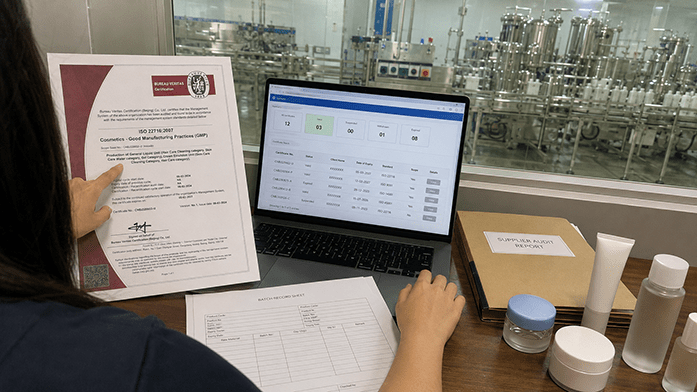
A certificate PDF is not evidence. A certificate number verified against the issuing body's public register is evidence. The opening failure story turns on exactly this gap.
Run this sequence before transferring a deposit:
1 — Identify the issuing body. ISO does not issue certificates. Accredited certification bodies conduct the audit and issue the certificate — for example, bodies accredited by UKAS (UK), ANAB (US), DAkkS (Germany), or CNAS (China). The certificate should name the body and display its accreditation mark.
2 — Extract the certificate number and scope. Every legitimate certificate carries a unique identification number. It also specifies scope: the manufacturing site address, product categories covered, and the standard referenced (ISO 22716:2007). If the scope says "skincare emulsions" and you are quoting a pressed powder project, the certificate does not cover your order.
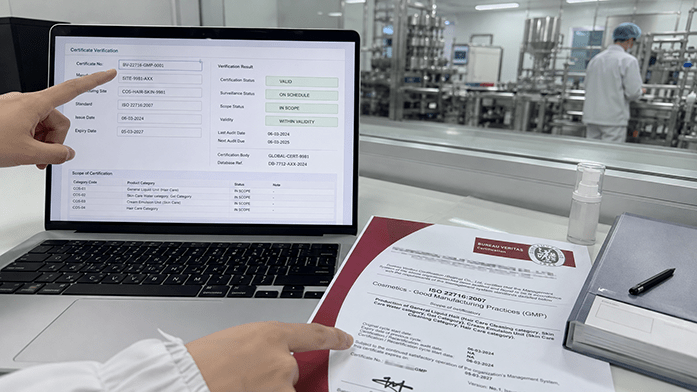
3 — Check the issuing body's online register. Most accredited certification bodies maintain a public verification database. Enter the certificate number and confirm three fields: the holder name matches your supplier's legal entity name, the scope covers your product category and manufacturing site, and the status reads "valid" — not suspended, expired, or withdrawn.
4 — Confirm validity dates and surveillance status. ISO 22716 certificates are typically issued with a three-year validity period, with annual surveillance audits during the cycle. Verify the current date falls within the validity window and that the most recent surveillance audit does not show unresolved major non-conformities.
Key Takeaway: Verification takes 10–15 minutes per supplier if the certification body has an online register. If the body has no public verification database — or the supplier cannot name the body — that is itself a red flag, not a paperwork delay.
The table below maps the certificate problems buyers encounter most often to their root causes and the corrective action to request:
| Symptom (what you see) | Root Cause | Verification Fix |
|---|---|---|
| Certificate PDF looks current; online register shows "suspended" | Factory failed a surveillance audit or missed a corrective action deadline; continued sharing the PDF without disclosing status change | Request the latest surveillance audit report and corrective action plan; confirm suspension lifted before proceeding |
| Scope covers "skincare" but you are quoting a powder foundation | Factory certified for one product line, quoting outside that scope | Request a scope extension amendment; if none exists, the project falls outside their certified GMP coverage |
| Issuing body not found in any accreditation database | The "certification body" may be a non-accredited entity issuing certificates without conducting audits | Cross-check the accreditation body against the IAF (International Accreditation Forum) members list; if not found, treat as non-verifiable |
| Certificate over three years old with no recertification record | Certification cycle expired and was not renewed | Request current certificate and recertification audit report; an expired certificate equals no certification |
| Certificate lists a different address than the manufacturing site | Factory holds certification for a different site — possibly a previous facility or partner location | Request a certificate naming the specific site where your production will run; GMP certification is site-specific |
When a Certificate Gap Is Not a Dealbreaker
Not every certificate problem should end a supplier conversation. During a recertification cycle — the window between an expiring certificate and the completion of a new audit — a factory may be operating under a valid transition. Accredited certification bodies typically permit continued operation during this period, and a formal letter from the body confirming that recertification is in progress is acceptable documentation.
A factory expanding into a new product category may be mid-process on a scope amendment. If the same accredited body that issued the original certificate is handling the amendment, the factory can provide a formal letter of scope extension in progress. This differs from a factory that has never held certification for the category and is quoting as if coverage exists.
The boundary is direct: a verifiable, in-process recertification or scope amendment by an accredited body is a legitimate transition. A certificate that has simply expired, with no evidence of renewal underway, is not a transition — it is a gap.
Key Takeaway: Ask for documentation of the recertification or amendment process, not verbal assurance. A dated letter from the certification body referencing the certificate number is the minimum acceptable evidence of a legitimate transition.
What to Do Next
If your supplier holds a valid ISO 22716:2007 certificate — verified by number against the issuing body's register, with scope covering your product category and manufacturing site — no action is needed in response to the "2026 update" question. The standard has not changed.
If the certificate cannot be verified, or the scope does not cover your project, or validity has lapsed without evidence of recertification in progress, the path forward depends on your target market. EU-bound products require GMP compliance under Regulation (EC) No 1223/2009 — a non-verifiable certificate is a regulatory risk, not just a procurement risk. US-bound products under MoCRA face FDA GMP enforcement that draws on ISO 22716 principles while adding facility registration and product listing obligations.
For buyers evaluating a private label or custom formulation project, the compliance readiness of your manufacturing partner is the foundation that formula development, packaging design, stability testing timelines, and market entry sequencing all rest on. If that base is uncertain, the project timeline inherits that uncertainty.
If you are evaluating a cosmetic manufacturing partner and want a compliance readiness assessment — covering certificate verification, target market regulatory requirements, and project feasibility — send your product category, target market, and any supplier certificates you have received. We will run the verification sequence above against your specific situation and flag risks before you commit to a production order.