

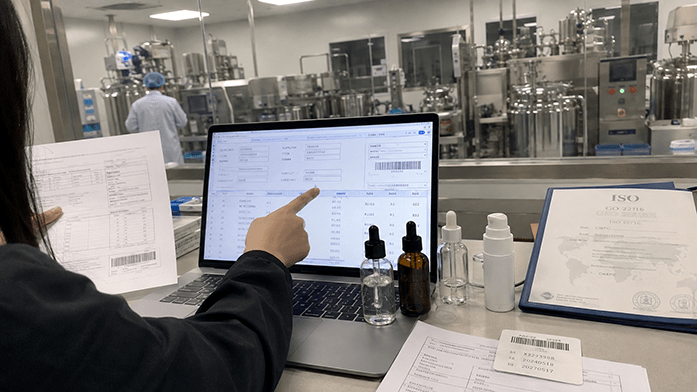
A procurement manager at a mid-sized beauty retailer types a prompt into their company's AI sourcing tool: "Find OEM manufacturers with ISO 22716 certification, INCI-compliant ingredient documentation, and EU CPNP notification capability for a niacinamide serum at 5% concentration." Seconds later, the agent returns a ranked shortlist. If your website describes capabilities in marketing prose rather than machine-readable data fields, you are not on that list. You were filtered out before a human ever saw your name.
TL;DR: Agentic commerce — where AI agents autonomously discover, evaluate, and shortlist B2B suppliers — is reshaping procurement. For cosmetic manufacturers, visibility now depends on structured, verifiable compliance data: GS1 product identifiers, ISO 22716 certification records, INCI ingredient mappings, and quantified specification tables. Suppliers relying on "Contact Us" forms and PDF brochures are increasingly invisible to automated sourcing pipelines.
The shift from human-to-human sourcing to machine-to-machine evaluation doesn't require rebuilding your factory. It requires making the compliance and specification data you already hold readable by systems that parse JSON-LD before they parse adjectives. Here is where the gaps typically appear, and what to do about them.
The New Gatekeeper Speaks in JSON, Not Handshakes
In traditional sourcing, a capable sales representative could offset thin documentation with relationship-building and persuasive pitches. An AI agent has no use for charisma. It evaluates suppliers against structured data fields — and when a field is empty, it does not send a follow-up email. It assigns a null value and moves to the next candidate.
We regularly encounter manufacturers whose websites list "GMP Certified" without specifying which standard. To a human buyer, the claim signals competence. To an AI agent cross-referencing certification registries, an unspecified "GMP" assertion cannot be verified and may be weighted as low-confidence. The same pattern applies to ingredient data. A product page stating "contains niacinamide and hyaluronic acid" provides no machine-parseable structure. An AI agent referencing the INCI (International Nomenclature of Cosmetic Ingredient) dictionary expects entries like "Niacinamide 3-5%" and "Sodium Hyaluronate 0.1-0.5%" — concentrations tied to standard units. Without INCI-aligned data, the agent cannot match your product against a buyer's formulation parameters.
Key Takeaway: AI sourcing agents filter suppliers using machine-readable compliance signals — GS1 GTIN/GLN identifiers, ISO 22716 certification with verifiable certificate numbers, INCI-compliant ingredient lists with concentration ranges, and restricted substance list (RSL) compliance status. Missing or unstructured data is treated as a null value, not a gap to be clarified through conversation.

GS1 standards provide the identification layer. A Global Trade Item Number (GTIN) allows an AI agent to identify a specific product across databases, marketplaces, and regulatory portals. A Global Location Number (GLN) identifies the manufacturing facility itself — useful when a buyer's agent needs to verify that a factory's registered address matches its ISO 22716 certificate scope. Without these identifiers, your product exists only as text on your own domain, invisible to cross-referencing systems that pull from multiple sources.
Schema.org markup adds the semantic layer. Tagging product pages with Product and Offer schemas — including fields for category, material, and additionalProperty — gives crawlers a structured map of what you manufacture. The data points most relevant to AI sourcing in cosmetics include INCI ingredient composition, certification identifiers, country of origin (ISO 3166-1), and quantified physical specifications. A page that renders beautifully for human eyes but carries no structured markup is, to an AI agent, a blank page.
Many AI sourcing tools operate on retrieval-augmented generation (RAG) architecture: they index supplier data from websites, databases, and regulatory portals, then retrieve relevant passages when a buyer submits a query. The retrieval step favors content that is structurally tagged and semantically explicit. A supplier page with JSON-LD Product markup containing an additionalProperty field for "Niacinamide 5%" is far more likely to be retrieved for a query about niacinamide serums than a page that mentions the same ingredient inside a marketing paragraph. The retrieval system does not infer — it matches.
| What the AI Agent Looks For | What Suppliers Typically Provide | The Gap | How to Close It |
|---|---|---|---|
| GS1 GTIN or GLN identifier | Internal SKU codes | Agent cannot cross-reference product across databases | Register with GS1; publish GTINs in product schema |
| ISO 22716 certification (with certificate number) | "GMP Certified" claim without standard reference | Unverifiable; agent marks as low-confidence | Specify standard name, certifying body, and validity period |
| INCI ingredient list with concentrations | Marketing highlights ("rich in vitamins") | No machine-parseable data for formulation matching | Publish full INCI list with percentage ranges |
| RSL compliance status | "Clean beauty" / "free from" language | Agent cannot verify against regulatory RSL databases | Map ingredients against EU Annex II/III or equivalent RSL |
When Vague Specs Become a Silent Filter
A buyer might prompt their sourcing AI: "Find manufacturers offering a 5% niacinamide serum with pH 5.0-6.0, MOQ above 2,000 units for custom formulation, ISO 22716 certified, with EU CPNP notification support." The agent then scans supplier data for matching values. Every field that lacks a specific number — viscosity, pH range, shelf life, lead time — becomes a gap that lowers your ranking or removes you from the results entirely.
AI agents treat ambiguity as missing data. If your page says "fast turnaround," the agent has no value to compare against a buyer's "8-week lead time maximum" filter. If your MOQ is described as "small batch friendly," the agent cannot determine whether you meet the buyer's volume threshold — and for custom formulation, that threshold typically starts above 2,000 units. Publishing "MOQ: >2,000 units (custom formulation)" gives the agent an exact match. The more precise your data, the more likely you survive automated filtering.
Key Takeaway: Replace qualitative descriptions with quantified specifications across every data point an AI agent might filter on: concentration percentages, pH ranges, viscosity in centipoise, shelf life in months, lead time in weeks, and MOQ thresholds by product category. Ambiguity does not buy flexibility — it buys exclusion.
| Data Point | Marketing Description (Filtered Out) | Technical Spec (Matched) | Why It Matters to the Agent |
|---|---|---|---|
| Order quantity | "Small batch friendly" | "MOQ: >2,000 units (custom formulation)" | Primary filter — agent discards suppliers below buyer's volume floor |
| Formulation | "Brightening serum" | "Niacinamide 5%, Sodium Hyaluronate 0.3%" | INCI match against buyer's ingredient requirements |
| Stability | "Long-lasting formula" | "Shelf life: 36 months / PAO: 12M" | Compliance and shelf-life planning filter |
| Timeline | "Fast turnaround" | "Lead time: 6-8 weeks (custom formulation)" | Production scheduling constraint |
| Certification | "GMP certified" | "ISO 22716, Certificate No. [XXX], valid through [date]" | Verifiable compliance signal |
The INCI dictionary serves as the reference standard here. When an AI agent encounters an ingredient name, it attempts to map that name to an INCI entry to verify nomenclature compliance and check for regulatory restrictions. A supplier listing "Vitamin B3" instead of "Niacinamide" forces the agent to perform an extra inference step — and inference introduces uncertainty. In automated sourcing, uncertainty is penalized. Suppliers who use INCI-registered names throughout their product data reduce the agent's processing friction and increase their retrieval probability.
When Privacy Is Legitimate
Not every data point should be public. Exact formulation percentages, proprietary active ingredient sources, and supplier pricing tiers may warrant protection for competitive reasons. EU Regulation (EC) No 1223/2009, for instance, requires that full quantitative and qualitative composition be documented in the Product Information File (PIF) for regulatory authorities — but the PIF is a regulatory filing, not a public-facing document. The boundary is not between transparency and secrecy. It is between data an agent needs to include you in a search and data that only matters after you are shortlisted.
A practical split: publish the ranges and certification identifiers that get you through the filter — INCI names with concentration ranges, ISO 22716 certificate numbers, MOQ thresholds, lead time windows, and RSL compliance status. Reserve exact proprietary details for the NDA-protected stage. An AI agent does not need your precise preservative system percentage to shortlist you. It needs to know that your product is INCI-compliant, stability-tested, and manufactured under ISO 22716 conditions. The detailed formula can follow once a human buyer initiates contact.
Building an AI-Readable Compliance Layer
Preparing for agentic commerce does not require a technology overhaul. It requires an audit of what data you have, what format it lives in, and whether an external system can reach it without sending an email.
Key Takeaway: Run a digital readiness audit across five layers: website data structure (Schema.org/JSON-LD), catalog format (searchable database vs. PDF), compliance documentation (downloadable COA/MSDS/ISO certificates), inventory visibility, and product identification (GS1 GTIN/GLN registration). Each layer should be independently machine-readable.
| Readiness Layer | At Risk | AI-Ready | Action |
|---|---|---|---|
| Website data | Text and images only | JSON-LD with Product/Offer schemas |
Install Schema markup; tag spec tables |
| Catalog | PDF brochures | Searchable, structured product database | Convert spec sheets to HTML tables with standard fields |
| Compliance docs | "Contact us for certificates" | Downloadable COA, MSDS, ISO 22716 certificate | Upload redacted certificates to product pages |
| Product ID | Internal SKU only | GS1 GTIN + GLN registered | Apply for GS1 company prefix |
| Specifications | Marketing descriptions | Quantified INCI data, pH, viscosity, MOQ | Build a spec table template per product line |

For manufacturers supplying the EU market, the Digital Product Passport (DPP) framework under the Ecodesign for Sustainable Products Regulation is establishing data transparency precedents that may expand to additional product categories over time. Even where DPP is not yet mandated for cosmetics, the underlying principle — that product data should be digitally accessible, verifiable, and standardized — aligns with what AI sourcing agents already demand. Preparing your data architecture for DPP readiness and for AI sourcing readiness are converging on the same requirement: structured, machine-readable compliance data that an external system can verify without human intermediation.
Some manufacturers are moving beyond static data publication toward API-accessible inventory and production capacity data — a pattern sometimes called headless commerce. An AI agent that can query a supplier's API to check real-time production slot availability or raw material stock can make sourcing decisions in minutes rather than days. This is an advanced step, not a starting point. The priority sequence is: structured product data first, downloadable compliance documentation second, API integration third. Attempting API integration before your base specification data is structured and published will not solve the visibility problem.
We approach our own data the same way. At CAMELLIA LABS, we structure specification tables, certification records, and compliance documentation so that buyers — human or automated — can verify our manufacturing capabilities without a preliminary email. If you are evaluating whether your current digital footprint would survive an AI sourcing filter, request a project readiness assessment. We can review your product category, target market compliance requirements, and data structure to identify where gaps may cost you visibility.