

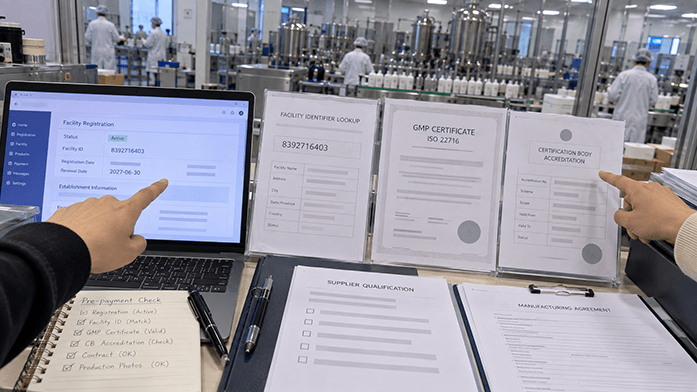
A supplier may offer an “FDA certificate” just as a beauty brand is preparing to pay a deposit. What should the buyer do with it? Start by separating four questions: who operates the manufacturing site, what the supplier’s current FDA account displays, whether a specific cosmetic product has been listed by the responsible person, and what separate quality-system evidence exists. A single document cannot answer all four.
TL;DR
FDA cosmetic facility registration is not FDA approval, and FDA says it does not issue certificates or letters verifying compliance with cosmetic facility registration or product listing. A supplier-provided Cosmetics Direct record can show what that account displayed on a particular date. FDA’s FEI Search Portal can help locate an establishment identifier by firm name and address. Neither is a buyer-facing certificate proving current registration, product listing, product safety, or manufacturing quality. Record the entity, site, date, and open questions before relying on any supplier claim.
What does “FDA registered” mean for a cosmetic supplier?
Under the Modernization of Cosmetics Regulation Act of 2022 (MoCRA), facilities that manufacture or process cosmetics for U.S. distribution generally have facility-registration obligations, while the responsible person must list each marketed cosmetic product. Some small businesses and certain products or facilities may be exempt from particular registration or listing requirements. The responsible person and the facility operator may be different companies, so ask which legal entity is responsible for each submission rather than assuming the manufacturer does everything.
Registration and listing are not FDA approval programs. FDA explicitly says that assigning a facility registration number or product listing number does not mean the agency has approved the facility or product. It also says it does not provide certificates, verification letters, or similar documents confirming compliance or exemption. A supplier’s “FDA-approved manufacturer” badge therefore should not be treated as an FDA finding. See the FDA registration and listing guidance and its September 2026 clarification.
The practical buyer question is narrower: which record is being offered, whose name and site it covers, when it was captured, and which conclusion it can actually support. If a supplier claims an exemption, ask for its explanation and have a qualified U.S. adviser assess the applicable facts. Do not assume that the absence of a screenshot proves noncompliance or that possession of a number proves compliance.
What can a buyer check before choosing a supplier?
The checks below are useful only when their limits are kept visible. They are a document-and-identity trail, not an independent FDA compliance verdict.
| Item | What to request or compare | What it may help establish | What it does not establish |
|---|---|---|---|
| Supplier-provided Cosmetics Direct record | Ask the authorized facility contact for a current view of the facility name, FEI, displayed registration status, renewal date, and capture date. Do not request the supplier’s login credentials. | What that supplier-controlled account displayed for the identified facility at that time. | An FDA-issued verification certificate, product listing, product safety, GMP certification, or a legal conclusion about current compliance. |
| FDA Establishment Identifier (FEI) | Use the FDA FEI Search Portal, subject to portal access, to look up an FEI by firm name and address or validate an FEI address. Compare the result with the contracting entity and production site. | An identifier and address trail that can expose mismatched names or sites requiring clarification. | Active MoCRA cosmetic registration, a particular product listing, FDA approval, or the legal status of the supplier. |
| Product-listing responsibility | Ask which responsible person will list the marketed cosmetic product, what product/label entity is involved, and what supplier-provided records can be shared. | Whether the parties have identified who is responsible for the product-listing task and what remains to be confirmed. | Proof that FDA has approved the product or that every listing obligation has been satisfied. |
| Separate quality documents | If a supplier cites an ISO 22716 certificate, check the named legal entity and site, scope, dates, and issuer; confirm the specific certificate with its issuer where appropriate. | Information about the particular certificate and its stated scope. | FDA facility registration, product listing, or product safety. ISO 22716 is a separate quality topic, not a third FDA verification step. |
FDA says Cosmetics Direct displays REGISTRATION STATUS and RENEWAL DATE on the facility registration homepage. That makes a current supplier-provided record more useful than an undated sales slide, but it remains a supplier-provided view. The buyer should not describe it as an FDA certificate or assume that the record covers a different facility or future production date. FDA also explains that required facility registrations are renewed every two years; the relevant renewal date depends on the facility’s initial registration date. Recheck the displayed information if the project will span a later date.
The FEI Portal answers a different question. FDA says it can look up an FEI by firm name and address or validate an FEI address. An FEI result can help compare the supplier’s stated entity and site with an FDA identifier; it cannot by itself tell a buyer whether the current MoCRA cosmetic facility registration is active. This is why “I found the FEI” and “I verified the cosmetic registration” should not be written as the same conclusion.
What belongs in a pre-deposit supplier file?
Keep a dated record that another team member could understand without repeating the conversation. Capture the supplier’s legal name, contracting entity, manufacturing-site address, and the name of the party responsible for the product label. Note whether these are the same or different entities. Save the supplier-provided facility record and any FEI lookup result with their dates, then write down discrepancies rather than silently resolving them yourself.
Next, make a simple received / pending / needs confirmation list. For each item, record who supplied it, which site or product it covers, and who should answer the next question. This can include a facility record, FEI information, proposed product-listing responsibility, and any separately offered quality certificate. Keep supplier quality documents in a separate column from FDA registration/listing materials. A certificate’s presence does not make a missing registration answer disappear, and an FEI does not make a quality claim true.
Before paying, ask the supplier these questions:
- Which legal entity and physical site will manufacture or process this product? Does that match the entity and address shown in the records?
- Who is responsible for facility registration, and who is the responsible person for product listing? Is any exemption being claimed, and on what basis?
- What does the supplier’s current Cosmetics Direct record display, and when was it captured? If a date or status changes before production, who will update the buyer?
- Which documents are available for this specific product and site, and which items are still pending or outside the supplier’s scope?
- Which questions require a qualified U.S. regulatory professional or independent testing rather than a supplier sales answer?
Be cautious with documents marketed as “FDA approval certificates” for cosmetics, mismatches between the contract entity and manufacturing site, undated screenshots, or an assertion that an FEI or ISO certificate alone settles MoCRA obligations. These are questions to investigate, not automatic proof of fraud or a definitive legal finding. If the supplier cannot identify the responsible parties and provide a coherent document trail, delay the decision until the gaps are resolved.
Camellia Labs can discuss limited organization of supplier-provided documents for a manufacturing project, marking items received, pending, and needing confirmation. This administrative checklist does not independently verify FDA registration or product-listing status, authenticate documents, determine regulatory compliance, or replace qualified local advice or third-party testing. If you are comparing project routes, share your product category, target market, proposed supplier/site, and the list of open document questions through our contact page.