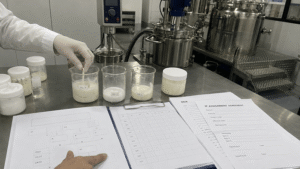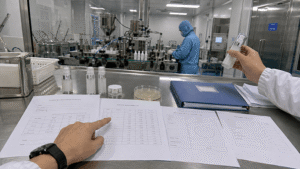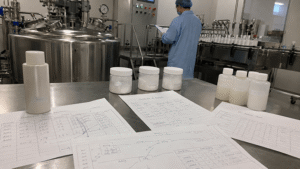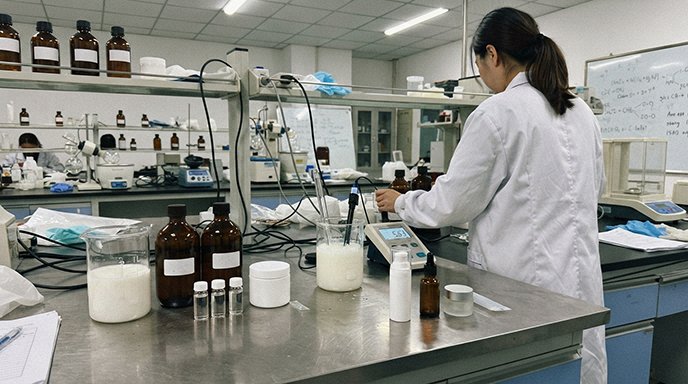
Getting ready to launch a beauty brand often starts with a dream formula, but transitioning that concept into a physical product can quickly become a technical nightmare if you do not understand the fundamental chemistry and industrial realities. When I consult with international brand founders, I see many of them hit a wall because they treat product development like a home kitchen recipe rather than a complex engineering process. Understanding the basic principles of cosmetic formulas is the only way to avoid costly production delays, packaging failures, and regulatory rejections before you sign a manufacturing contract.
The basic principles of cosmetic formulas require balancing active ingredients, functional vehicles, stabilizers, and preservation systems so the product remains safe, effective, and physically stable from the factory floor to the consumer's vanity. On an industrial scale, a formula must be designed not just for skin benefits, but for mechanical shear, thermal stability, packaging compatibility, and regulatory compliance in your target market.
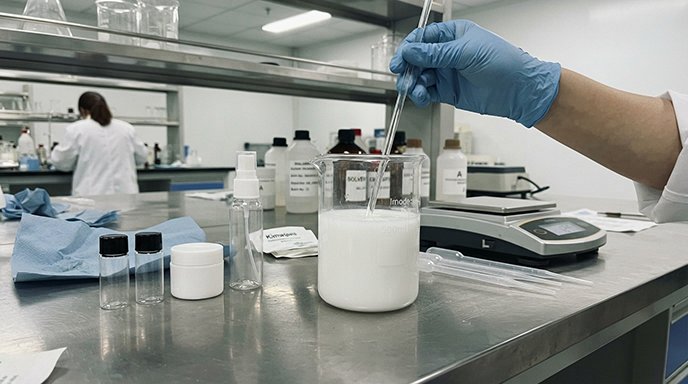
When you transition from bench-scale samples to commercial production, your formula ceases to be just a list of ingredients. It becomes a set of chemical reactions that must behave predictably under intense heat, high-speed industrial mixers, and prolonged shipping transits. Let us dive deep into the real-world principles of cosmetic formulation that dictate whether your product will succeed or fail in production.
Why Do Bench-Scale Formulas Fail to Scale in Industrial Manufacturing?
You might have a beautiful handmade sample or a small-batch formula from an independent lab that feels absolutely perfect on the skin. However, assuming that a 1-kilogram bench batch will behave the exact same way when mixed in a 1-ton industrial vessel is one of the most common mistakes I see sourcing managers make.
Scaling up a cosmetic formula requires translating manual mixing into mechanical shear rates1, adjusting heating and cooling phases, and managing raw ingredient thermodynamics. If your formula is not optimized for industrial processing equipment, the entire batch can separate, discolor, or change viscosity during scale-up.

The Physics of Scale: Shear, Heat, and Time
In a laboratory, a chemist uses a small overhead stirrer to mix a beaker of cream. The heat distributes instantly, and the blades mix every milliliter of liquid uniformly. In a massive manufacturing tank, the physical forces are entirely different.
- High-Shear Emulsification2: To create a stable emulsion (combining oil and water), industrial homogenizers use high shear forces to break oil droplets down to micrometer sizes. If your emulsifiers cannot handle high shear, or if they require too much energy to disperse, the emulsion will fail during scale-up, leading to oil separation.
- Thermodynamics and Cooling Rates3: Heating a 1,000-liter jacketed tank to 75°C takes hours, and cooling it down takes even longer. Ingredients that are sensitive to prolonged heat (like certain vitamins, botanical extracts, and natural oils) can degrade during this slow heating and cooling cycle, even if they survived the rapid heating of a small lab beaker.
- Viscosity Shift4: The thickness of your cream or lotion often changes when subjected to the mechanical stress of industrial pumps and filling machines. A formula that looks thick in a jar can turn watery after being forced through pneumatic filling nozzles.
How Does Your Formula Dictate Your Packaging and MOQ?
Many brand founders treat formulation and packaging as two completely separate tasks, choosing a bottle based on aesthetics while a chemist develops the liquid inside. In reality, the basic principles of cosmetic formulas dictate that your chemical composition is completely co-dependent on your packaging materials and your manufacturing volume.
If your formula contains ingredients that react with your packaging, or if your viscosity does not match your dispensing system, you face leaking, discoloration, or inactive ingredients. Furthermore, the complexity of your formula and packaging choice directly determines your realistic Minimum Order Quantity (MOQ).
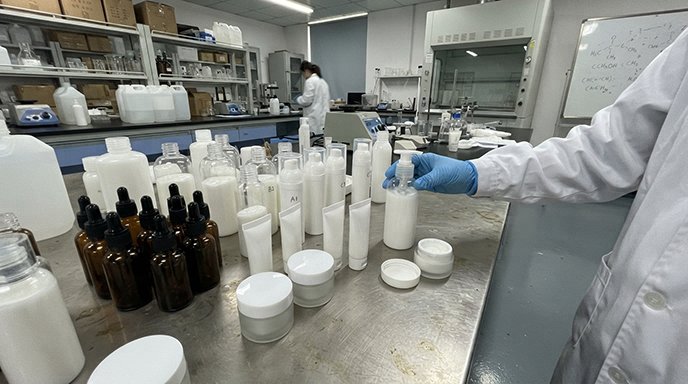
The Chemical Co-Dependency of Liquid and Container
Different chemical compounds interact with plastics, glass, and metals in highly specific ways. When formulating, we must analyze these interactions long before production begins.
| Formula Characteristic | Packaging Vulnerability | Required Packaging Solution |
|---|---|---|
| High Active Acid Content (e.g., L-Ascorbic Acid, Salicylic Acid) | Can corrode metal components and degrade cheap plastics; highly sensitive to light and oxygen. | Amber glass, airless opaque pumps, or specialized coated plastics. |
| Essential Oils & Terpenes5 | Act as natural solvents that can crack acrylic plastics and cause swelling in rubber gaskets. | Glass or high-density polyethylene (HDPE) containers. |
| Highly Viscous Emulsions (Thick creams) | Cannot be drawn up by standard dip-tube lotion pumps. | Wide-mouth jars, squeeze tubes, or high-vacuum airless jars. |
| Low-Viscosity Serums | Prone to leaking through standard screw-cap threads and pump valves. | Precision dropper assemblies or high-viscosity pump gaskets. |
The MOQ Reality Check
I often have to walk clients through the commercial reality of custom formulations. If you want a standard, off-the-shelf formula with standard stock packaging, manufacturers can often offer flexible production runs. However, if you require a highly customized formula with unique active ingredients, custom colors, or specialized physical behaviors, the raw material suppliers themselves dictate high MOQs.
Color cosmetics, complex emulsions, and products requiring custom-molded components cannot realistically be run at low volumes like 500 or 1,000 pieces because the industrial machinery cannot be calibrated or washed down efficiently for such small runs.
Why Does Custom Formulation Require Months of Testing?
I frequently speak with brand owners who believe they can submit a custom ingredient deck and have a retail-ready product shipped to their warehouse in four weeks. This is a dangerous timeline assumption. Opting for a custom formulation—even if you are just adding a single "hero" botanical extract to a manufacturer's base—triggers a strict cycle of stability, compatibility, and microbiological testing that cannot be bypassed.
Modifying a stable base formula introduces new chemical variables that can break the emulsion, change the pH, neutralize your preservative system, or cause the scent to sour over time.
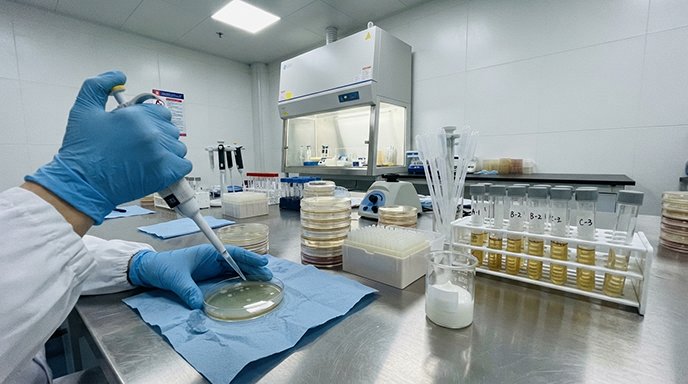
The Three Pillars of Formula Validation
To ensure your custom formula survives international transit, warehousing, and months on a customer’s shelf, it must undergo three rigorous testing protocols:
1. Accelerated Stability Testing6
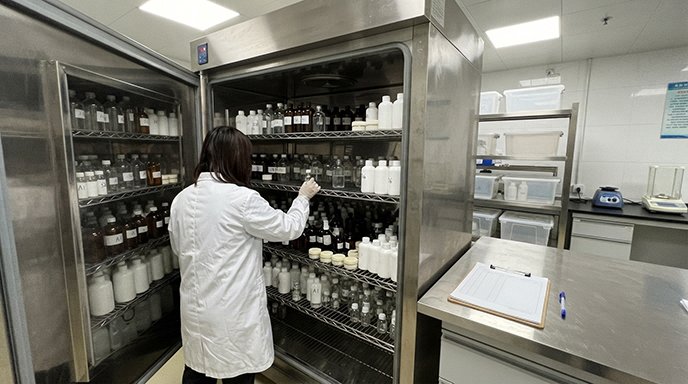
This process evaluates how the formula holds up under extreme environmental stress over time. Samples are placed in specialized stability chambers set to various temperatures (usually 4°C, 25°C, 40°C, and 45°C) and high humidity for up to 12 weeks. We look for:
- Phase Separation: Oil splitting from the water phase.
- Sedimentation: Powders or suspended particles settling to the bottom.
- Color and Odor Shifts: Oxidation causing the product to turn yellow, brown, or develop an unpleasant smell.
2. Packaging Compatibility Testing
We place your actual formula inside your final production packaging and subject it to the same temperature cycles. This tests whether the formula migrates through the plastic, causes the bottle to collapse, clogs the pump mechanism, or strips the silk-screen printing off the exterior of the container.
3. Preservative Efficacy Testing (PET / Challenge Testing)7
In a sterile lab environment, the formula is deliberately inoculated with high concentrations of bacteria, yeast, and mold (such as Pseudomonas aeruginosa8 and Candida albicans). The lab then measures the formulation's ability to neutralize these pathogens over a 28-day period. If the preservative system fails to kill the micro-organisms within the required timeline, the formula is legally unsafe for commercial distribution.
Why Is Preservation a Non-Negotiable Principle of Cosmetic Chemistry?
In the age of clean beauty marketing, many emerging brands ask me for "preservative-free" or "100% natural water-based" formulas. While the marketing appeal of these claims is clear, the scientific and legal reality is brutal: water-based cosmetics without a robust, broad-spectrum preservation system are biological hazards waiting to happen.
Microbial contamination can occur during manufacturing, packing, shipping, or when a consumer sticks their finger into a jar. Without preservatives, bacteria and mold will multiply rapidly, causing skin infections, eye damage, and massive brand-destroying product recalls.
The Challenge with "Natural" Alternatives
While natural preservative systems exist, they are far more complex to formulate with than traditional synthetics like phenoxyethanol.
- Narrow pH Windows9: Many organic acids (such as sodium benzoate or potassium sorbate) only work as effective preservatives in highly acidic formulas with a pH below 5.5. If your product needs to be neutral (like an eye cream or a gentle cleanser), these natural preservatives lose their efficacy entirely.
- Odor and Color Interference: High concentrations of natural antimicrobial agents, such as essential oils or plant-derived acids, can impart strong herbal smells or yellow tints to your formula, ruining your desired aesthetic.
- Global Regulatory Differences: A preservative that is approved in the United States might be heavily restricted or banned in the European Union or China. Designing your preservative system requires a clear understanding of your target market's specific regulatory lists from day one.
Frequently Asked Questions
Can I use a third-party formula sheet I bought online directly for factory manufacturing?
A formula sheet purchased online is usually just a theoretical starting point. It lacks the manufacturing process instructions, specific raw material grades, and shear-rate parameters required for industrial machinery. A professional manufacturer will need to run lab pilots to adapt that sheet into a scalable, production-ready recipe.
What is the difference between a stock formula and a custom formula?
A stock formula is a pre-developed, pre-tested, and fully validated formulation owned by the manufacturer. It requires minimal testing, has a much faster time-to-market, and lower production risks. A custom formula is built from scratch or heavily modified, requiring months of stability, compatibility, and challenge testing before production can start.
Why does my cream separate or sweat when shipped internationally?
Extreme temperature fluctuations inside shipping containers (which can reach over 50°C in cargo holds) can break weak emulsions. If your formula lacks proper stabilizers (like carbomers, xanthan gum, or high-quality emulsifiers) or did not undergo rigorous freeze-thaw stability testing10, it will separate or sweat during transit.
How do I know if my formula complies with cosmetic regulations in the US and EU?
Compliance cannot be checked after the product is made; it must be designed into the formula. Every raw ingredient and color additive must be cross-referenced with the FDA11, EU Cosmetics Regulation12, and other local databases. Working with an experienced manufacturing partner like Camellia Labs ensures your ingredients are checked against global regulatory restrictions before compounding begins.
Conclusion
Mastering the basic principles of cosmetic formulas is not about memorizing chemical bonds; it is about understanding how your ingredient choices impact industrial scaling, packaging compatibility, shelf-life stability, and regulatory compliance. Cutting corners during the formulation phase by skipping stability tests or demanding unpresorved water-based mixtures always leads to wasted capital, delayed launches, and ruined supplier relationships.
At Camellia Labs, we do not just act as a generic factory directory. We act as your practical development and compliance partner, helping you navigate formula feasibility, packaging compatibility, and realistic production planning for international markets. If you are ready to transition your beauty concept into a scientifically sound, legally compliant, and physically stable reality, contact us today to discuss your project parameters.
"What Are the Basic Principles of Cosmetic Formulas?", https://camellia-labs.com/what-are-the-basic-principles-of-cosmetic-formulas/. Research on emulsion scale-up demonstrates that maintaining consistent droplet size distribution requires precise mathematical translation of shear rates and energy dissipation from bench-scale to industrial vessels. Evidence role: mechanism; source type: paper. Supports: the physical and mechanical challenges of scaling up cosmetic emulsions from laboratory stirrers to industrial high-shear mixers. Scope note: The exact scaling factors depend heavily on the specific geometry of the manufacturing vessel and the rheological properties of the formulation. ↩
"Vocabulary relating to oil spill response", https://www.iso.org/obp/ui/en/#!iso:std:78956:en. High-shear homogenization is a standard industrial method used to reduce droplet size to the micrometer range, which significantly decreases the rate of creaming and phase separation. Evidence role: mechanism; source type: paper. Supports: the use of high-shear forces to reduce emulsion droplet sizes to micrometer levels for physical stability. Scope note: Excessive shear can sometimes destabilize certain polymer-based emulsifiers or cause over-processing. ↩
"SUPAC: Manufacturing Equipment Addendum", https://www.fda.gov/files/drugs/published/SUPAC--Manufacturing-Equipment-Addendum.pdf. Industrial scale-up studies confirm that thermal lag in large jacketed reactors exposes ingredients to elevated temperatures for significantly longer periods than laboratory beakers, accelerating the degradation of heat-sensitive actives. Evidence role: general_support; source type: research. Supports: the prolonged heating and cooling cycles in large-scale industrial vessels and their potential to degrade sensitive cosmetic ingredients. Scope note: The degradation rate is highly dependent on the specific chemical structure of the active ingredient and the presence of antioxidants in the formula. ↩
"Hyaluronic Acid (HA) Safety Profile", https://www.fda.gov/media/158489/download. Many cosmetic emulsions exhibit non-Newtonian, shear-thinning behavior, meaning their viscosity temporarily or permanently decreases when subjected to the high shear stress of pneumatic filling pumps. Evidence role: mechanism; source type: paper. Supports: how mechanical stress from pumps and filling nozzles alters the viscosity of cosmetic emulsions. Scope note: Some emulsions exhibit thixotropic behavior and will recover their original viscosity after a period of rest. ↩
"ISO 472:2013(en), Plastics — Vocabulary", https://www.iso.org/obp/ui/#iso:std:iso:472:ed-4:v1:en. Material compatibility charts indicate that many terpenes and essential oils act as organic solvents, leading to environmental stress cracking in acrylics and swelling or degradation in nitrile and silicone rubbers. Evidence role: general_support; source type: research. Supports: the solvent action of essential oils and terpenes on acrylic plastics and rubber gaskets. Scope note: The severity of the degradation depends on the concentration of the essential oils and the specific grade of the polymer used. ↩
"Guidelines on the stability testing of cosmetic products", https://www.iso.org/obp/ui/en/#!iso:std:63465:en. According to industry guidelines established by Cosmetics Europe (formerly COLIPA) and the FDA, accelerated stability testing typically involves storing samples at elevated temperatures such as 37°C, 40°C, or 45°C for 1 to 3 months to predict a shelf life of 1 to 2 years. Evidence role: expert_consensus; source type: institution. Supports: the standard temperature and duration parameters used in accelerated cosmetic stability testing. Scope note: Accelerated testing is a predictive model and cannot completely replace real-time, long-term ambient stability data. ↩
"ISO 29621:2010(en), Cosmetics — Microbiology", https://www.iso.org/obp/ui/es/#iso:std:iso:29621:ed-1:en. Standardized protocols like USP Chapter <51> and ISO 11930 outline a 28-day challenge test where formulations are inoculated with specific strains of bacteria, yeast, and mold to evaluate log reductions at set intervals. Evidence role: definition; source type: institution. Supports: the standard 28-day protocol and microbial strains used in cosmetic preservative efficacy testing. Scope note: A passing result in a laboratory challenge test does not guarantee protection against unusual or extreme consumer contamination in the field. ↩
"ISO 11930:2019(en), Cosmetics — Microbiology", https://www.iso.org/obp/ui/es/#!iso:std:75058:en. The US Pharmacopeia and ISO standards mandate the use of specific indicator organisms, including Pseudomonas aeruginosa, Staphylococcus aureus, Candida albicans, and Aspergillus brasiliensis, for validating preservative efficacy. Evidence role: definition; source type: government. Supports: the specific regulatory micro-organisms used to challenge cosmetic preservative systems. Scope note: These standard strains represent general classes of pathogens but may not cover every wild strain of contaminant found in manufacturing environments. ↩
"Recommended requirements for stability testing of ...", https://www.fda.gov/media/124676/download. Organic acids like benzoic acid and sorbic acid rely on their undissociated forms to penetrate microbial cell membranes; because their pKa values lie between 4.2 and 4.8, their antimicrobial efficacy drops sharply as the pH rises above 5.5. Evidence role: mechanism; source type: paper. Supports: the requirement of a low pH (typically below 5.5) for organic acid preservatives to remain in their active, undissociated state. Scope note: At higher pH levels, these organic acids must be paired with co-preservatives or chelating agents to achieve adequate preservation. ↩
"Why Can a Custom Face Cream Look Perfect as a Sample but ...", https://camellia-labs.com/why-can-a-custom-face-cream-look-perfect-as-a-sample-but-separate-after-launch/. Freeze-thaw stability testing, which typically subjects an emulsion to alternating cycles of extreme cold (-10°C to -20°C) and room temperature, is a standard industry method to simulate the thermal stresses encountered during international shipping. Evidence role: general_support; source type: research. Supports: the role of freeze-thaw cycle testing in evaluating the physical stability of emulsions against temperature extremes. Scope note: Passing freeze-thaw cycles does not guarantee long-term chemical stability or resistance to prolonged high-temperature exposure. ↩
"Modernization of Cosmetics Regulation Act of 2022 (MoCRA)", https://www.fda.gov/cosmetics/cosmetics-laws-regulations/modernization-cosmetics-regulation-act-2022-mocra. Under the Federal Food, Drug, and Cosmetic Act and the recent Modernization of Cosmetics Regulation Act (MoCRA), the FDA regulates cosmetic ingredients and mandates strict pre-market approval for all color additives used in cosmetics. Evidence role: historical_context; source type: government. Supports: the FDA's regulatory oversight of cosmetic ingredients and color additives in the United States. Scope note: Unlike drugs, the FDA does not approve cosmetic products or individual non-color ingredients before they go to market, placing the safety burden on the manufacturer. ↩
"How Can You Navigate The Real Process of Cosmetic Product ...", https://camellia-labs.com/how-can-you-navigate-the-real-process-of-cosmetic-product-development/. Regulation (EC) No 1223/2009 of the European Parliament and of the Council serves as the main regulatory framework for cosmetic products in the EU, detailing prohibited, restricted, and authorized substances in its annexes. Evidence role: historical_context; source type: government. Supports: the regulatory framework governing cosmetic ingredients and safety assessments in the European Union. Scope note: The annexes of Regulation (EC) No 1223/2009 are updated frequently, requiring continuous monitoring by formulation chemists. ↩