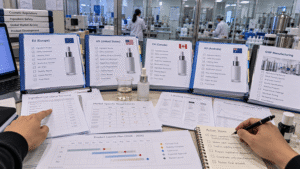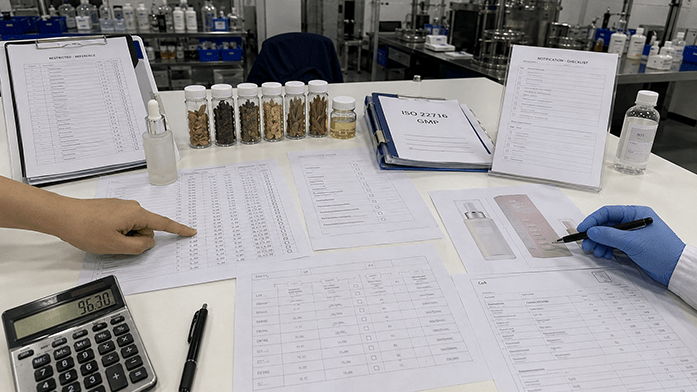
Most skincare brands entering Canada assume their US FDA registration or EU CPNP file clears the bar here. It doesn't. Health Canada runs an independent, notification-based system with three separate gates — ingredient screening against the Hotlist, a Cosmetic Notification Form (CNF), and mandatory bilingual labelling — and missing any one of them can hold an entire shipment at the border.
Canadian skincare OEM compliance turns on three independent gates: screening every INCI name against the Health Canada Hotlist, filing a Cosmetic Notification Form (CNF) within 10 days of first sale, and applying bilingual English/French labels. None is satisfied by US FDA or EU approval — Canada runs its own notification system, not a pre-market approval regime.
This guide walks brand owners and procurement leads through the Health Canada cosmetic framework as it applies to OEM and private-label manufacturing: what each gate requires, where brands commonly fail, and the documentation and supplier controls that keep a launch on schedule. For teams weighing Canada against other strict markets, navigating TGA, Health Canada and UK compliance is a different exercise in each jurisdiction.
The Canadian Regulatory Stack — Who Governs, and What "Notification" Means
Brand owners often map Canadian requirements onto a US or EU mental model and miss that Canada uses neither pre-market approval nor a single consolidated file. The result is a launch plan built on the wrong assumption — that a foreign approval carries over.
Health Canada regulates cosmetics under the Food and Drugs Act (F-27) and the Cosmetic Regulations (C.R.C., c. 869). Filing a CNF is a notification, not an approval: Health Canada does not certify the product before sale, and can request supporting information at any time.
Four instruments sit beneath the cosmetic framework, each with a distinct scope. A brand that treats them as one blended requirement usually discovers the gap at the worst moment — after production is already committed.
| Regulatory instrument | What it governs | Responsible party | Consequence of non-compliance |
|---|---|---|---|
| Food and Drugs Act (F-27) | Safety, labelling, and admissibility of cosmetics sold in Canada | Brand owner / importer | Product detained, recalled, or subject to Health Canada action |
| Cosmetic Regulations (C.R.C., c. 869) | INCI naming, prohibited and restricted substances, notification mechanics | Manufacturer + brand owner | CNF rejected or product deemed non-compliant |
| Cosmetic Ingredient Hotlist | Prohibited and restricted ingredients with use conditions | Formula owner | Formula cannot be legally sold as submitted |
| Consumer Packaging and Labelling Act (C-38) | Bilingual labelling, net quantity, dealer identity | Brand owner / importer | Labels refused at border; corrective re-labelling required |
The notification mechanic is the part most often misunderstood. Submitting the CNF does not constitute approval by Health Canada. The form is filed within 10 days of the product's first sale in Canada, no fee is charged, and Health Canada may request formulation or safety information on its own initiative. A US FDA registration or EU CPNP file does not substitute for a Canadian CNF — the two systems share no mutual recognition.
Pre-Market Checklist — Five Steps Before Import
The order of the gates matters. Screening the formula before any label artwork or notification work begins avoids rework that can push a launch back by weeks. A brand that finishes French labelling around a formula that later fails the Hotlist has to redo both.
Run the steps in sequence: formula review, Hotlist check, CNF submission, bilingual label, then import. Each later step depends on an earlier one being correct. CNF filing is timed to first sale, but formula and label compliance must already be in place at first sale.
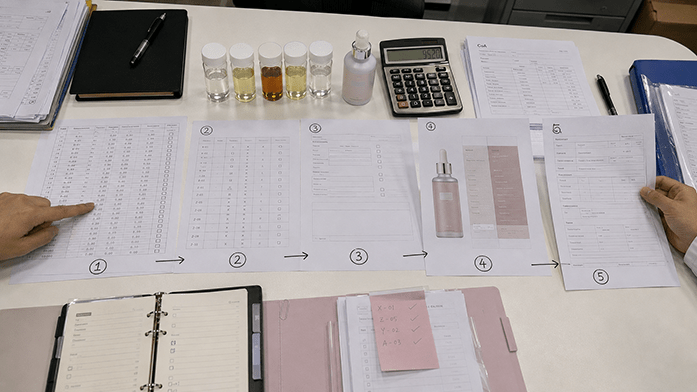
- Formula review. Obtain the full quantitative formula from the OEM — every INCI name with its exact percentage. Without it, no downstream step can be completed.
- Hotlist check. Cross-reference each INCI name against the current Hotlist for both prohibited status and restricted-use conditions.
- CNF submission. Prepare the notification and file it within 10 days of first sale. Treat it as a notification, not a clearance.
- Bilingual label. Apply English and French to the principal display panel, with metric net-quantity units.
- Import. Bring the compliant product across, with documentation retained and accessible.
Step 2 is where Canada diverges most sharply from other markets. An ingredient permitted in a US or EU formula can sit on the Canadian Hotlist as restricted or prohibited. Brand owners reusing an existing international formula should treat the Hotlist check as mandatory, not a formality. The Hotlist is revised periodically; Canada's 2026 update is one example of previously allowable entries being narrowed, so the current published list must be the reference.
Screening Your Formula Against the Hotlist
This is the step most often skipped when a brand ports a formula that already sells elsewhere. The assumption is that "cosmetic ingredient" means the same thing in every market. It does not.
Every INCI name must be checked against the Hotlist for both prohibited status and restricted-use conditions — maximum concentration, required warning, or permitted product type. A substance allowed in the US or EU can be restricted in Canada, and the restriction usually attaches to a concentration threshold rather than a blanket ban.
The Hotlist splits into two buckets. Prohibited substances cannot appear in a cosmetic under any condition. Restricted substances are permitted only within defined limits or with specific label warnings. The failure mode is rarely "banned ingredient present" — it is more often "allowed ingredient, wrong concentration or missing caution."
| INCI name | Hotlist status | Concentration condition (if restricted) | Required warning / condition |
|---|---|---|---|
| Salicylic acid | Restricted | Capped differently for leave-on vs rinse-off formats | Specific caution statement on label |
| Retinol | Restricted | Maximum concentration in cosmetic format | Sun-exposure caution where required |
| Chloroform | Prohibited | Not permitted in cosmetics | Cannot be used under any condition |
| Certain heavy-metal compounds | Prohibited | Zero tolerance in finished product | Cannot be used |
Exact thresholds shift with each Hotlist revision, so the current published list, not a cached copy, must be the reference. A restricted entry that was compliant two years ago can be non-compliant today.
Squalane is permitted in Canada and does not appear on the Hotlist as a prohibited or restricted substance. The compliance exposure for squalane is source and purity, not the headline ingredient: plant-derived squalane can carry naturally occurring adulterants or contaminants that a Hotlist entry would not capture. Brands should obtain a Certificate of Analysis confirming botanical origin and batch purity, and verify the supplier screened the full formula, not just squalane, against the Hotlist. What the Hotlist says about squalane is narrower than the full supply-chain question a buyer should actually ask.
Bilingual Labelling — English and French Are Both Mandatory
A label that is flawless in English fails in Canada if the French panel is missing or wrong. Bilingual labelling is governed by the Food and Drugs Act, the Cosmetic Regulations, and the Consumer Packaging and Labelling Act (C-38) — not by US FDA rules, despite the frequent assumption that North American labelling is interchangeable.
Cosmetics sold in Canada require English and French on the principal display panel, with metric units for net quantity. Missing or inaccurate French labelling can be refused at the border independently of any ingredient issue — a label gap stops a shipment the same way a Hotlist failure does.
| Label element | French requirement | Risk if omitted or wrong |
|---|---|---|
| Product identity / name | Bilingual on principal display | Border refusal; corrective re-labelling |
| Ingredient list (INCI) | Bilingual; established French INCI where published | Non-compliance with Cosmetic Regulations |
| Net quantity | Metric units (mL, g) | CPLA (C-38) violation |
| Warnings / cautions | Bilingual where mandated | Health Canada action |
| Dealer identity & address | Bilingual where required | CPLA (C-38) violation |
Net quantity in metric is a frequent miss for brands accustomed to imperial or mixed units. The Consumer Packaging and Labelling Act (C-38) sets the unit and disclosure rules, and a non-metric or French-less quantity declaration is a standalone refusal reason.
Choosing an OEM That Can Carry the Compliance Load
The brand owner holds the legal responsibility, but the OEM's documentation discipline determines whether compliance is achievable in practice. A low unit price that omits formula transparency or Hotlist screening shifts 100% of the regulatory risk onto the brand.
Select an OEM on verifiable compliance evidence: formula transparency, GMP under ISO 22716, and documented Hotlist screening. Do not select on unit price alone. A quote that cannot produce the underlying dossier will not help you file a defensible CNF.
| Dimension | Compliance evidence to request | Red flag |
|---|---|---|
| Formula transparency | Full quantitative formula with INCI names + percentages | "Trade secret" refusal to disclose |
| GMP | ISO 22716 certificate and written SOPs | No documented quality system |
| Hotlist screening | Written screening against the current Hotlist | "We don't check; you order it" |
| Batch traceability | Lot records linking raw material to finished batch | No lot retention or COA on file |
| COA / MSDS | Per-batch COA; MSDS under Health Canada HPR | Generic or missing documents |
Custom formulation or custom-packaging OEM orders generally require more than 2,000 pieces to be economical on a filling line — this reflects manufacturing setup and fill-line batch economics, not a selling point. The compliance dossier is the same whether the run is 2,000 or 20,000 pieces; the volume threshold is a production-efficiency reality.
Per industry feedback, bilingual label adaptation and Hotlist screening each add a per-SKU cost — brand-owner reports commonly cite ranges such as $500–$2,000 per SKU for bilingual label adaptation and $200–$800 per SKU for formula Hotlist screening, though figures vary with formula complexity and supplier. These are brand-owner reports, not official statistics, and should be verified with your own supplier. The 7 due-diligence dimensions for OEM selection extend well beyond price into documentation, testing, and traceability controls.
After the three gates are clear, the practical question is whether your current formula and supplier can clear them without rework. A formula that sailed through US or EU review is not automatically Canadian-ready, and the gap usually shows up in the Hotlist check or the French label — both fixable before production if caught early.
If you are validating a formula for the Canadian market or comparing OEM partners, a structured readiness review against the Hotlist, CNF mechanics, and bilingual labelling catches gaps before they become border holds. Request a Canada-market compliance readiness assessment.
References / Sources
- Health Canada — Cosmetics Overview — https://www.canada.ca/en/health-canada/services/cosmetics.html
- Health Canada — Cosmetic Ingredient Hotlist — https://www.canada.ca/en/health-canada/services/consumer-product-safety/cosmetics/cosmetic-ingredient-hotlist-prohibited-restricted-ingredients.html
- Health Canada — Notification of Cosmetics (CNF) — https://www.canada.ca/en/health-canada/services/consumer-product-safety/cosmetics/notification-cosmetics.html
- Health Canada — Labelling of Cosmetics (Bilingual) — https://www.canada.ca/en/health-canada/services/consumer-product-safety/cosmetics/labelling.html
- Government of Canada (Justice Laws) — Food and Drugs Act (F-27) — https://laws-lois.justice.gc.ca/eng/acts/f-27/
- Government of Canada (Justice Laws) — Consumer Packaging and Labelling Act (C-38) — https://laws-lois.justice.gc.ca/eng/acts/c-38/
- Government of Canada (Justice Laws) — Cosmetic Regulations (C.R.C., c. 869) — https://laws-lois.justice.gc.ca/eng/regulations/C.R.C.,_c._869/
- ISO — ISO 22716 (GMP for Cosmetics) — https://www.iso.org/standard/36437.html