

Most first-time founders picture the launch in the wrong order. They pick a hero ingredient, commission a logo, and spec out a bottle—then discover the formula is barred in their target market. The costly part of a private label line is rarely the creative work; it is the rework that follows a missed compliance step.
TL;DR — Starting a private label line in 2026 begins with regulatory framing, not branding. Lock your target-market compliance—FDA MoCRA, EU PIF and CPNP, or TGA—before you design formulas and packaging. Then choose a GMP-certified, document-ready manufacturer whose batch consistency survives scale. Ready-to-go bases cut R&D time; custom formulas carry a higher minimum and full testing.
This guide walks the sequence that protects capital: compliance first, then a manufacturer whose quality holds at volume, then the formula route that fits your stage. Each section ends with a decision rule you can apply before signing a contract.
Compliance Frameworks Come Before the Brand
Founders spend weeks on typography and shade names, then meet a regulatory wall at the border. Market access is decided by law, not by design taste. If you formulate before you know where you will sell, you risk building a product that cannot legally ship.
Key Takeaway — Decide your target market's regulatory framework before you lock a formula or print a label. A preservative legal in one region can be banned in another, and rework after tooling is rarely cheap.
A skincare label built its launch around a US-formulated preservative system and printed claims written for the American market. When the team filed for EU entry, the notification portal rejected the dossier: the preservative was prohibited under EU cosmetic rules, and the claims were non-compliant. The printed packaging was scrapped and the formula rebuilt before a single unit shipped.
The three frameworks a B2B buyer most often faces:
- United States — The Modernization of Cosmetic Regulation Act (MoCRA) shifted obligations onto responsible persons: facility registration, product listing, safety substantiation, and adverse-event recordkeeping. The FDA's MoCRA page outlines the current obligations for importers and brands.
- European Union — Access runs through a Product Information File (PIF) and notification via the Cosmetic Products Notification Portal (CPNP), under Regulation (EC) No 1223/2009. Banned-substance lists and allowable limits differ from the US, so a formula legal at home may be barred abroad.
- Australia — The Therapeutic Goods Administration (TGA) framework applies where a product makes therapeutic claims; aesthetic-only cosmetics follow a lighter route.
A compliance miss does not just block a shipment; it reshapes the cost model. The 2026 raw-material and logistics picture shows how fragile margins get once a batch is rejected and must be reformulated.
What "Scalability" Actually Means in a Manufacturer
A small lab can deliver a beautiful first run. The question is what happens at the fifth batch and the fiftieth. Scalability is the difference between a hobby and a business that survives a demand spike.
Key Takeaway — Scalability is not headcount or tank size. It is documented process control—ISO 22716 GMP certification, written SOPs, supplier redundancy, and on-demand documentation (COA, SDS). Without it, your second batch will not match your first.
One brand graduated from a boutique lab to volume orders. The boutique had mixed bulk in open, unsterilized vats with no standard procedure for lot homogeneity. At scale, the second batch arrived with a color shift and a sour odor. Repeat customers noticed; the brand spent more fixing the trust gap than it saved on the cheaper fill.
Batch-to-batch consistency depends on Good Manufacturing Practice discipline. The international benchmark is the ISO 22716 GMP standard, which sets out hygiene, traceability, and process controls a buyer can audit before contracting.
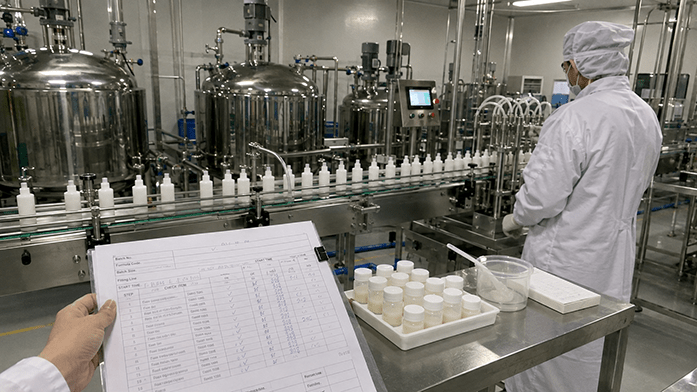
When a quality signal appears, the cause is almost always procedural. The table below maps the common failures a procurement team should screen for during a factory audit:
| Symptom | Root cause | Fix |
|---|---|---|
| Second batch yellows or develops off-odor | Bulk mixed in open, unsterilized vats; no SOP for lot homogeneity | Require ISO 22716 GMP facility with closed-system mixing; retain-sample program |
| Shipment held at customs for missing papers | Supplier cannot produce SDS or COA on demand; PIF not assembled | Verify documentation readiness (SDS, COA, PIF/CPNP) before signing |
| Formula legal in US, rejected in EU | Preservative permitted under MoCRA but banned under EU 1223/2009 | Define target-market compliance before formulation; cross-check banned lists |
Small-batch trial production has a legitimate role. Running a limited trial run of a standardized base to test market response, retail buyer interest, or a limited campaign is sound—provided it is treated as learning, not as a substitute for a production-ready supply chain.
How supply-chain transparency protects brands is worth reading before you audit a supplier, because batch traceability turns a quality incident from a brand-ending event into a contained one.
Ready-to-Go Formulas Versus Custom R&D
Speed and uniqueness pull in opposite directions. A pre-developed base gets you to market in weeks; a ground-up formula can take the better part of a year and still need a full test battery.
Key Takeaway — Standardized, stability-tested bases let you skip 6–12 months of R&D and reach market faster. Custom formulation is justified when the claim depends on a unique actives profile—but it carries a higher minimum order and full testing before scale.
Ready-to-go formulas are pre-developed, stability-tested, and already assessed for safety. The manufacturer has paid for the stability testing, preservative efficacy testing, and safety substantiation, so a new brand inherits proven documentation rather than funding it from zero.
Custom R&D is the right call when differentiation is the product—a proprietary active blend, a texture no competitor matches, a clinical claim you must own. But it is not free of constraints. The real mass-production threshold for a custom formulation typically sits above 2,000 pieces, because the testing and setup costs only amortize at volume.
Early market validation can use a standardized-base trial run to learn what sells. That is a learning step, not a low-minimum production strategy. Treat "small batch" as proof-of-concept, never as your forever number.
The promise of a no-minimum partner rarely survives contact with reality—the no-MOQ mirage explains why scale is a compliance wall, not a lower floor. And the ultra-low MOQ trap is where most first orders quietly die: the real minimum is set by your supply chain, not a sales pitch.
If you are scoping a private label line for 2026, a project-readiness assessment can map your target markets, formula route (ready-to-go base versus custom R&D), packaging path, and compliance documentation before you commit capital. The fastest path to market is the one that does not require a rebuild at the border.
Sources
- ISO 22716 — Cosmetic GMP standard: https://www.iso.org/standard/36437.html
- FDA — Modernization of Cosmetics Regulation Act (MoCRA): https://www.fda.gov/cosmetics/cosmetics-laws-regulations/modernization-cosmetics-regulation-act-2022-mocra
- European Commission — Cosmetic Products Notification Portal (CPNP): https://ec.europa.eu/growth/sectors/cosmetics/cpnp_en
- EUR-Lex — Regulation (EC) No 1223/2009: https://eur-lex.europa.eu/legal-content/EN/TXT/?uri=CELEX:32009R1223