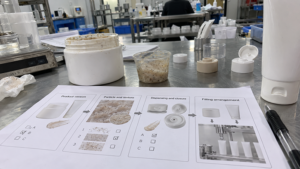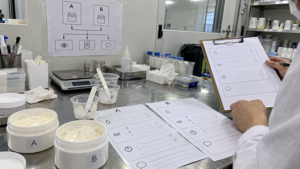


Most procurement briefs treat minimum order quantity as a single dial you turn down to protect cash. The gap between a 500-unit run and a 2,000-unit run is not a pricing discount — it marks the boundary between two distinct manufacturing modes, each with its own quality envelope, documentation burden, and failure modes. Reading the split as "cheaper versus more expensive" hides the real trade you are making.
TL;DR A 500-unit run typically uses a pre-validated base formula and standard packaging, keeping fixed costs near zero but limiting differentiation. A 2,000-unit custom order absorbs tooling, preservative efficacy, and stability testing that smaller runs cannot economically carry. Treating 500 as a universal threshold for custom formulation invites undocumented batches and compliance gaps.
This article separates the two tiers by what actually changes on the production floor, so you can match order size to the risk you are willing to carry.
The Fault Line: Why 500 and 2,000 Run on Different Manufacturing Logic
A common assumption is that 500 and 2,000 are the same process at different scale. They are not. A 500-unit order typically rides on a pre-validated base — a standardized emulsion, serum, or cleansing base the manufacturer has already stabilized — paired with stock packaging. A 2,000-unit custom order is a different event: new formula ownership, bespoke raw-material sourcing, and custom mold or print tooling.
Key Takeaway The 500 tier is a configuration choice on an existing line; the 2,000 tier is a new product development event with its own validation chain. They share a building, not a workflow.
That distinction is why batch-to-batch repeatability behaves differently. Cosmetic GMP discipline — structured around the ISO 22716 cosmetics GMP standard and reflected in the FDA cosmetics GMP inspection checklist — is what keeps a formula behaving the same way on the tenth batch as on the first. On a standardized base, that discipline is already baked into the master batch record. On a custom formula, it has to be earned again through scale-up and validation.
Documentation burden tracks the same fault line. A custom formula destined for the EU triggers the responsible-person and Product Information File framework under the EU Cosmetic Regulation 1223/2009; a US-bound custom product carries MoCRA facility registration, product listing, and safety substantiation expectations. None of that disappears at low volume — it simply goes unfunded.
A 500-unit standard-packaging run is a sound choice when the goal is to test a brand concept, a sales funnel, or a limited campaign rather than to establish a defensible formula. The trap is confusing that legitimate use with a custom-formulation entry point. For a closer look at how premium programs hold the line on repeatability, see premium QA batch consistency.
The Ice-Cube Tray Problem: How Fixed Costs Melt Into Unit Price
Why does per-unit cost climb so steeply below a threshold instead of falling smoothly? Because a block of fixed costs does not shrink with the order. Tooling or print plates, label setup, a microbial challenge (preservative efficacy) test, a stability protocol, and supplier raw-material minimums all sit on the table before the first unit exists.
Key Takeaway Below roughly 2,000 units, fixed quality costs stop amortizing and start to dominate unit price. A 500-unit custom run pays the full testing bill for a fraction of the volume.
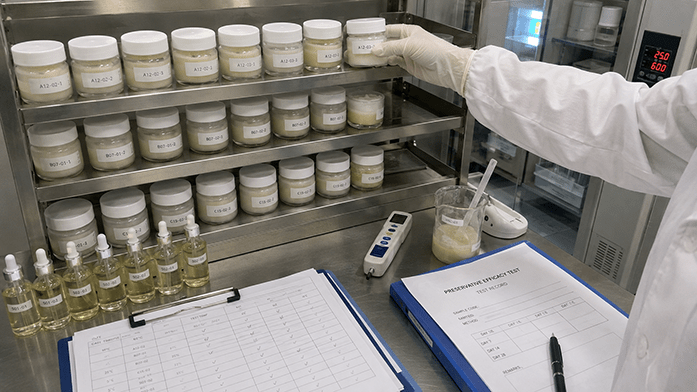
Spread those costs across 2,000 units and each one carries a small, tolerable slice. Spread the same costs across 500 and the slice balloons. The ice-cube tray analogy holds: the mold costs the same whether you freeze two cubes or a full tray, so the per-cube cost swings wildly at low fill.
Stability work makes the point concrete. Reputable manufacturers run accelerated and real-time stability protocols — aligned with guidance such as NIFDC stability testing principles or ISO/TR 18811 frameworks — to confirm a formula holds appearance, viscosity, and microbial limits across its claimed shelf life. Those protocols consume lab time and chamber space whether the commercial run is 500 or 5,000 units. At a 500-unit custom size, the test can cost more per unit than the filling itself.
This is the mechanics behind the ultra-low MOQ trap: when a supplier quotes custom work at a few hundred units, the only way to hit the price is to skip the fixed steps — and the skipped steps are exactly the ones that prove the product is safe.
The 500-Unit Temptation: When a Low Threshold Becomes a Quality Cliff
The temptation is to read "500 available" as a green light for a bespoke custom formula at that size. The 500 figure is real only as a standard-packaging exception on an existing base; custom formulation orders are scoped above 2,000 pieces precisely because the validation chain below that size cannot be funded. As a custom-formulation entry point it collides with the economics above — and the first thing to break is documentation.
Key Takeaway 500 as a standard-packaging exception is legitimate. 500 as a custom-formulation minimum is where batch consistency and compliance records fall apart.
The pattern shows up the same way across failed micro-batch programs:
| Symptom | Root cause | Fix |
|---|---|---|
| Batch 2 smells or looks different from Batch 1 | Micro-batch skipped scale-up validation and homogenization checks | Set the custom minimum above 2,000 units, where scale-up is validated against the master record |
| No preservative efficacy or microbial challenge record | Test cost cannot amortize on 100–500 custom units | Require PET and challenge testing before any custom release; the FDA cosmetics GMP inspection checklist outlines the discipline expected |
| Cannot clear a MoCRA or EU authority review | Missing PIF, responsible person, or safety substantiation | Build the documentation set at the custom tier, not after launch |
None of these are hypothetical edge cases; they are the predictable output of asking a custom workflow to run below its economic floor. The 500-unit standard-packaging exception avoids them precisely because it does not pretend to be custom.
The reverse case is real and worth stating plainly. A small run is the correct tool for concept testing, a limited holiday or influencer campaign, or a market where distribution is still unproven — provided it uses a standardized base and stock packaging rather than a bespoke formula. That is a pilot, not a product line. Treating it as the latter is the mirage behind the no-MOQ mirage: the number looks freeing until the audit arrives.
If you are weighing a 500-unit standard-packaging pilot against a custom formulation program, a short feasibility assessment of your category, target market, packaging route, and compliance footprint will show which tier actually fits your risk profile. The assessment can cover formula feasibility, the stability and documentation steps your market requires, and the minimum volume that keeps every batch traceable.